
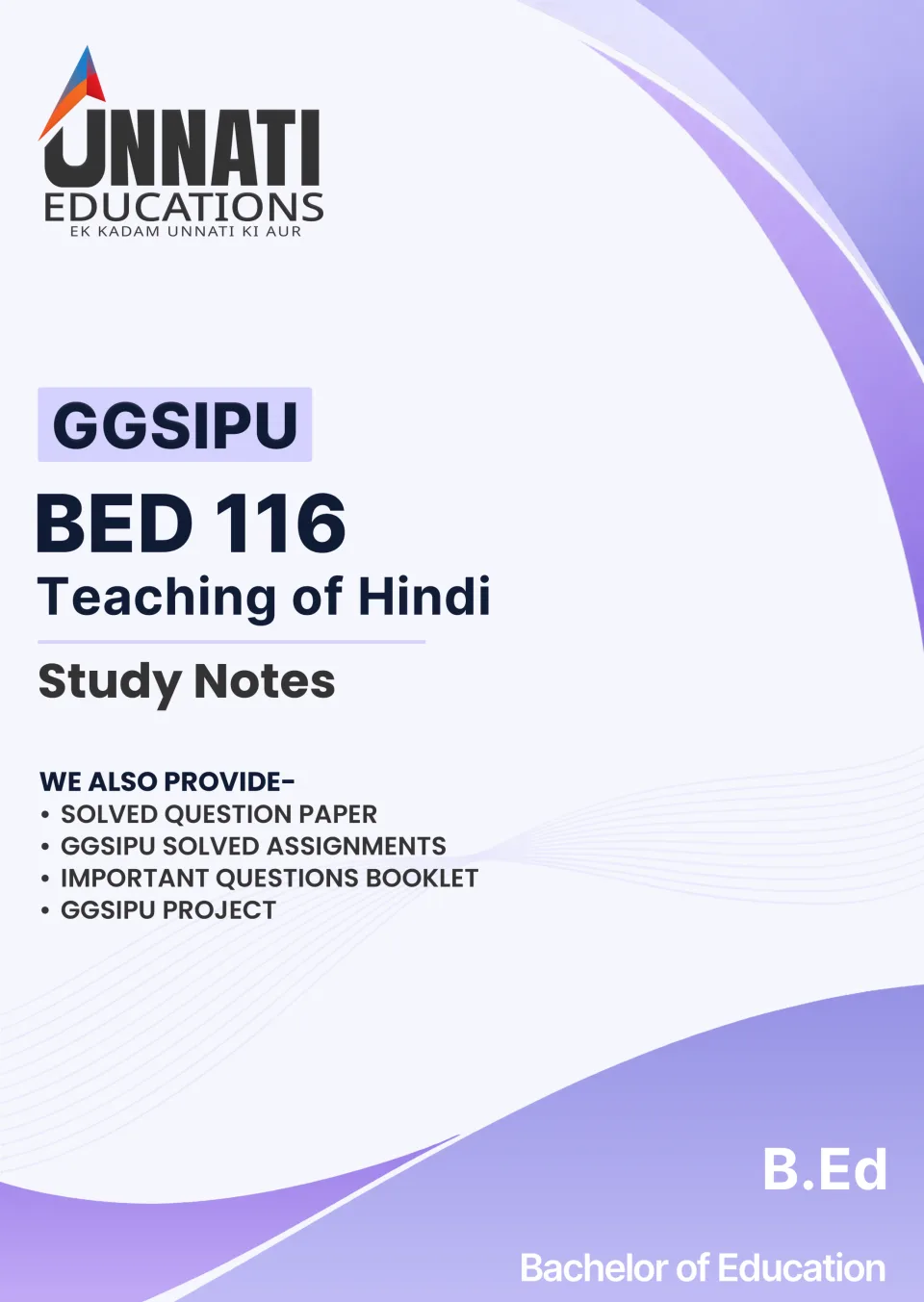
BED 116 Teaching of Hindi Notes from Unnati Educations cover all four units of the GGSIPU B.Ed Semester 2 Hindi pedagogy paper in 83 pages, written in Hindi. They list 45 short-answer and 34 long-answer exam questions, 32 quick-check questions with answers and 6 sample 40-minute lesson plans, mapped to the syllabus for session 2023-24 onwards.
Written by Sheetal Kirola, Academic Head · Reviewed by Prateek Talwar, ACS, B.Com, B.Ed counsellor since 2020 · Checked against the B.Ed Course Curriculum (Two Years), Session 2023-24 onwards · Updated 26 October 2026 · Editorial policy
Scheme: B.Ed Course Curriculum (Two Years) | Applies to: Session 2023-24 onwards | Verified against: syllBEd210823.pdf on ipu.ac.in
BED 116 Teaching of Hindi at a glance: GGSIPU B.Ed Sem 2 credits, units and exam pattern
The scheme lists BED 116 as "Teaching of Hindi"; its syllabus page is printed in Hindi as हिन्दी शिक्षण (Hindi Shikshan). It sits with the other GGSIPU B.Ed Semester 2 papers.
Course and semester | B.Ed (two years), Semester 2, Pedagogical Courses |
|---|---|
Category and credits | Pedagogy of School Subject, 4 credits: 3 theory + 1 practical |
Marks | 100: 75 theory exam + 15 practical assignments or field engagement + 10 minors |
Passing mark | Minimum 40% in any course (40 out of 100) |
End-term pattern | Paper-setter instructions are not printed in the official PDF |
Units | 4 theory units + a practical list (any two tasks) |
Paired lab | None |
Unit titles are printed only in Hindi, so the English glosses below are ours; these BED 116 Teaching of Hindi IPU notes keep the same order. Re-appear rules: Ordinance 11.
BED 116 Teaching of Hindi Notes unit-wise: 111 exam questions and 6 sample lesson plans across 4 units
Written as GGSIPU B.Ed Sem 2 Teaching of Hindi notes, the book runs to 83 pages in Hindi, with English terms in brackets. Each unit ends with a Quick Revision Table and an exam questions page. Notes for other papers: GGSIPU B.Ed notes.
BED 116 Unit 1: भाषा शिक्षण के सैद्धान्तिक पक्ष (Theoretical aspects of language teaching)
Pages 6 to 24, four sections: eight origin theories, nine roles of language, key definitions and Halliday's seven functions, then Articles 343, 350A and 351, commission recommendations from Radhakrishnan to NCF 2005, and Hindi under NEP 2020 and NCF-SE 2023. Exam page: 11 short, 9 long, 8 quick-check.
Theory | Core idea | Example |
|---|---|---|
Bow-Wow (अनुकरण) | Copying natural and animal sounds | काँव-काँव, कल-कल |
Pooh-Pooh (मनोभाव) | Sounds that burst out with feelings | आह!, वाह! |
Ding-Dong (धातु) | Each object has its own sound | A strike gives "टन" |
Yo-He-Ho (श्रम-परिहरण) | Sounds of group labour (Noiré) | हैया-हो |
Quick look: four origin theories (from page 8)
Theory
Bow-Wow (अनुकरण)
Core idea
Copying natural and animal sounds
Example
काँव-काँव, कल-कल
Theory
Pooh-Pooh (मनोभाव)
Core idea
Sounds that burst out with feelings
Example
आह!, वाह!
Theory
Ding-Dong (धातु)
Core idea
Each object has its own sound
Example
A strike gives "टन"
Theory
Yo-He-Ho (श्रम-परिहरण)
Core idea
Sounds of group labour (Noiré)
Example
हैया-हो
BED 116 Unit 2: भाषा कौशल एवं भाषा शिक्षण (Language skills and language teaching)
Pages 25 to 51, seven sections, the longest unit. Each LSRW skill gets a section (listening barriers, pronunciation, Montessori to Jacotot writing methods, loud and silent reading), then functional grammar and prose and poetry teaching. All six 40-minute lesson plans sit here. Exam page: 12 short, 10 long, 8 quick-check.
Error | Wrong → correct |
|---|---|
स / श / ष | सीसा → शीशा, भासा → भाषा |
व / ब | बन → वन, बिस्वास → विश्वास |
न / ण | प्रान → प्राण, कारन → कारण |
ड़ / र / ड | परना → पढ़ना, सरक → सड़क |
Quick look: common pronunciation errors (from page 32)
Error
स / श / ष
Wrong → correct
सीसा → शीशा, भासा → भाषा
Error
व / ब
Wrong → correct
बन → वन, बिस्वास → विश्वास
Error
न / ण
Wrong → correct
प्रान → प्राण, कारन → कारण
Error
ड़ / र / ड
Wrong → correct
परना → पढ़ना, सरक → सड़क
BED 116 Unit 3: विद्यालयी शिक्षा में भाषा एवं मूल्यांकन (Language and evaluation in school education)
Pages 52 to 68, five sections: the need for Hindi in school, secondary and senior secondary teaching (Aroh, Vitan, Antra, Antral), types of evaluation including CCE and PARAKH, an 80-mark Class 9 blueprint and seven achievement-test steps. Exam page: 11 short, 8 long, 8 quick-check.
Quick look: item analysis on 100 answer scripts (from page 65)
Take the top 27% and bottom 27% of scripts: 27 students in each group.
Correct answers to one item: 20 in the upper group (RU), 8 in the lower (RL).
Difficulty P = (RU + RL) ÷ (NU + NL) = 28 ÷ 54 = 0.52, average.
Discrimination D = (RU − RL) ÷ N = 12 ÷ 27 = 0.44, very good. Keep the item.
BED 116 Unit 4: ऑनलाइन शिक्षण, आभासी (वर्चुअल) शिक्षण एवं MOOCs (Online teaching, virtual teaching and MOOCs)
Pages 69 to 83, four sections: online vs virtual teaching, five types, merits and limits; flipped classes and podcasts for Hindi lessons; SWAYAM, DIKSHA and Hindi Samay; a 10-mark essay rubric; and teacher skills including TPACK. Exam page: 11 short, 7 long, 8 quick-check.
Limit | Remedy in the notes |
|---|---|
Digital divide | Community centres, DTH channels, offline material |
Network and power cuts | Low-data material, download option |
No face-to-face contact | Blended teaching |
Copying in online tests | Open-book tasks, projects, oral tests |
Quick look: limits of online teaching and remedies (from page 72)
Limit
Digital divide
Remedy in the notes
Community centres, DTH channels, offline material
Limit
Network and power cuts
Remedy in the notes
Low-data material, download option
Limit
No face-to-face contact
Remedy in the notes
Blended teaching
Limit
Copying in online tests
Remedy in the notes
Open-book tasks, projects, oral tests
Hindi teaching at secondary level (Classes 9 and 10) in school education: excerpt from page 55 of the BED 116 notes
Excerpt from page 55 (Unit 3, Section 2), shown in Hindi as in the notes.
माध्यमिक स्तर का परिचय
माध्यमिक स्तर से सामान्यतः कक्षा 9 और 10 का बोध होता है। इस समय छात्र किशोरावस्था (लगभग 14-16 वर्ष) में होते हैं, जब जिज्ञासा, तर्क-शक्ति, कल्पना और भावुकता चरम पर होती है। यह स्तर बोर्ड परीक्षा का भी होता है, इसलिए भाषा शिक्षण का स्वरूप अधिक विश्लेषणात्मक और साहित्यिक हो जाता है।
NCERT/CBSE में इस स्तर पर हिंदी दो रूपों में पढ़ाई जाती है: हिंदी 'अ' (कोर्स A), जिसकी पाठ्यपुस्तकें क्षितिज और कृतिका हैं, तथा हिंदी 'ब' (कोर्स B), जिसकी पाठ्यपुस्तकें स्पर्श और संचयन हैं।
माध्यमिक स्तर पर भाषा शिक्षण का महत्व
बोर्ड परीक्षा एवं आगे की पढ़ाई: भाषा की पकड़ हर विषय के उत्तर-लेखन में मदद करती है।
किशोर मन का भावात्मक विकास: साहित्य किशोरों की भावनाओं को सही दिशा देता है।
आलोचनात्मक चिंतन: पाठ का विश्लेषण, लेखक के विचारों पर सहमति-असहमति।
सृजनात्मक अभिव्यक्ति: कहानी, कविता, निबंध, संवाद लेखन।
व्यावहारिक लेखन: औपचारिक पत्र, सूचना, विज्ञापन, संदेश, ईमेल।
करियर की तैयारी: विषय-चयन और प्रतियोगी परीक्षाओं के लिए भाषा की नींव।
क्षेत्र | उद्देश्य |
|---|---|
श्रवण | भाषण, वार्ता, समाचार, साक्षात्कार को ध्यान से सुनकर मुख्य बिंदु ग्रहण करना |
वाचन | किसी विषय पर धाराप्रवाह, तर्कपूर्ण और प्रभावशाली ढंग से बोलना; वाद-विवाद में भाग लेना |
पठन | विविध विधाओं (कहानी, निबंध, कविता, संस्मरण, रिपोर्ताज) को समझकर पढ़ना; अपठित का बोध |
लेखन | शुद्ध, सुसंगठित और मौलिक लेखन: निबंध, पत्र, अनुच्छेद, विज्ञापन, लघुकथा |
व्याकरण | शब्द-निर्माण (उपसर्ग, प्रत्यय, समास), वाक्य-भेद, वाच्य, पद-परिचय, अलंकार, रस का व्यावहारिक ज्ञान |
साहित्य | प्रमुख कवियों-लेखकों से परिचय; साहित्य की सराहना और रसानुभूति |
मूल्य | मानवीय, सामाजिक, राष्ट्रीय और पर्यावरणीय मूल्यों का विकास |
माध्यमिक स्तर पर हिंदी शिक्षण के उद्देश्य (page 55)
क्षेत्र
श्रवण
उद्देश्य
भाषण, वार्ता, समाचार, साक्षात्कार को ध्यान से सुनकर मुख्य बिंदु ग्रहण करना
क्षेत्र
वाचन
उद्देश्य
किसी विषय पर धाराप्रवाह, तर्कपूर्ण और प्रभावशाली ढंग से बोलना; वाद-विवाद में भाग लेना
क्षेत्र
पठन
उद्देश्य
विविध विधाओं (कहानी, निबंध, कविता, संस्मरण, रिपोर्ताज) को समझकर पढ़ना; अपठित का बोध
क्षेत्र
लेखन
उद्देश्य
शुद्ध, सुसंगठित और मौलिक लेखन: निबंध, पत्र, अनुच्छेद, विज्ञापन, लघुकथा
क्षेत्र
व्याकरण
उद्देश्य
शब्द-निर्माण (उपसर्ग, प्रत्यय, समास), वाक्य-भेद, वाच्य, पद-परिचय, अलंकार, रस का व्यावहारिक ज्ञान
क्षेत्र
साहित्य
उद्देश्य
प्रमुख कवियों-लेखकों से परिचय; साहित्य की सराहना और रसानुभूति
क्षेत्र
मूल्य
उद्देश्य
मानवीय, सामाजिक, राष्ट्रीय और पर्यावरणीय मूल्यों का विकास
माध्यमिक स्तर की शिक्षण विधियाँ
प्रश्नोत्तर / चर्चा विधि: प्रश्नों और चर्चा से छात्रों की सक्रिय भागीदारी; जैसे पाठ के पात्रों के व्यवहार पर चर्चा।
व्याख्या विधि: कठिन अंशों और काव्य-पंक्तियों की विस्तृत व्याख्या; जैसे कबीर की साखियों की व्याख्या।
प्रोजेक्ट / परियोजना विधि: छात्र समूह में किसी विषय पर शोध करके प्रस्तुति दें; जैसे 'हमारे क्षेत्र की लोककथाएँ' संग्रह।
Do the BED 116 notes cover the full GGSIPU syllabus?
Yes for all four theory units, topic by topic; the practical list (any two tasks) is only partly covered.
Official unit | Official topics (shortened) | Where in the notes | Status |
|---|---|---|---|
Unit 1 | भाषा की उत्पत्ति, भूमिकाएँ, अर्थ, प्रकार, महत्व, कार्य; हिन्दी का स्थान, समितियों की सिफ़ारिशें; NEP 2020 | Sections 1 to 4, pp 7 to 21 | Covered |
Unit 2 | भाषा-कौशल; श्रवण, वाचन, लेखन, पठन और पाठ योजना; उच्चारण; व्यावहारिक व्याकरण; पद्य एवं गद्य शिक्षण | Sections 1 to 7, pp 26 to 48 | Covered |
Unit 3 | हिन्दी शिक्षण की आवश्यकता; माध्यमिक, उच्च माध्यमिक स्तर; मूल्यांकन, प्रश्नपत्र-निर्माण; उपलब्धि परीक्षण | Sections 1 to 5, pp 53 to 66 | Covered |
Unit 4 | ऑनलाइन एवं आभासी शिक्षण; विधियाँ, उपकरण, संसाधन; मूल्यांकन; शिक्षक के व्यावसायिक गुण | Sections 1 to 4, pp 70 to 81 | Covered |
Practical (any two) | सहायक सामग्री, पाठ योजना, सृजन, श्रुतलेख, गूगल ऐप्स, यूट्यूब | pp 43, 47, 73, 77 | Partly covered: grammar and poetry plans, Google tools only |
BED 116 official syllabus mapped to the notes
Official unit
Unit 1
Official topics (shortened)
भाषा की उत्पत्ति, भूमिकाएँ, अर्थ, प्रकार, महत्व, कार्य; हिन्दी का स्थान, समितियों की सिफ़ारिशें; NEP 2020
Where in the notes
Sections 1 to 4, pp 7 to 21
Status
Covered
Official unit
Unit 2
Official topics (shortened)
भाषा-कौशल; श्रवण, वाचन, लेखन, पठन और पाठ योजना; उच्चारण; व्यावहारिक व्याकरण; पद्य एवं गद्य शिक्षण
Where in the notes
Sections 1 to 7, pp 26 to 48
Status
Covered
Official unit
Unit 3
Official topics (shortened)
हिन्दी शिक्षण की आवश्यकता; माध्यमिक, उच्च माध्यमिक स्तर; मूल्यांकन, प्रश्नपत्र-निर्माण; उपलब्धि परीक्षण
Where in the notes
Sections 1 to 5, pp 53 to 66
Status
Covered
Official unit
Unit 4
Official topics (shortened)
ऑनलाइन एवं आभासी शिक्षण; विधियाँ, उपकरण, संसाधन; मूल्यांकन; शिक्षक के व्यावसायिक गुण
Where in the notes
Sections 1 to 4, pp 70 to 81
Status
Covered
Official unit
Practical (any two)
Official topics (shortened)
सहायक सामग्री, पाठ योजना, सृजन, श्रुतलेख, गूगल ऐप्स, यूट्यूब
Where in the notes
pp 43, 47, 73, 77
Status
Partly covered: grammar and poetry plans, Google tools only
Verify each topic in the official PDF: B.Ed Course Curriculum (Two Years), Session 2023-24 onwards, BED 116 on pages 38 and 39.
Every course in GGSIPU notes is checked against its own official IPU syllabus PDF the same way.
How to write BED 116 answers: comparison tables, 40-minute lesson plans and theory-wise long answers
The BED 116 exam tips repeat three habits: add a comparison table, name each method in Hindi and English, and end with a one-line conclusion naming the best option.
Origin of language: Hindi name, English name, core idea, one example and one criticism per theory; conclude with the synthetic (समन्वय) theory (page 9).
Grammar methods: deductive vs inductive table; conclude with inductive-deductive and a विशेषण example (page 42).
Achievement test: seven steps, the P and D formulas, one solved example and a blueprint (page 66).
Lesson-plan answers need steps and minutes, as in this 40-minute Class 6 listening plan on "प्यासा कौआ":
Step | Minutes | What happens |
|---|---|---|
Introduction and aim | 5 | A question about thirst, then the aim |
Presentation | 15 | Story told with gestures, picture cards shown |
Comprehension questions | 8 | What was the crow looking for? |
Sequencing activity | 7 | Students order the picture cards |
Recap and homework | 5 | Moral of the story; retell it at home |
Worked example: 40-minute listening lesson plan (pages 29 and 30)
Step
Introduction and aim
Minutes
5
What happens
A question about thirst, then the aim
Step
Presentation
Minutes
15
What happens
Story told with gestures, picture cards shown
Step
Comprehension questions
Minutes
8
What happens
What was the crow looking for?
Step
Sequencing activity
Minutes
7
What happens
Students order the picture cards
Step
Recap and homework
Minutes
5
What happens
Moral of the story; retell it at home
The minutes total 40; aims, aids and prior knowledge come first. Practise this format on GGSIPU B.Ed important questions.
BED 116 exam corner: 45 short-answer and 34 long-answer questions by unit
Unit | Short answer | Long answer | Quick check with answers | Lesson plans |
|---|---|---|---|---|
Unit 1 | 11 | 9 | 8 | 0 |
Unit 2 | 12 | 10 | 8 | 6 |
Unit 3 | 11 | 8 | 8 | 0 |
Unit 4 | 11 | 7 | 8 | 0 |
BED 116 exam questions in the notes, by unit
Unit
Unit 1
Short answer
11
Long answer
9
Quick check with answers
8
Lesson plans
0
Unit
Unit 2
Short answer
12
Long answer
10
Quick check with answers
8
Lesson plans
6
Unit
Unit 3
Short answer
11
Long answer
8
Quick check with answers
8
Lesson plans
0
Unit
Unit 4
Short answer
11
Long answer
7
Quick check with answers
8
Lesson plans
0
Unit 1: त्रिभाषा सूत्र क्या है? इसे सबसे पहले किसने प्रस्तावित किया? Pointer: CABE (1956-57) first proposed it; the 1961 Chief Ministers' Conference accepted it; Kothari revised it.
Unit 2: व्याकरण शिक्षण की विभिन्न विधियों का आलोचनात्मक वर्णन कीजिए। Pointer: seven methods, a comparison table, inductive-deductive as best.
Unit 3: कक्षा 9 हिंदी के लिए एक नील-पत्र तैयार कीजिए। Pointer: content × objective grid; rows and columns both total 80; difficulty 30/50/20.
Unit 4: MOOCs क्या हैं? SWAYAM का विस्तृत वर्णन कीजिए। Pointer: full form, Dave Cormier 2008, SWAYAM from 9 July 2017, four quadrants.
The BED 116 notes list 45 short-answer and 34 long-answer exam questions across 4 units, plus 32 quick-check questions with one-line answers and 6 sample 40-minute lesson plans.
There are no exam-year tags, so treat these as exam-style practice. More practice sits in the BED 116 important questions.
Who writes and checks the BED 116 Hindi Shikshan notes?
Sheetal Kirola, author: Academic Head, Unnati Educations · M.Ed. · 7 years of experience.
Prateek Talwar, reviewer: Founder, Unnati Educations · ACS, ICSI · B.Com, University of Delhi (SOL) · B.Ed counselling since 2020.
The 2026-27 edition of the BED 116 notes follows the Session 2023-24 onwards curriculum in its Hindi unit order. Last updated 26 October 2026, under our editorial policy.
The same team prepares GGSIPU important questions for every course.
BED 116 and the GGSIPU B.Ed Sem 2 papers it connects to
BED 116 has no lab paper; its practical credit comes from the syllabus tasks. All Semester 2 codes are on the GGSIPU B.Ed syllabus page.
Other Semester 2 papers: BED 102 Learning and Teaching, BED 104 Contemporary Perspectives in Education, BED 106 Assessment of Learning, BED 108 Experiential Learning, BED 110 Entrepreneurship in Education, a second pedagogy, BED 152 Reading and Reflecting on Texts and BED 154 PSE-II.
Unit 3 → BED 106: blueprint, item analysis and CCE also appear in BED 106.
Unit 4 → BED 106: BED 106 lists "Assessment in MOOCs" (pages 77 and 78 here).
Unit 3 → BED 154: PSE-II needs a reflective journal on CCE in schools.
BED 116 Hindi Shikshan notes FAQs
How do I get the full BED 116 notes?
Message us on WhatsApp at 9899436384 with the code BED 116. The full notes come as a printed book only; they are not available as a PDF. Delivery takes a maximum of 5 to 7 days, depending on your location.
Are the BED 116 Teaching of Hindi notes in Hindi or English?
The BED 116 notes are written in simple Hindi (Devanagari), matching the official syllabus, which GGSIPU prints in Hindi for this paper. Technical terms keep their English names in brackets, for example Blueprint, Item Analysis, Flipped Classroom and TPACK, so you can follow books and college lectures in either language without confusion while revising for the exam.
How is BED 116 marked and what is the passing mark?
BED 116 is marked out of 100: 75 for the theory exam, 15 for practical assignments or field engagement, and 10 for minors. The B.Ed scheme of examination states pass marks as 40%, which is 40 out of 100. For end-term minimums and re-appear rules, read GGSIPU Ordinance 11 on ipu.ac.in, as the B.Ed scheme itself does not repeat them.
Is BED 116 Pedagogy of School Subject I or II?
It can be either. The Semester 2 scheme has two pedagogy slots, Pedagogy of School Subject (I) and (II), and gives both the code range BED 116 to BED 150. BED 116 Teaching of Hindi fills one slot, and your second pedagogy is another paper from that same range, as allotted by your institute at the start of the semester.
Which BED 116 unit has the lesson plans?
Unit 2 holds all six sample 40-minute lesson plans in the BED 116 notes: listening (Class 6), speaking (Class 7), writing (Class 8), reading (Class 6), grammar through the inductive-deductive method (Class 7) and poetry (Class 8). It is also the longest unit, with 27 pages and 7 sections on the four skills, grammar, prose and poetry.
Do the BED 116 notes help with the practical tasks?
Partly. The syllabus asks for any two practical tasks. The BED 116 notes give 40-minute grammar and poetry lesson plans and explain online evaluation with Google Forms and other Google apps. They do not give step-by-step guides for teaching aids from waste material, the dictation contest, story and poem writing, or running your own YouTube teaching channel.
Get the full BED 116 Teaching of Hindi Notes on WhatsApp
Unit | Pages | Sections | Exam questions |
|---|---|---|---|
Unit 1 | 6 to 24 (19) | 4 | 28 |
Unit 2 | 25 to 51 (27) | 7 | 30 |
Unit 3 | 52 to 68 (17) | 5 | 27 |
Unit 4 | 69 to 83 (15) | 4 | 26 |
What the printed BED 116 notes book contains
Unit
Unit 1
Pages
6 to 24 (19)
Sections
4
Exam questions
28
Unit
Unit 2
Pages
25 to 51 (27)
Sections
7
Exam questions
30
Unit
Unit 3
Pages
52 to 68 (17)
Sections
5
Exam questions
27
Unit
Unit 4
Pages
69 to 83 (15)
Sections
4
Exam questions
26
These Hindi Shikshan notes in Hindi come as an 83-page printed book only, not a PDF. Delivery takes a maximum of 5 to 7 days, depending on your location.
Order the printed BED 116 notes book on WhatsApp (4 units, 83 pages)
Unnati Educations is an independent education provider based in Vikaspuri, Delhi. We are not affiliated with, authorised by, or endorsed by Guru Gobind Singh Indraprastha University (GGSIPU). 'GGSIPU' and 'IPU' are used only to describe the syllabus our notes follow. For official information, visit ipu.ac.in.
Ready for the full notes?
Discuss coverage and delivery with our team.