
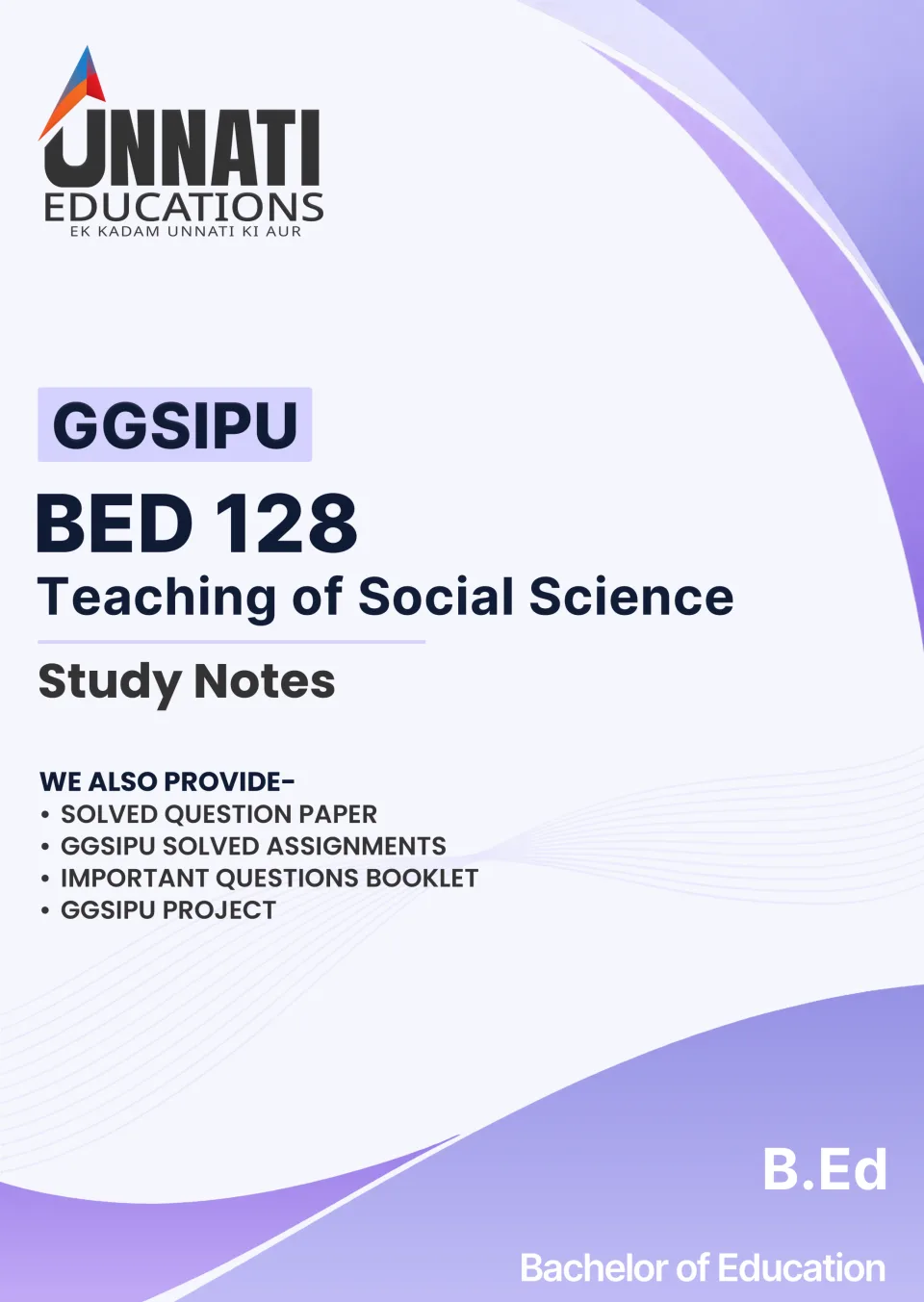
BED 128 Teaching of Social Science Notes are 70 pages of English study notes for GGSIPU B.Ed Semester 2. They cover all 4 official units in 34 topics, and every unit ends with a Quick Revision Table plus 26 exam questions (16 short, 10 long). The notes follow the B.Ed curriculum for session 2023-24 onwards.
Written by Sheetal Kirola, Academic Head, M.Ed. · Reviewed by Prateek Talwar, Founder, Unnati Educations (B.Ed counselling since 2020) · Checked against B.Ed. Course Curriculum (Two Years), Session 2023-24 onwards · Updated 14 October 2026 · Editorial policy
Scheme: B.Ed. Course Curriculum (Two Years) | Applies to: session 2023-24 onwards | Verified against: syllBEd210823.pdf on ipu.ac.in, 13 October 2026
BED 128 Teaching of Social Science at a glance: GGSIPU B.Ed Sem 2 credits, units and exam pattern
BED 128 is one of 18 Pedagogy of School Subject papers (BED116 to BED150) in GGSIPU B.Ed Semester 2; every student takes two.
Item | Official detail |
|---|---|
Code and title | BED128 Teaching of Social Science (the pedagogy list prints "Teaching of Social Sciences") |
Course and semester | B.Ed (two years), Semester 2, Pedagogy of School Subject (I) or (II) |
Credits | 4: 3 theory + 1 practical assignments or field work |
Marks | 100: 75 theory exam + 15 practical assignments / field engagement + 10 minors |
Pass mark | 40% in the course (40 out of 100) |
Applies to | Session 2023-24 onwards |
Units | 4, with official titles |
Practical assignment (any one) | Project report on a Social Science topic, or a multimedia ICT lesson taught before peers in simulated teaching |
Paired lab paper | None; the practical part is inside the 100 marks |
BED 128 snapshot from the official B.Ed curriculum (session 2023-24 onwards)
Item
Code and title
Official detail
BED128 Teaching of Social Science (the pedagogy list prints "Teaching of Social Sciences")
Item
Course and semester
Official detail
B.Ed (two years), Semester 2, Pedagogy of School Subject (I) or (II)
Item
Credits
Official detail
4: 3 theory + 1 practical assignments or field work
Item
Marks
Official detail
100: 75 theory exam + 15 practical assignments / field engagement + 10 minors
Item
Pass mark
Official detail
40% in the course (40 out of 100)
Item
Applies to
Official detail
Session 2023-24 onwards
Item
Units
Official detail
4, with official titles
Item
Practical assignment (any one)
Official detail
Project report on a Social Science topic, or a multimedia ICT lesson taught before peers in simulated teaching
Item
Paired lab paper
Official detail
None; the practical part is inside the 100 marks
It is listed with the other second-semester courses on the GGSIPU B.Ed Semester 2 papers page.
BED 128 Teaching of Social Science Notes unit-wise: 34 topics and 104 exam questions across 4 units
These BED 128 Teaching of Social Science IPU notes keep the official unit titles word for word and follow the syllabus order.
Notes for every other paper are on GGSIPU B.Ed notes.
BED 128 Unit 1: Social Science in School Curriculum
Pages 3 to 19 (17 pages, 8 topics). A 10-point table sets Social Science against Social Studies, then come aims vs objectives with Bloom's revised levels, three ways to write behavioural objectives (Mager, ABCD, RCEM), correlation, a textbook appraisal proforma, values and the inclusive classroom.
Part | In the example objective |
|---|---|
A: Audience | Class VIII students |
B: Behaviour | will compare the Moderates and Extremists |
C: Condition | using the textbook chart |
D: Degree | giving at least three points of difference |
Quick look: the ABCD model of a behavioural objective (from page 9)
Part
A: Audience
In the example objective
Class VIII students
Part
B: Behaviour
In the example objective
will compare the Moderates and Extremists
Part
C: Condition
In the example objective
using the textbook chart
Part
D: Degree
In the example objective
giving at least three points of difference
BED 128 Unit 2: Planning, Designing and Transaction
Pages 20 to 38 (19 pages, 10 topics). Micro teaching, Herbart's five steps and a lesson plan on Fundamental Rights open the unit; then the 5E model, seven methods from storytelling to field study, concept and mind maps, aids from charts to the globe, role play, the Social Science club and controversial issues.
Quick look: the 36-minute Indian micro teaching cycle (from page 21)
Plan, then teach: 6 minutes
Feedback: 6 minutes
Re-plan: 12 minutes
Re-teach: 6 minutes
Re-feedback: 6 minutes (6 + 6 + 12 + 6 + 6 = 36)
BED 128 Unit 3: Evaluation in Social Science
Pages 39 to 55 (17 pages, 8 topics). Measurement vs evaluation, the evaluation triangle and norm vs criterion-referenced testing lead into ICT tools, CCE, test items, a 40-mark achievement test on "The Indian Constitution" with a blueprint, diagnostic testing and a case study format.
Step | Working |
|---|---|
Data | Upper 20 learners, 15 correct; lower 20, 7 correct |
Difficulty index P | (15 + 7) / 40 × 100 = 55% (average) |
Discrimination index D | (15 − 7) / 20 = 0.40 (very good) |
Decision | Retain the item |
Quick look: item analysis worked example (from page 50)
Step
Data
Working
Upper 20 learners, 15 correct; lower 20, 7 correct
Step
Difficulty index P
Working
(15 + 7) / 40 × 100 = 55% (average)
Step
Discrimination index D
Working
(15 − 7) / 20 = 0.40 (very good)
Step
Decision
Working
Retain the item
BED 128 Unit 4: Professional Development of a Social Science Teacher
Pages 56 to 70 (15 pages, 8 topics). Teacher qualities, NCTE competency areas and growth at individual, school and government levels come first; then MOOCs and FDPs, action research with the Kemmis cycle, Schön, Gibbs and Brookfield on reflection, and an NTeQ lesson on "Population".
Problem | Possible title |
|---|---|
Students forget dates | Effect of timeline activities on chronological understanding of Class VII students |
Poor map reading | Improving map skills of Class VI students through map puzzles |
Rote learning | Use of concept maps for understanding Civics concepts |
Quick look: classroom problem to action research title (from page 62)
Problem
Students forget dates
Possible title
Effect of timeline activities on chronological understanding of Class VII students
Problem
Poor map reading
Possible title
Improving map skills of Class VI students through map puzzles
Problem
Rote learning
Possible title
Use of concept maps for understanding Civics concepts
Approach, strategy and method in Social Science teaching: excerpt from page 24 of the BED 128 notes
Excerpt from page 24
Four words that sound alike
An approach is the broad belief about how learning happens: the "why". The constructivist approach, for example, holds that learners build their own knowledge. A strategy is the overall plan for reaching the objectives, and it can combine more than one method: the "plan", such as cooperative learning or a questioning strategy.
A method is the step-by-step classroom procedure for presenting content: the "how", such as the project method or the discussion method. A technique or device is a small, specific tool used inside a method, such as questioning, illustration, dramatisation or narration.
Remember the hierarchy
Approach (broad philosophy) → Strategy (plan) → Method (procedure) → Technique (specific tool). In one chain: constructivist approach → inquiry-based strategy → project method → questioning technique.
Basis | Approach | Strategy | Method |
|---|---|---|---|
Meaning | Philosophical viewpoint about learning | Planned set of actions to reach goals | Systematic procedure of teaching |
Nature | Theoretical | Plan, flexible | Practical, procedural |
Scope | Widest | Medium | Narrower |
Answers | Why? | What plan? | How? |
Time span | Whole curriculum | Unit or topic | Lesson or period |
Example | Inductive, constructivist, integrated | Cooperative learning, brainstorming, simulation | Storytelling, project, discussion |
Approach vs strategy vs method (page 24)
Basis
Meaning
Approach
Philosophical viewpoint about learning
Strategy
Planned set of actions to reach goals
Method
Systematic procedure of teaching
Basis
Nature
Approach
Theoretical
Strategy
Plan, flexible
Method
Practical, procedural
Basis
Scope
Approach
Widest
Strategy
Medium
Method
Narrower
Basis
Answers
Approach
Why?
Strategy
What plan?
Method
How?
Basis
Time span
Approach
Whole curriculum
Strategy
Unit or topic
Method
Lesson or period
Basis
Example
Approach
Inductive, constructivist, integrated
Strategy
Cooperative learning, brainstorming, simulation
Method
Storytelling, project, discussion
The inductive approach
The inductive approach moves from specific examples to a general rule: particular to general, concrete to abstract, known to unknown. In a Geography lesson, the teacher shows that Shimla, Darjeeling and Ooty are cooler than the plains near them, and students reach the rule themselves: temperature falls as altitude rises.
It gives active, discovery-based learning and builds reasoning, which is why the notes call it a psychological method. Teachers often follow it with the deductive step, which gives the inducto-deductive approach used in many B.Ed lesson plans. Its limits: it takes time, does not suit every topic, needs a skilled teacher, and can lead to a wrong rule when there are too few examples.
BED 128 exam corner: 64 two-to-five-mark and 40 ten-to-fifteen-mark questions by unit
Each unit closes with "Short Answer Questions (2–5 Marks)" and "Long Answer Questions (10–15 Marks)", listed without model answers.
Unit | Short (2–5 Marks) | Long (10–15 Marks) | Topics |
|---|---|---|---|
Unit 1 | 16 | 10 | 8 |
Unit 2 | 16 | 10 | 10 |
Unit 3 | 16 | 10 | 8 |
Unit 4 | 16 | 10 | 8 |
Total | 64 | 40 | 34 |
BED 128 exam questions by unit, as printed in the notes
Unit
Unit 1
Short (2–5 Marks)
16
Long (10–15 Marks)
10
Topics
8
Unit
Unit 2
Short (2–5 Marks)
16
Long (10–15 Marks)
10
Topics
10
Unit
Unit 3
Short (2–5 Marks)
16
Long (10–15 Marks)
10
Topics
8
Unit
Unit 4
Short (2–5 Marks)
16
Long (10–15 Marks)
10
Topics
8
Unit
Total
Short (2–5 Marks)
64
Long (10–15 Marks)
40
Topics
34
Unit 1 (long): Distinguish between Social Science and Social Studies. Why did NCF 2005 prefer "Social Sciences"? Pointer: the 10-basis table, Wesley's line, NCF 2005's disciplinary depth.
Unit 2 (short): Write the five formal steps of Herbart. Pointer: the steps in order, each with a Fundamental Rights example.
Unit 3 (short): Explain assessment of, for and as learning. Pointer: credit Lorna Earl (2003); one example each: term-end test, exit slips, self-assessment checklist.
Unit 4 (short): What is NTeQ? Who developed it? Pointer: "iNtegrating Technology for inQuiry", Morrison and Lowther (2002), ten lesson components.
The BED 128 notes list 64 short-answer and 40 long-answer exam questions across 4 units.
More practice sits in the BED 128 important questions.
Who writes and checks the BED 128 Social Science notes?
Sheetal Kirola, author: Academic Head, Unnati Educations · M.Ed. · 7 years of experience · bio
Prateek Talwar, reviewer: Founder, Unnati Educations · B.Ed counselling since 2020 · Associate Company Secretary (ICSI) · B.Com, University of Delhi · bio
Sheetal writes the GGSIPU B.Ed Sem 2 Teaching of Social Science notes against the session 2023-24 curriculum; Prateek checks each syllabus bullet against a heading. The 2026-27 edition has 70 pages and four Quick Revision Tables, last updated 14 October 2026. See our editorial policy.
The same team prepares GGSIPU important questions for every course on the site.
Do the BED 128 notes cover the full GGSIPU syllabus?
Yes for all four units; the practical assignment is only partly covered.
Official unit | Official topics | In the notes | Status |
|---|---|---|---|
Unit I: Social Science in School Curriculum | Nature and scope; vs Social Studies; objectives; correlation; textbook; values; inclusive classroom | Pages 4 to 17 | Covered |
Unit II: Planning, Designing and Transaction | Planning; approaches, methods; concept mapping; ICT; aids; grouping; co-curricular; controversial issues | Pages 21 to 36 | Covered |
Unit III: Evaluation in Social Science | Evaluation, assessment; ICT techniques; CCE; achievement test; diagnostic testing, case studies | Pages 40 to 53 | Covered |
Unit IV: Professional development of a Social Science Teacher | Qualities; growth at three levels; MOOCs, FDPs; action research; reflective practice; NTeQ; challenges | Pages 57 to 68 | Covered |
Practical assignment (any one) | Project report, or multimedia lesson | Rubric p43; ICT resources p29 to 30 | Partly covered: no dedicated guide |
Official BED128 units mapped to the notes
Official unit
Unit I: Social Science in School Curriculum
Official topics
Nature and scope; vs Social Studies; objectives; correlation; textbook; values; inclusive classroom
In the notes
Pages 4 to 17
Status
Covered
Official unit
Unit II: Planning, Designing and Transaction
Official topics
Planning; approaches, methods; concept mapping; ICT; aids; grouping; co-curricular; controversial issues
In the notes
Pages 21 to 36
Status
Covered
Official unit
Unit III: Evaluation in Social Science
Official topics
Evaluation, assessment; ICT techniques; CCE; achievement test; diagnostic testing, case studies
In the notes
Pages 40 to 53
Status
Covered
Official unit
Unit IV: Professional development of a Social Science Teacher
Official topics
Qualities; growth at three levels; MOOCs, FDPs; action research; reflective practice; NTeQ; challenges
In the notes
Pages 57 to 68
Status
Covered
Official unit
Practical assignment (any one)
Official topics
Project report, or multimedia lesson
In the notes
Rubric p43; ICT resources p29 to 30
Status
Partly covered: no dedicated guide
Official source: GGSIPU B.Ed. Course Curriculum (Two Years), session 2023-24 onwards, pages 53 to 54 (marks scheme: page 6).
Every course in GGSIPU notes is mapped to its official PDF the same way.
How to write BED 128 answers: definition-first long answers with NCF 2005 links and classroom examples
A strong answer has a named thinker or document, a clear order, and an example from History, Geography, Civics or Economics.
Open with a named definition: Wesley for Social Studies, D.W. Allen for micro teaching, Thorndike and Hagen for achievement tests, Stephen Corey for action research.
Use the notes' plan for long answers. The exam tip on page 5 sets the order for "Nature, Scope and Importance": two definitions, 6 to 8 nature points, scope as a table, 8 to 10 importance points, then a conclusion linked to NCF 2005 or NEP 2020. The tip on page 58 does the same for teacher qualities, ending on the teacher as a nation-builder.
Give every theory point a classroom example: the hill-station temperature rule for inductive teaching, the law of demand and onion prices for deductive teaching.
Worked example (short answer): "Write a behavioural objective in Mager's format." Name the three parts, then show them in one sentence: "Given an outline map of India (condition), the student will locate (performance) the major oil refineries with at least 80% accuracy (criterion)." Add why "locate" beats "understand".
Draw flow lines for the micro teaching, Kemmis and Gibbs cycles; a neat cycle earns marks quickly in a short answer and saves writing time.
Common slip to avoid: mixing up the four planning words. An approach is not a method, and "constructivist method" is a weak phrase; write "constructivist approach, project method". In Unit 3, keep measurement (marks), assessment (gathering evidence) and evaluation (judging value) apart, and quote Lorna Earl when you name assessment of, for and as learning.
Close with a policy line linking the answer to NCF 2005, NCF-SE 2023 or NEP 2020, such as the NEP 2020 call for 50 hours of teacher CPD a year in a Unit 4 answer.
Practise this format on GGSIPU B.Ed important questions.
BED 128 and the GGSIPU B.Ed Sem 2 papers it connects to
BED 128 has no lab paper; all papers are listed on the GGSIPU B.Ed syllabus page.
Unit 3 → BED 106 Assessment of Learning: both cover assessment of, for and as learning, CCE and norm vs criterion-referenced testing.
Units 2, 3 and 4 → BED 154 PSE-II: co-curricular activities, action research and a reflective journal on CCE.
Second pedagogy paper: for example BED 136 Teaching of Political Science, BED 138 Teaching of Economics, BED 140 Teaching of Geography or BED 142 Teaching of History (all "Teaching of").
Other Semester 2 courses: BED 102 Learning and Teaching, BED 104 Contemporary Perspectives in Education, BED 108 Experiential Learning, BED 110 Entrepreneurship in Education, BED 152 Reading and Reflecting on Texts.
BED 128 Social Science notes FAQs
How do I get the full BED 128 notes?
Message Unnati Educations on WhatsApp at 9899436384 through the "Get Full Notes" button. The full BED 128 notes come only as a 70-page printed book, not as a PDF. Delivery takes a maximum of 5 to 7 days, depending on your location. The team shares current order details on WhatsApp.
How many marks is BED 128, and what is the passing mark?
BED 128 is marked out of 100: 75 for the theory exam, 15 for practical assignments or field engagement, and 10 for minors. The B.Ed scheme of examination states pass marks as 40%, which is 40 out of 100. For end-term minimums, re-appear and results, read GGSIPU Ordinance 11 on ipu.ac.in, because only the university can decide those rules.
Do the BED 128 notes follow the current GGSIPU B.Ed syllabus?
Yes. The BED 128 notes were checked against the official B.Ed Course Curriculum for session 2023-24 onwards on ipu.ac.in. All four unit titles match the official wording, and every syllabus bullet has its own section. The only partial area is the practical assignment, which has a project report rubric (page 43) but no separate step-by-step guide.
Which BED 128 unit needs the most study time?
Unit 2, Planning, Designing and Transaction, is the longest in the BED 128 notes: 19 pages and 10 topics. It covers micro teaching, lesson and unit planning, five approaches, seven methods, concept and mind maps, ICT resources, instructional aids, grouping and co-curricular activities. The other three units have 8 topics each and run 15 to 17 pages.
Are the BED 128 exam questions answered in the notes?
Not one by one. Each BED 128 unit ends with 16 short-answer (2–5 Marks) and 10 long-answer (10–15 Marks) questions, 104 in all across the book. You build the answers from that unit's topic pages, tables and Quick Revision Table, so your answers stay in your own words while the content stays tied to the official syllabus.
Get the full BED 128 Teaching of Social Science Notes on WhatsApp
Unit | Pages | Topics | Exam questions |
|---|---|---|---|
Unit 1 | 3 to 19 (17) | 8 | 26 |
Unit 2 | 20 to 38 (19) | 10 | 26 |
Unit 3 | 39 to 55 (17) | 8 | 26 |
Unit 4 | 56 to 70 (15) | 8 | 26 |
Total | 70 | 34 | 104 |
What the full BED 128 printed notes book contains
Unit
Unit 1
Pages
3 to 19 (17)
Topics
8
Exam questions
26
Unit
Unit 2
Pages
20 to 38 (19)
Topics
10
Exam questions
26
Unit
Unit 3
Pages
39 to 55 (17)
Topics
8
Exam questions
26
Unit
Unit 4
Pages
56 to 70 (15)
Topics
8
Exam questions
26
Unit
Total
Pages
70
Topics
34
Exam questions
104
These are Teaching of Social Science notes in English, the B.Ed medium of instruction, sold only as a printed book, not as a PDF. Delivery takes a maximum of 5 to 7 days; the rest depends on your location.
Order the BED 128 printed notes book on WhatsApp (4 units, 70 pages)
Unnati Educations is an independent education provider based in Vikaspuri, Delhi. We are not affiliated with, authorised by, or endorsed by Guru Gobind Singh Indraprastha University (GGSIPU). 'GGSIPU' and 'IPU' are used only to describe the syllabus our notes follow. For official information, visit ipu.ac.in.
Ready for the full notes?
Discuss coverage and delivery with our team.