
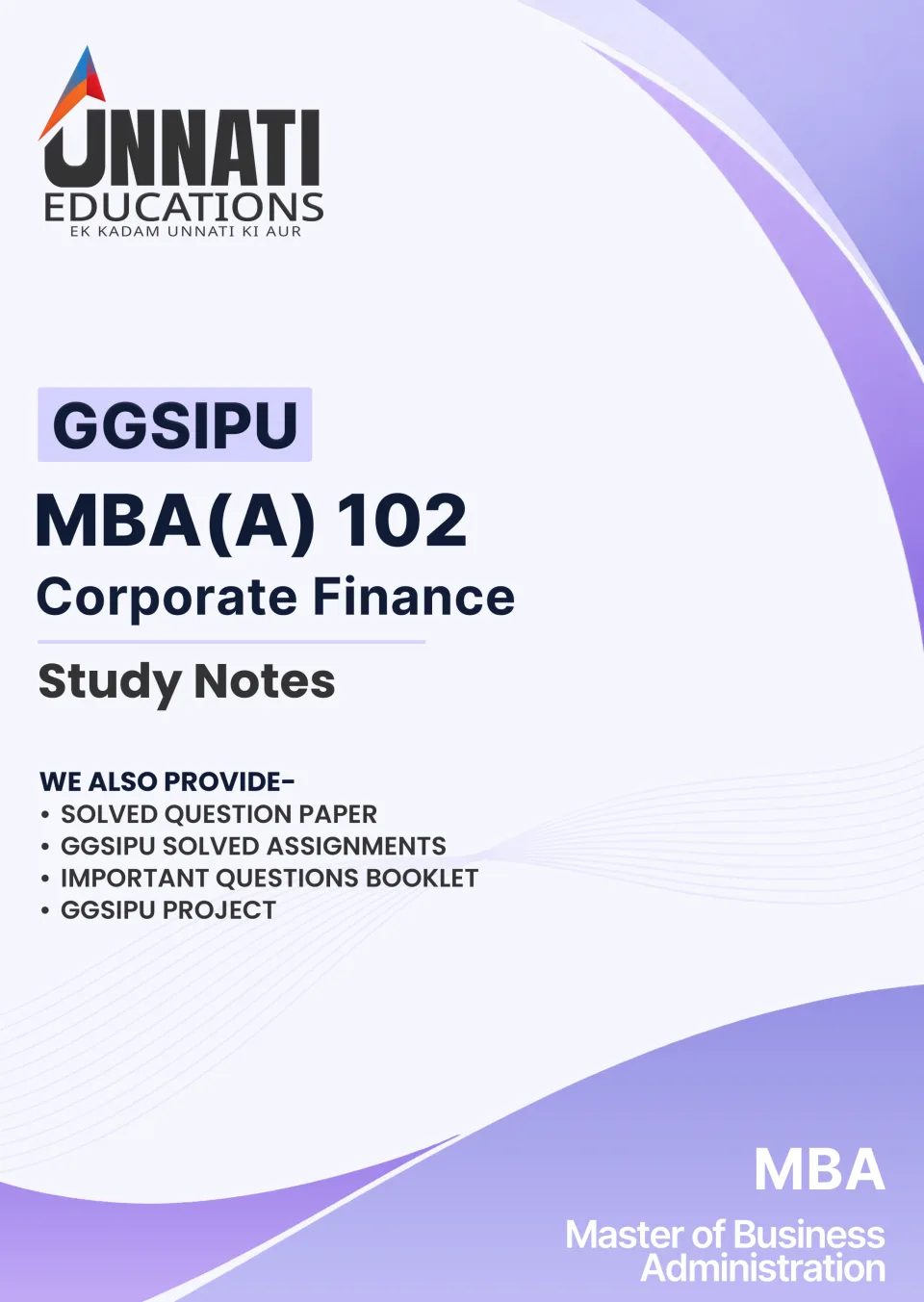
MBA(A) 102 Corporate Finance Notes from Unnati Educations cover all 4 units of this GGSIPU MBA (Analytics) Semester 2 core paper in 43 pages, with 51 worked illustrations, 14 diagrams, an MS-Excel function table for every unit and 50 exam-style questions, mapped to the Scheme and Syllabus 2022-24 onwards.
Written by Prateek Talwar, Founder, Unnati Educations (ACS, B.Com) · Reviewed by Sheetal Kirola, Academic Head, M.Ed., 7 years of experience · Checked against syllMBAAnalytics180225.pdf (approved 22 March 2023) · Updated 14 October 2026 · Editorial policy
Scheme: MBA (Analytics) Scheme and Syllabus 2022-24 onwards | Applies to: batches from 2022-24 onwards | Verified against: syllMBAAnalytics180225.pdf, 13 October 2026
MBA(A) 102 Corporate Finance at a glance: GGSIPU MBA (Analytics) Sem 2 credits, units and exam pattern
Code and title | MBA(A) 102 · Corporate Finance (syllabus page prints it as MBA (A) - 102L) |
|---|---|
Category and credits | Core · 3 credits · L 3, T/P nil |
Teaching hours | 10 + 10 + 10 + 12 = 42 hours |
Internal assessment | 25 marks: Class Test-I 15 + presentation, viva-voce or group discussion 10 |
End-term and total marks | Not printed in the official PDF |
End-term pattern | Not printed; the scheme follows GGSIPU Ordinance 11 |
Tool named in the syllabus | "MS-Excel Functions and Formulas to be used" |
Applies to | Scheme and Syllabus 2022-24 onwards |
Units | 4 |
Paired lab | None (Sem 2 labs 152 and 154 go with 106 and 114) |
The only finance paper of the term, it carries 3 of the 28 credits in the GGSIPU MBA (Analytics) Semester 2 papers.
MBA(A) 102 Corporate Finance Notes unit-wise: 51 worked illustrations and 14 diagrams across 4 units
Each unit of these GGSIPU MBA (Analytics) Sem 2 Corporate Finance notes is summarised below with one quick look from inside the book. Other papers are listed under GGSIPU MBA (Analytics) notes.
MBA(A) 102 Unit 1: Introduction
Also covered as "Introduction, TVM, Risk & Return and Valuation" (pages 4 to 14). Time value of money runs from single amounts to annuity due and EMI; risk and return go from SD and CV to CAPM and beta via =SLOPE(), then bond, YTM and two-stage equity valuation.
Counts: 9 sections, 20 worked illustrations, 4 diagrams, 13 exam questions.
Month | EMI (₹) | Interest (₹) | Principal (₹) |
|---|---|---|---|
1 | 20,758.36 | 7,500.00 | 13,258.36 |
2 | 20,758.36 | 7,400.56 | 13,357.79 |
3 | 20,758.36 | 7,300.38 | 13,457.98 |
Quick look: where a ₹10 lakh EMI goes in the first three months (from page 8)
Month
1
EMI (₹)
20,758.36
Interest (₹)
7,500.00
Principal (₹)
13,258.36
Month
2
EMI (₹)
20,758.36
Interest (₹)
7,400.56
Principal (₹)
13,357.79
Month
3
EMI (₹)
20,758.36
Interest (₹)
7,300.38
Principal (₹)
13,457.98
Excel: =PMT(9%/12,60,-1000000).
MBA(A) 102 Unit 2: Capital Structure
Also covered as "Capital Structure, Cost of Capital and Leverage" (pages 15 to 23). NI, NOI, traditional and MM (with a worked arbitrage) come first; specific costs then feed a WACC of 12.75% on book weights, followed by leverage, EBIT-EPS indifference points and gearing.
Counts: 8 sections, 12 worked illustrations, 3 diagrams, 12 exam questions.
Leverage | Working | Result |
|---|---|---|
Operating (DOL) | Contribution ₹4,00,000 ÷ EBIT ₹2,00,000 | 2.00 |
Financial (DFL) | EBIT ₹2,00,000 ÷ EBT ₹1,50,000 | 1.33 |
Combined (DCL) | DOL × DFL | 2.67 |
Quick look: three leverages for one firm (from page 20)
Leverage
Operating (DOL)
Working
Contribution ₹4,00,000 ÷ EBIT ₹2,00,000
Result
2.00
Leverage
Financial (DFL)
Working
EBIT ₹2,00,000 ÷ EBT ₹1,50,000
Result
1.33
Leverage
Combined (DCL)
Working
DOL × DFL
Result
2.67
MBA(A) 102 Unit 3: Capital Budgeting
Also covered as "Capital Budgeting and Risk Analysis" (pages 24 to 32). One ₹5 lakh project runs through every appraisal method from payback to MIRR. Risk follows (RADR, certainty equivalents, decision tree, Hillier's dependent cash flows), then replacement, sensitivity and Scenario Manager.
Counts: 9 sections, 10 worked illustrations, 4 diagrams, 12 exam questions.
Machine | PV of all costs (₹) | Life | Equivalent annual cost (₹) |
|---|---|---|---|
A | 2,49,474 | 3 years | 1,00,317 |
B | 3,53,724 | 5 years | 93,311 (choose B) |
Quick look: two machines with unequal lives at 10% (from page 30)
Machine
A
PV of all costs (₹)
2,49,474
Life
3 years
Equivalent annual cost (₹)
1,00,317
Machine
B
PV of all costs (₹)
3,53,724
Life
5 years
Equivalent annual cost (₹)
93,311 (choose B)
MBA(A) 102 Unit 4: Dividend Policy and Working Capital Management
Pages 33 to 42 compare Walter, Gordon, MM (a ₹1 crore irrelevance proof) and Lintner. Working capital covers the operating cycle, an ₹8,38,750 estimate, inventory, cash (Baumol, Miller-Orr), receivables and marketable securities.
Counts: 12 sections, 9 worked illustrations, 3 diagrams, 13 exam questions.
Quick look: economic order quantity in four steps (from page 38)
A = 12,000 units, O = ₹150, C = 20% of ₹50 = ₹10.
EOQ = √(2AO ÷ C) = √(2 × 12,000 × 150 ÷ 10) = 600 units.20 orders a year: ordering cost ₹3,000; carrying cost 300 × ₹10 = ₹3,000.
Total cost ₹6,000 is lowest where the two are equal.
MBA(A) 102 exam corner: 30 two-to-five-mark and 20 ten-to-fifteen-mark exam questions by unit
Unit | Short Answer Questions (2–5 marks) | Long Answer Questions (10–15 marks) | Worked illustrations |
|---|---|---|---|
I | 8 | 5 | 20 |
II | 7 | 5 | 12 |
III | 7 | 5 | 10 |
IV | 8 | 5 | 9 |
MBA(A) 102 question bank by unit, as printed in the notes
Unit
I
Short Answer Questions (2–5 marks)
8
Long Answer Questions (10–15 marks)
5
Worked illustrations
20
Unit
II
Short Answer Questions (2–5 marks)
7
Long Answer Questions (10–15 marks)
5
Worked illustrations
12
Unit
III
Short Answer Questions (2–5 marks)
7
Long Answer Questions (10–15 marks)
5
Worked illustrations
10
Unit
IV
Short Answer Questions (2–5 marks)
8
Long Answer Questions (10–15 marks)
5
Worked illustrations
9
One exam-style question per unit, with the line of attack:
Unit I: EMI on ₹30,00,000 at 8.5% for 20 years.
=PMT(8.5%/12,240,-3000000)gives the printed key, ₹26,034.70.Unit II: Contribution ₹6 lakh, fixed cost ₹2 lakh, interest ₹1 lakh; find DOL, DFL, DCL. EBIT ₹4 lakh, EBT ₹3 lakh: 1.5, 1.33, 2.0.
Unit III: Cost ₹2,00,000, CFAT ₹60,000 for 5 years. Payback 3.33 years; NPV at 10% ₹27,447; PI 1.137.
Unit IV: Baumol versus Miller-Orr. Steady flows and one conversion size, against random flows with upper, lower and return points.
The MBA(A) 102 notes list 30 short-answer and 20 long-answer exam questions across 4 units; four numericals carry printed answer keys. More practice sits in the MBA(A) 102 important questions.
Wealth maximisation and the agency problem in corporate finance: excerpt from page 6 of the MBA(A) 102 notes
Excerpt from page 6
Why profit maximisation falls short
Profit maximisation ignores the time value of money: ₹1 lakh in year 1 and ₹1 lakh in year 5 are treated as equal. It ignores risk, so two projects with the same profit but different uncertainty look the same. It ignores dividends and the quality of earnings, because high profit with no cash or dividend may not help owners. And it has a short-term focus: a firm may cut R&D, training or maintenance to show higher profit now.
Wealth maximisation (shareholder value maximisation)
Wealth maximisation means maximising the net present value (NPV) of the firm for its shareholders, which is reflected in the market price of the share. Any decision with a positive NPV creates wealth and should be accepted. Ezra Solomon's formula is W = V − C, where V is the present value of expected cash benefits, discounted at a rate that reflects risk and timing, and C is the cost of the investment. If W is greater than zero, the decision creates wealth.
Basis | Profit maximisation | Wealth maximisation |
|---|---|---|
Measure | Accounting profit / EPS | NPV and market price of share |
Time value of money | Ignored | Considered by discounting |
Risk | Ignored | Considered in discount rate |
Time horizon | Short term | Long term |
Clarity | Vague | Clear, based on cash flows |
Profit maximisation vs wealth maximisation (Table 1.1, page 6)
Basis
Measure
Profit maximisation
Accounting profit / EPS
Wealth maximisation
NPV and market price of share
Basis
Time value of money
Profit maximisation
Ignored
Wealth maximisation
Considered by discounting
Basis
Risk
Profit maximisation
Ignored
Wealth maximisation
Considered in discount rate
Basis
Time horizon
Profit maximisation
Short term
Wealth maximisation
Long term
Basis
Clarity
Profit maximisation
Vague
Wealth maximisation
Clear, based on cash flows
Other objectives and the agency problem
A firm also pursues liquidity and solvency, growth and survival, and stakeholder and ESG goals. Economic Value Added is EVA = NOPAT − (Capital employed × WACC); a positive EVA means true value creation.
Shareholders (principals) appoint managers (agents), and managers may chase high salaries, perks or empire-building instead of shareholder wealth. The cost of monitoring this conflict is agency cost. It is reduced through ESOPs, performance-linked pay, independent directors, audit committees, SEBI LODR disclosures and the threat of takeover.
Key point: modern corporate finance accepts shareholder wealth maximisation as the goal, achieved by taking only positive-NPV decisions while respecting the interests of all stakeholders.
Do the MBA(A) 102 notes cover the full GGSIPU syllabus?
Yes: every listed topic has its own section, and each unit ends with the MS-Excel table the syllabus note asks for. For cash models, Baumol and Miller-Orr are worked in full; Beranek, Stone and Orgler are only named.
Official unit | Official topics | Where in the notes | Status |
|---|---|---|---|
I: Introduction (10 hours) | FM nature, scope, objectives; TVM, EMI, annuity, annuity due; risk and return (CAPM); bond and equity valuation | Sections 1 to 8, pages 4 to 13 | Covered |
II: Capital Structure (10 hours) | NI, NOI, traditional, MM; cost of capital; three leverages; EBIT-EPS; capital gearing | Sections 1 to 7, pages 15 to 23 | Covered |
III: Capital Budgeting (10 hours) | Conventional and DCF methods; cash flows; CE, RADR, decision tree; independent and dependent risk; replacement; sensitivity; spreadsheet scenarios | Sections 1 to 8, pages 24 to 32 | Covered |
IV: Dividend Policy; Working Capital Management (12 hours) | Walter, Gordon, MM, Lintner; WC approaches, estimation; inventories; cash models; receivables, marketable securities | Sections 1 to 11, pages 33 to 41 | Covered |
MBA(A) 102 official units mapped to the notes
Official unit
I: Introduction (10 hours)
Official topics
FM nature, scope, objectives; TVM, EMI, annuity, annuity due; risk and return (CAPM); bond and equity valuation
Where in the notes
Sections 1 to 8, pages 4 to 13
Status
Covered
Official unit
II: Capital Structure (10 hours)
Official topics
NI, NOI, traditional, MM; cost of capital; three leverages; EBIT-EPS; capital gearing
Where in the notes
Sections 1 to 7, pages 15 to 23
Status
Covered
Official unit
III: Capital Budgeting (10 hours)
Official topics
Conventional and DCF methods; cash flows; CE, RADR, decision tree; independent and dependent risk; replacement; sensitivity; spreadsheet scenarios
Where in the notes
Sections 1 to 8, pages 24 to 32
Status
Covered
Official unit
IV: Dividend Policy; Working Capital Management (12 hours)
Official topics
Walter, Gordon, MM, Lintner; WC approaches, estimation; inventories; cash models; receivables, marketable securities
Where in the notes
Sections 1 to 11, pages 33 to 41
Status
Covered
Source: GGSIPU MBA (Analytics) Scheme and Syllabus 2022-24 onwards, page 29.
Each paper listed in GGSIPU notes gets this row-by-row check against its ipu.ac.in PDF.
Who writes and checks the MBA(A) 102 finance notes?
Prateek Talwar, author: Founder, Unnati Educations; Associate Company Secretary (ACS), ICSI, membership no. 58704, since 15 May 2019; B.Com, University of Delhi (School of Open Learning), 2012. Author profile
Sheetal Kirola, reviewer (language, layout and exam presentation): Academic Head, Unnati Educations; M.Ed.; 7 years of experience. Reviewer profile
The MBA(A) 102 Corporate Finance IPU notes follow the 2022-24 onwards scheme unit by unit. The 2026-27 edition has 43 pages, 14 figures and Indian context: RBI repo moves and bond prices (page 12), Section 123 of the Companies Act, 2013 (page 33) and TReDS (page 41). Last updated 14 October 2026 under our editorial policy.
Question sets for the other courses are collected under GGSIPU important questions.
MBA(A) 102 and the GGSIPU MBA (Analytics) Sem 2 papers it connects to
MBA(A) 102 has no paired lab; every paper is listed on the GGSIPU MBA (Analytics) syllabus page.
MBA(A) 102 unit | Other paper | Shared ground |
|---|---|---|
Unit I beta, CAPM, bond and equity value | Unit I beta and valuation; Unit III CAPM | |
Unit III sensitivity and scenario analysis | Unit I what-if, scenario, Goal Seek; Unit II best and worst cases | |
Unit III Monte Carlo idea (page 30) | Unit IV Monte Carlo VaR | |
Unit IV EOQ and stock levels | Unit II EOQ, ABC, reorder levels |
Where MBA(A) 102 topics come back later
MBA(A) 102 unit
Unit I beta, CAPM, bond and equity value
Shared ground
Unit I beta and valuation; Unit III CAPM
MBA(A) 102 unit
Unit III sensitivity and scenario analysis
Other paper
Shared ground
Unit I what-if, scenario, Goal Seek; Unit II best and worst cases
MBA(A) 102 unit
Unit III Monte Carlo idea (page 30)
Other paper
Shared ground
Unit IV Monte Carlo VaR
MBA(A) 102 unit
Unit IV EOQ and stock levels
Other paper
Shared ground
Unit II EOQ, ABC, reorder levels
The other Sem 2 papers are MBA(A) 104 Business Research, MBA(A) 106 Data Visualization, MBA(A) 108 Econometrics, MBA(A) 110 Business Performance Modelling, MBA(A) 112 Risk Assessment and Mitigation, MBA(A) 114 Data Modelling with Python, 116 MOOCs/Open elective, 118 Minor Project, and the labs 152 and 154. 227, 229 and 231 are the Sem 3 finance electives.
How to write MBA(A) 102 answers: Excel-backed finance numericals and diagram-led theory answers
The paper mixes numericals and theory, and the syllabus asks for MS-Excel. The notes' exam tips give a format for each.
Numericals. Formula, substitution, answer in ₹ or %, Excel syntax, then one decision line. The page 8 tip: in annuity questions write the last Excel argument, 0 for ordinary and 1 for annuity due. Remember from page 26 that Excel's NPV treats the first value as year 1, so the year-0 outflow is added separately.
Theory. For capital structure, the page 18 tip asks for the three-panel Ke-Kd-Ko graph and the approach's key assumption in the first line, such as "Under NOI, Ko is constant at 12.5%." When NPV and IRR disagree, the page 27 tip: give the reason (size, timing or lives), follow NPV and mark Fisher's intersection. Close dividend answers with Indian practice, as the page 36 tip suggests: stable dividends with gradual increases, buy-backs and bonus issues.
Worked example (page 14). Rf = 7%, Rm = 14%, β = 1.2; find the required return. CAPM: 7 + 1.2 × (14 − 7) = 15.4%. Decision: a share expected to earn above 15.4% is undervalued. Two traps the notes flag: CML uses total risk (σ) while SML uses beta (page 11), and financial leverage helps only when ROI exceeds the cost of debt (page 21).
Test each format on GGSIPU MBA (Analytics) important questions.
MBA(A) 102 finance notes FAQs
How do I get the full MBA(A) 102 notes?
Message 9899436384 on WhatsApp with the code MBA(A) 102. The full Corporate Finance notes are sold only as a 43-page printed book; there is no PDF edition. Delivery takes a maximum of 5 to 7 days, and the rest depends on your location.
What is the passing mark for MBA(A) 102 Corporate Finance?
For MBA(A) 102, the official syllabus prints only the internal assessment: 25 marks, made up of Class Test-I for 15 and a presentation, viva-voce or group discussion for 10. It does not print end-term marks, a total or a pass percentage. The scheme says it follows GGSIPU Ordinance 11, so check end-term minimums and re-appear rules there on ipu.ac.in.
Do the MBA(A) 102 notes show the MS-Excel functions the syllabus asks for?
Yes. Every MBA(A) 102 unit ends with an Excel table, and many illustrations give the formula next to the hand working. Examples: PMT and CUMIPMT for EMI, SLOPE for beta, RATE for YTM, NPV, IRR and MIRR, Goal Seek for the EBIT-EPS indifference point, and Data Table plus Scenario Manager for the Unit III risk work.
Which MBA(A) 102 unit has the most numericals?
Unit I, with 20 of the 51 worked illustrations in MBA(A) 102. Unit II has 12, Unit III 10 and Unit IV 9, so start revision with TVM and valuation. Unit III is the most connected one: a single ₹5 lakh project is solved by payback, ARR, NPV, IRR, PI and MIRR on pages 25 to 27.
Is MBA(A) 102 the same paper as MBA (A)-102L?
Yes. The scheme table in the official MBA (Analytics) PDF lists the paper as MBA(A) 102 Corporate Finance, while its syllabus page prints "Course Code: MBA (A) - 102L - 3, Credits – 3", and the notes cover uses MBA (A)-102L. All three mean the same 3-credit core paper, so the notes apply to both codes.
Do the MBA(A) 102 notes match the 2022-24 onwards GGSIPU syllabus?
Yes. The MBA(A) 102 notes were checked against syllMBAAnalytics180225.pdf, the GGSIPU MBA (Analytics) Scheme and Syllabus 2022-24 onwards, whose first and second semesters were approved by the Academic Council on 22 March 2023. Every topic in the four units has a section, and the syllabus map above links the official PDF so you can check it yourself.
Get the full MBA(A) 102 Corporate Finance Notes on WhatsApp
Part | Pages | Worked illustrations | Exam questions |
|---|---|---|---|
Cover and index | 1 to 3 | - | - |
Unit I | 4 to 14 | 20 | 13 |
Unit II | 15 to 23 | 12 | 12 |
Unit III | 24 to 32 | 10 | 12 |
Unit IV | 33 to 42 | 9 | 13 |
What is inside the MBA(A) 102 printed notes book
Part
Cover and index
Pages
1 to 3
Worked illustrations
-
Exam questions
-
Part
Unit I
Pages
4 to 14
Worked illustrations
20
Exam questions
13
Part
Unit II
Pages
15 to 23
Worked illustrations
12
Exam questions
12
Part
Unit III
Pages
24 to 32
Worked illustrations
10
Exam questions
12
Part
Unit IV
Pages
33 to 42
Worked illustrations
9
Exam questions
13
These Corporate Finance notes in English come only as a printed book, not a PDF. Delivery: maximum 5 to 7 days; the rest depends on your location.
Order the MBA(A) 102 notes book on WhatsApp (4 units, 43 pages)
Unnati Educations is an independent education provider based in Vikaspuri, Delhi. We are not affiliated with, authorised by, or endorsed by Guru Gobind Singh Indraprastha University (GGSIPU). 'GGSIPU' and 'IPU' are used only to describe the syllabus our notes follow. For official information, visit ipu.ac.in.
Ready for the full notes?
Discuss coverage and delivery with our team.