
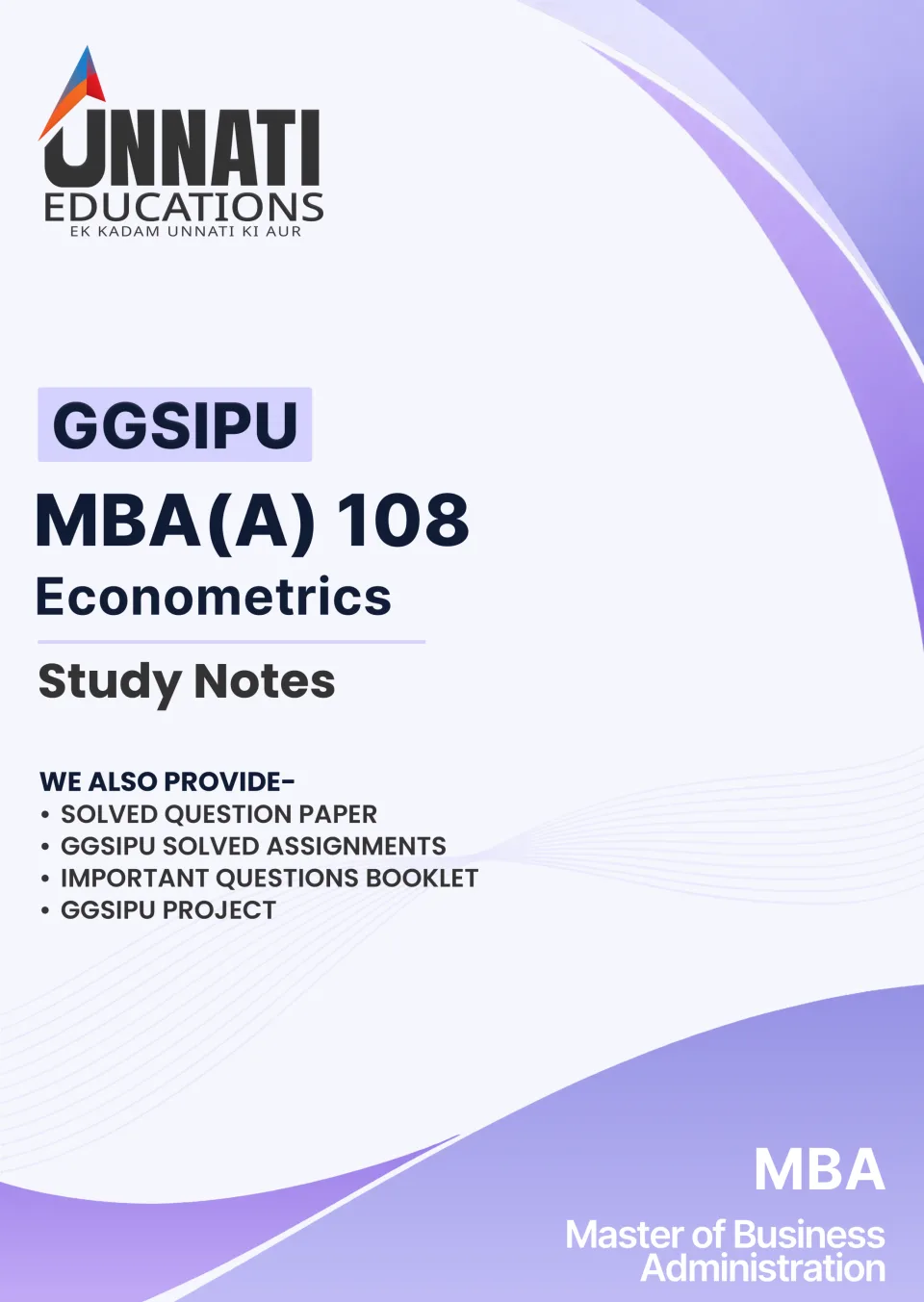
MBA(A) 108 Econometrics Notes from Unnati Educations cover all 4 units of the GGSIPU MBA (Analytics) Semester 2 paper in 61 pages, with 26 worked illustrations, 17 diagrams, 64 exam-style questions and an R and Excel command table for every unit. They follow the official Scheme and Syllabus 2022-24 onwards.
Written by Prateek Talwar, Founder, Unnati Educations · Reviewed by Sheetal Kirola, Academic Head, M.Ed. · Checked against syllMBAAnalytics180225.pdf (Sem 1-2 approved 22.03.2023) · Updated 14 October 2026 · Editorial policy
Scheme: MBA (Analytics) 2022-24 onwards | Applies to: batches from 2022-24 onwards | Verified against: syllMBAAnalytics180225.pdf
MBA(A) 108 Econometrics at a glance: GGSIPU MBA (Analytics) Sem 2 credits, units and exam pattern
Code and title | MBA(A) 108 Econometrics (printed as "MBA (A) - 108L - 3") |
|---|---|
Course and semester | MBA (Analytics), Semester 2 |
Category and credits | Core · 3 credits · L 3, T/P nil |
Marks | Internal 25 (Class Test-I 15 + presentation, viva-voce or group discussion 10). End-term and total marks not printed in the official PDF. |
Teaching hours by unit | Unit I 12 · Unit II 10 · Unit III 10 · Unit IV 10 (42 hours) |
Applies to | Scheme and Syllabus 2022-24 onwards |
End-term pattern | Paper-setter instructions not printed in the official PDF |
Paired lab | None (Semester 2 labs are MBA(A) 152 and MBA(A) 154) |
MBA(A) 108 carries the same 3 credits as Corporate Finance and Business Research. It is one of eleven GGSIPU MBA (Analytics) Semester 2 papers (28 credits in all). The scheme follows GGSIPU Ordinance 11 for examinations.
MBA(A) 108 Econometrics Notes unit-wise: 26 worked illustrations and 64 exam questions across 4 units
Notes for the other papers of the programme are listed under GGSIPU MBA (Analytics) notes.
The official PDF numbers the units only, so the headings below use the notes' unit titles.
MBA(A) 108 Unit 1: Econometrics, Simple and Multiple Linear Regression
Unit 1 covers the methodology of econometrics, data types and log returns, then builds simple regression: classical assumptions, OLS, Gauss-Markov, R², t and F tests and Maximum Likelihood, ending with the three-variable model and adjusted R².
Pages 4-21 · 13 sections · 3 worked illustrations · 6 figures · 9 short and 6 long exam questions.
Quick look: fitting Ŷ = 10.44 + 2.26X from six months of data (from page 12)
Deviations from X̄ = 6 and Ȳ = 24 give Σxy = 113 and Σx² = 50.
Slope b₂ = Σxy ÷ Σx² = 113 ÷ 50 = 2.26.
Intercept b₁ = Ȳ − b₂X̄ = 24 − 13.56 = 10.44.
At X = 12, forecast sales are ₹37.56 lakh.
MBA(A) 108 Unit 2: Issues with Classical Regression Model and Stationary Time Series Models
Unit 2 takes multicollinearity, autocorrelation and heteroscedasticity from causes to remedies, with VIF and Goldfeld-Quandt worked in numbers, then functional forms, dummies, AR, MA and ARMA processes and unit-root tests.
Pages 22-36 · 11 sections · 8 worked illustrations · 4 figures · 4 numbered comparison tables · 10 short and 7 long exam questions.
Check | Working | Result |
|---|---|---|
Stationary? | |φ| = 0.6 < 1 | Yes |
Mean | δ ÷ (1 − φ) = 2 ÷ 0.4 | 5 |
Variance | σ² ÷ (1 − φ²) = 4 ÷ 0.64 | 6.25 |
Forecasts from YT = 8 | 2 + 0.6 × 8, then 2 + 0.6 × 6.8 | 6.8, then 6.08 |
Quick look: AR(1) model Yt = 2 + 0.6Yt−1 + εt, σ² = 4 (from page 32)
Check
Stationary?
Working
|φ| = 0.6 < 1
Result
Yes
Check
Mean
Working
δ ÷ (1 − φ) = 2 ÷ 0.4
Result
5
Check
Variance
Working
σ² ÷ (1 − φ²) = 4 ÷ 0.64
Result
6.25
Check
Forecasts from YT = 8
Working
2 + 0.6 × 8, then 2 + 0.6 × 6.8
Result
6.8, then 6.08
MBA(A) 108 Unit 3: Modelling Volatility, Volatility and Correlation, and Vector Autoregressive Models
Unit 3 starts with volatility clustering in Nifty returns, then ARCH, GARCH(1,1) estimation and forecasting, and GJR, EGARCH and GARCH-in-Mean for the leverage effect. It compares five multivariate GARCH models and ends with VAR and Granger causality.
Pages 37-48 · 8 sections · 7 worked illustrations · 4 figures · 2 numbered comparison tables · 11 short and 5 long exam questions.
Model | Parameters (N = 2) | Positive definite? |
|---|---|---|
VECH | 21 | Not guaranteed |
BEKK | 11 | Guaranteed |
CCC | 7 | Yes, if R is positive definite |
DCC | 9 | Guaranteed |
Quick look: multivariate GARCH models, two assets (from page 45)
Model
VECH
Parameters (N = 2)
21
Positive definite?
Not guaranteed
Model
BEKK
Parameters (N = 2)
11
Positive definite?
Guaranteed
Model
CCC
Parameters (N = 2)
7
Positive definite?
Yes, if R is positive definite
Model
DCC
Parameters (N = 2)
9
Positive definite?
Guaranteed
MBA(A) 108 Unit 4: Advanced Topics in Regression Analysis
Unit 4 explains why business effects arrive with a lag: distributed lag multipliers, Koyck and Almon schemes, partial adjustment and Durbin's h test. It then covers instrumental variables, identification, ILS and 2SLS, and panel data models.
Pages 49-60 · 8 sections · 8 worked illustrations · 3 figures · 3 numbered comparison tables · 10 short and 6 long exam questions.
Quick look: choosing between fixed and random effects in R (from page 59)
fe <- plm::plm(y ~ x, data, index = c("firm","year"), model = "within")
re <- plm::plm(y ~ x, data, index = c("firm","year"), model = "random")
plm::phtest(fe, re) # Hausman testA significant Hausman result points to the fixed effects model.
Durbin-Watson test for autocorrelation in econometrics: excerpt from page 25 of the MBA(A) 108 notes
Excerpt from page 25
Consequences of autocorrelation for OLS
When errors are serially correlated, OLS estimators stay linear, unbiased and consistent, but they are no longer efficient, so they are not BLUE. The usual variance formulas become biased. With positive autocorrelation the standard errors are usually underestimated, t-ratios look larger than they are, and variables appear significant when they are not. R² is overstated, the t, F and χ² tests become invalid, and forecasts are inefficient.
Graphical check
Before any formal test, plot the residuals eₜ against time, or against eₜ₋₁. Long runs of the same sign point to positive autocorrelation, which is common in monthly sales or price data; frequent sign changes point to negative autocorrelation. The plot only suggests a problem, so a formal test is still needed.
The Durbin-Watson d statistic
d is the sum of squared differences between successive residuals, Σ(eₜ − eₜ₋₁)², divided by the sum of squared residuals, Σeₜ². It is roughly 2(1 − ρ̂), and because ρ lies between −1 and 1, d lies between 0 and 4. A value near 2 means no first-order autocorrelation.
Value of d | Decision |
|---|---|
0 < d < dL | Reject H0: positive autocorrelation |
dL ≤ d ≤ dU | Zone of indecision |
dU < d < 4 − dU | Do not reject H0: no autocorrelation |
4 − dU ≤ d ≤ 4 − dL | Zone of indecision |
4 − dL < d < 4 | Reject H0: negative autocorrelation |
Decision rule for the Durbin-Watson d test
Value of d
0 < d < dL
Decision
Reject H0: positive autocorrelation
Value of d
dL ≤ d ≤ dU
Decision
Zone of indecision
Value of d
dU < d < 4 − dU
Decision
Do not reject H0: no autocorrelation
Value of d
4 − dU ≤ d ≤ 4 − dL
Decision
Zone of indecision
Value of d
4 − dL < d < 4
Decision
Reject H0: negative autocorrelation
The test assumes the regression has an intercept, the X values are non-stochastic, errors follow an AR(1) pattern, there is no lagged dependent variable among the regressors and no observations are missing.
Worked case
Ten residuals from a time-series regression with one regressor give Σ(eₜ − eₜ₋₁)² = 1.68 and Σeₜ² = 6.14. So d = 1.68 ÷ 6.14 = 0.274. At 5%, dL = 0.879 and dU = 1.320. Since d is below dL, H0 is rejected: there is strong positive autocorrelation. The estimated ρ̂ is about 1 − 0.274 ÷ 2 = 0.863.
MBA(A) 108 exam corner: 40 short-answer and 24 long-answer questions by unit
Each unit ends with "Short Answer Questions (2–5 marks)" and "Long Answer Questions (10–15 marks)", answered through that unit's sections. They carry no year tags, so treat them as exam-style practice.
Unit | Short answer (2–5 marks) | Long answer (10–15 marks) | Worked illustrations |
|---|---|---|---|
Unit 1 | 9 | 6 | 3 |
Unit 2 | 10 | 7 | 8 |
Unit 3 | 11 | 5 | 7 |
Unit 4 | 10 | 6 | 8 |
Total | 40 | 24 | 26 |
MBA(A) 108 exam questions and worked illustrations in the notes, by unit
Unit
Unit 1
Short answer (2–5 marks)
9
Long answer (10–15 marks)
6
Worked illustrations
3
Unit
Unit 2
Short answer (2–5 marks)
10
Long answer (10–15 marks)
7
Worked illustrations
8
Unit
Unit 3
Short answer (2–5 marks)
11
Long answer (10–15 marks)
5
Worked illustrations
7
Unit
Unit 4
Short answer (2–5 marks)
10
Long answer (10–15 marks)
6
Worked illustrations
8
Unit
Total
Short answer (2–5 marks)
40
Long answer (10–15 marks)
24
Worked illustrations
26
The MBA(A) 108 notes list 40 short-answer and 24 long-answer exam questions across 4 units, plus 26 worked illustrations.
Unit 1: Distinguish between R² and adjusted R². Pointer: R² never falls when a regressor is added; adjusted R² corrects for degrees of freedom and is always ≤ R² (page 19).
Unit 2: What is the dummy variable trap? How is it avoided? Pointer: m dummies plus an intercept give perfect multicollinearity; use m − 1 (page 29).
Unit 3: Explain the GARCH(1,1) model. What is meant by persistence? Pointer: σₜ² = ω + αuₜ₋₁² + βσₜ₋₁²; persistence = α + β (page 39).
Unit 4: State the order and rank conditions of identification. Pointer: order K − k ≥ m − 1 (necessary); rank needs a non-zero determinant of order M − 1 (page 55).
More practice sits in the MBA(A) 108 important questions.
Who writes and checks the MBA(A) 108 Econometrics notes?
Prateek Talwar, author of these notes. Founder, Unnati Educations. Associate Company Secretary (ACS), ICSI, membership no. 58704, since 15 May 2019. B.Com, University of Delhi (School of Open Learning), 2012. Author profile
Sheetal Kirola, reviewer: checks syllabus mapping, language and exam presentation. Academic Head, Unnati Educations. M.Ed., 7 years of experience. Reviewer profile
The 2026-27 edition of these MBA(A) 108 Econometrics IPU notes is mapped to the Scheme and Syllabus 2022-24 onwards and adds R commands (lmtest, rugarch, plm) beside the theory. Last updated 14 October 2026, under our editorial policy.
The same team prepares GGSIPU important questions for every course.
Do the MBA(A) 108 notes cover the full GGSIPU syllabus?
Yes. Every topic in the four official units has its own section in the notes, which also add the Augmented Dickey-Fuller test and R and Excel command tables.
Official unit | Official topics | Where in the notes | Status |
|---|---|---|---|
I | Meaning, nature, scope, methodology, types of data, returns, model formulation | Sections 1-6, pages 4-10 | Covered |
I | Simple linear regression: assumptions, OLS, R², tests of significance, Maximum Likelihood | Sections 7-10, pages 10-16 | Covered |
I | Multiple linear regression: least squares, tests, R² and adjusted R² | Section 11, pages 16-20 | Covered |
II | Multicollinearity, autocorrelation, heteroscedasticity, functional forms, dummy variables | Sections 1-6, pages 22-30 | Covered |
II | Stationarity, AR, MA, ARMA, trends, unit roots, Dickey-Fuller and Phillips-Perron | Sections 7-9, pages 30-35 | Covered |
III | ARCH, GARCH estimation and forecasting, asymmetric GARCH, GARCH-in-Mean | Sections 1-4, pages 37-42 | Covered |
III | VECH, Diagonal VECH, BEKK, Constant and Dynamic Correlation; VAR issues and hypothesis testing | Sections 5-6, pages 43-47 | Covered |
IV | Distributed lag and autoregressive models, instrumental variables, simultaneous equations | Sections 1-5, pages 49-56 | Covered |
IV | Panel data: estimation, fixed and random effects | Section 6, pages 57-58 | Covered |
Official MBA(A) 108 syllabus topics mapped to the notes
Official unit
I
Official topics
Meaning, nature, scope, methodology, types of data, returns, model formulation
Where in the notes
Sections 1-6, pages 4-10
Status
Covered
Official unit
I
Official topics
Simple linear regression: assumptions, OLS, R², tests of significance, Maximum Likelihood
Where in the notes
Sections 7-10, pages 10-16
Status
Covered
Official unit
I
Official topics
Multiple linear regression: least squares, tests, R² and adjusted R²
Where in the notes
Section 11, pages 16-20
Status
Covered
Official unit
II
Official topics
Multicollinearity, autocorrelation, heteroscedasticity, functional forms, dummy variables
Where in the notes
Sections 1-6, pages 22-30
Status
Covered
Official unit
II
Official topics
Stationarity, AR, MA, ARMA, trends, unit roots, Dickey-Fuller and Phillips-Perron
Where in the notes
Sections 7-9, pages 30-35
Status
Covered
Official unit
III
Official topics
ARCH, GARCH estimation and forecasting, asymmetric GARCH, GARCH-in-Mean
Where in the notes
Sections 1-4, pages 37-42
Status
Covered
Official unit
III
Official topics
VECH, Diagonal VECH, BEKK, Constant and Dynamic Correlation; VAR issues and hypothesis testing
Where in the notes
Sections 5-6, pages 43-47
Status
Covered
Official unit
IV
Official topics
Distributed lag and autoregressive models, instrumental variables, simultaneous equations
Where in the notes
Sections 1-5, pages 49-56
Status
Covered
Official unit
IV
Official topics
Panel data: estimation, fixed and random effects
Where in the notes
Section 6, pages 57-58
Status
Covered
Official source: MBA (Analytics) Scheme and Syllabus 2022-24 onwards (ipu.ac.in).
Every paper in GGSIPU notes is mapped to its official PDF the same way.
How to write MBA(A) 108 answers: regression numericals, test decisions and five-head ten-mark theory answers
Theory questions on Unit 2 problems. For multicollinearity, autocorrelation or heteroscedasticity, write under five heads: Meaning, Causes, Consequences, Detection, Remedies. When you list the Unit 1 assumptions, write them with symbols and tie each to its violation: assumption 4 to heteroscedasticity, 5 to autocorrelation, 9 to multicollinearity.
Regression numericals. Draw the working table (X, Y, x, y, x², xy), write the formula, substitute, and end with a one-line interpretation in rupees or units. For adjusted R², write the (n − 1) ÷ (n − k) relation and state that it never exceeds R².
Test decisions. Write four lines: H0, statistic, critical value, decision in words. In Unit 4, show identification as a table of M, K, m, k, K − k and m − 1.
Method answers. For GARCH estimation give three steps: specify mean and variance equations, write the log-likelihood, maximise it and check diagnostics, adding that OLS fails because the model is non-linear. In return questions, say log returns are time-additive.
Worked example: White test (page 27)
H0: no heteroscedasticity. The auxiliary regression of e² on X₂, X₃, their squares and cross-product gives R² = 0.21, n = 50. Statistic: nR² = 10.5. Critical value: χ² (5 df, 5%) = 11.07. Decision: 10.5 < 11.07, so do not reject H0.
Practise this format on GGSIPU MBA (Analytics) important questions.
MBA(A) 108 and the GGSIPU MBA (Analytics) Sem 2 papers it connects to
No lab is paired with MBA(A) 108; every paper and lab is listed on the GGSIPU MBA (Analytics) syllabus page.
MBA(A) 112 Risk Assessment and Mitigation: Unit 3 GARCH forecasts feed Value-at-Risk (page 41).
MBA(A) 102 Corporate Finance: Unit 1 lists CAPM beta estimation among the finance uses of regression (page 5).
MBA(A) 104 Business Research: Unit 1 data types and Unit 4 panel models used in MBA research projects (page 59).
MBA(A) 106 Data Visualization and MBA(A) 152 lab: Unit 2 residual and ACF plots.
MBA(A) 114 Data Modelling with Python and MBA(A) 154 lab: Unit 1-2 regression models (the notes use R and Excel, not Python).
Also in Semester 2: MBA(A) 110 Business Performance Modelling, MBA(A) 116 MOOCs/Open elective, MBA(A) 118 Minor Project.
MBA(A) 108 Econometrics notes FAQs
How many marks is MBA(A) 108 Econometrics, and what is the passing mark?
The official MBA (Analytics) scheme prints internal assessment of 25 marks for MBA(A) 108: Class Test-I for 15 and an individual presentation, viva-voce or group discussion for 10. The end-term marks, the total and a pass percentage are not printed in that PDF. For minimum marks and re-appear rules, check GGSIPU Ordinance 11 on ipu.ac.in.
Which MBA (Analytics) batch do the MBA(A) 108 notes follow?
They follow the GGSIPU MBA (Analytics) Scheme and Syllabus 2022-24 onwards, whose first and second semesters were approved by the Academic Council on 22.03.2023. The file on ipu.ac.in is syllMBAAnalytics180225.pdf. Each unit of the notes was matched topic by topic to that PDF, and the coverage table above shows where every official topic sits in the notes.
Which unit of MBA(A) 108 has the most numericals?
Units 2 and 4 have 8 worked illustrations each, against 7 in Unit 3 and 3 in Unit 1. Unit 2 numericals cover VIF, Durbin-Watson, Goldfeld-Quandt, White test, dummy salary models, AR(1), MA(1) and ADF. Unit 4 covers lag multipliers, Koyck, partial adjustment, Durbin h, IV, identification, ILS and Hausman. Unit 1 has fewer but longer worked regressions.
Do I need R or Excel software for MBA(A) 108?
The official syllabus does not name any software, but CO2 asks you to apply econometric techniques to real economic data. So the notes close each unit with a command table, for example lm() and =LINEST in Unit 1, car::vif and tseries::adf.test in Unit 2, rugarch and vars in Unit 3, and plm in Unit 4.
Is there a lab paper with MBA(A) 108 Econometrics?
No. The Semester 2 scheme lists MBA(A) 108 as a 3-credit core theory paper with 3 lecture hours and no tutorial or practical hours. The only Semester 2 labs are MBA(A) 152 Data Visualization Lab and MBA(A) 154 Data Modelling with Python Lab. The R and Excel tables in these notes support the theory paper.
How do I get the full MBA(A) 108 notes?
Message Unnati Educations on WhatsApp at 9899436384 using the button on this page. The full MBA(A) 108 notes come as a printed book only, not as a PDF. Delivery takes a maximum of 5-7 days, and the exact time depends on your location.
Get the full MBA(A) 108 Econometrics Notes on WhatsApp
Unit | Pages | Worked illustrations | Exam questions |
|---|---|---|---|
Unit 1 | 4-21 (18 pages) | 3 | 15 |
Unit 2 | 22-36 (15 pages) | 8 | 17 |
Unit 3 | 37-48 (12 pages) | 7 | 16 |
Unit 4 | 49-60 (12 pages) | 8 | 16 |
Full book | 61 pages (with cover and index) | 26 | 64 |
Pages per unit in the full MBA(A) 108 notes book
Unit
Unit 1
Pages
4-21 (18 pages)
Worked illustrations
3
Exam questions
15
Unit
Unit 2
Pages
22-36 (15 pages)
Worked illustrations
8
Exam questions
17
Unit
Unit 3
Pages
37-48 (12 pages)
Worked illustrations
7
Exam questions
16
Unit
Unit 4
Pages
49-60 (12 pages)
Worked illustrations
8
Exam questions
16
Unit
Full book
Pages
61 pages (with cover and index)
Worked illustrations
26
Exam questions
64
The book adds 17 diagrams, 10 numbered comparison tables and exam-tip boxes. These Econometrics notes in English come as a printed book only, not a PDF. Delivery takes a maximum of 5-7 days; the exact time depends on your location.
Order the MBA(A) 108 notes book on WhatsApp (4 units, 61 pages)
Unnati Educations is an independent education provider based in Vikaspuri, Delhi. We are not affiliated with, authorised by, or endorsed by Guru Gobind Singh Indraprastha University (GGSIPU). 'GGSIPU' and 'IPU' are used only to describe the syllabus our notes follow. For official information, visit ipu.ac.in.
Ready for the full notes?
Discuss coverage and delivery with our team.