
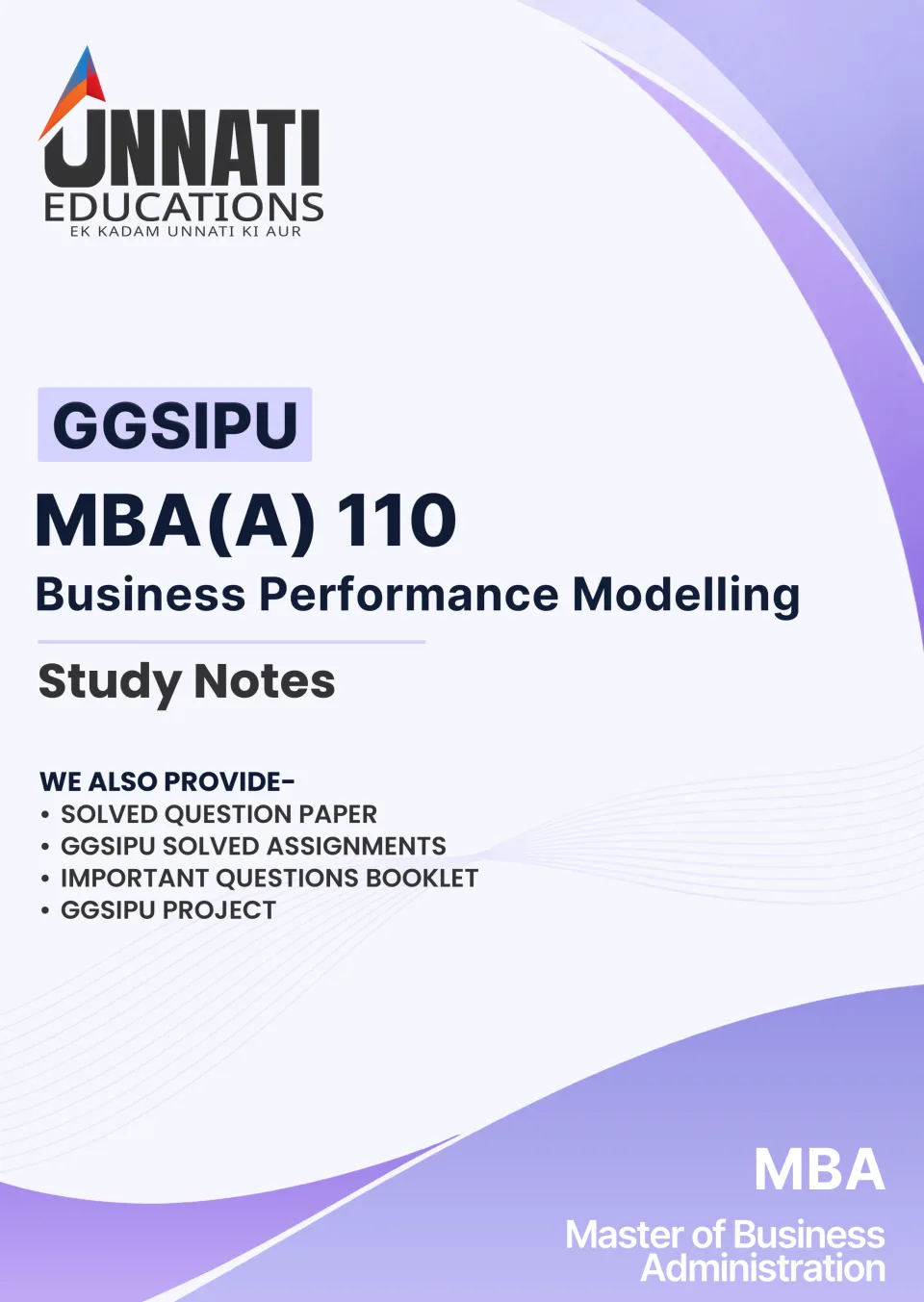
MBA(A) 110 Business Performance Modelling Notes are a 57-page printed book covering all 4 units of the GGSIPU MBA (Analytics) Semester 2 paper: performance metrics, model performance and hyperparameter search, optimisation algorithms, and hyperparameter tuning with batch normalisation. They hold 22 worked illustrations, 4 case studies and 62 exam questions, mapped to the 2022-24 onwards scheme.
Written by Prateek Talwar, Founder, Unnati Educations · Reviewed by Sheetal Kirola, M.Ed., Academic Head · Checked against syllMBAAnalytics180225.pdf · Updated 14 October 2026 · Editorial policy
Scheme: MBA (Analytics) Scheme and Syllabus 2022-24 onwards | Applies to: batches under the 2022-24 onwards scheme | Verified against: syllMBAAnalytics180225.pdf, Sem 1-2 approved 22.03.2023
MBA(A) 110 Business Performance Modelling at a glance: GGSIPU MBA (Analytics) Sem 2 credits, units and exam pattern
MBA(A) 110 asks one question of every model built in this programme: does it work for the business? It sits with ten other GGSIPU MBA (Analytics) Semester 2 papers in the second-semester scheme.
Code and title | MBA(A) 110 Business Performance Modelling |
|---|---|
Course and semester | MBA (Analytics), Semester 2 |
Category and credits | Skill Enhancement · 3 credits · 3 lecture hours a week |
Teaching hours | 10 + 11 + 11 + 10 = 42 hours |
Marks | Internal 25: Class Test-I 15 + presentation / viva-voce / group discussion 10. End-term and total: not printed in the official PDF. |
End-term pattern | Paper-setter instructions not printed in the official PDF |
Applies to | Scheme and Syllabus 2022-24 onwards |
Units | 4 |
Paired lab | None |
Pass and re-appear rules for MBA(A) 110 follow GGSIPU Ordinance 11.
MBA(A) 110 Business Performance Modelling Notes unit-wise: 22 worked illustrations and 4 business case studies across 4 units
The GGSIPU MBA (Analytics) Sem 2 Business Performance Modelling notes run from page 4 to page 56 in the official unit order, with Indian business data in every illustration.
Notes for every other paper of this programme: GGSIPU MBA (Analytics) notes.
MBA(A) 110 Unit 1: Introduction
Also covered as "Introduction: Performance Metrics for Algorithms" (pages 4-18). Business outcomes are matched to ML tasks, classification metrics are built from one telecom confusion matrix, and regression, forecasting, ranking and profit metrics follow, sorted on six bases. Contains 5 illustrations, 7 figures, an NBFC loan-default case and 16 exam questions.
Metric | Working | Result |
|---|---|---|
Accuracy | (70 + 820) ÷ 1,000 | 89.0% |
Precision | 70 ÷ 150 | 46.7% |
Recall | 70 ÷ 100 | 70.0% |
F1-score | 2 × 0.467 × 0.70 ÷ 1.167 | 0.56 |
Quick look: churn confusion matrix, TP 70, FP 80, FN 30, TN 820 (from page 7)
Metric
Accuracy
Working
(70 + 820) ÷ 1,000
Result
89.0%
Metric
Precision
Working
70 ÷ 150
Result
46.7%
Metric
Recall
Working
70 ÷ 100
Result
70.0%
Metric
F1-score
Working
2 × 0.467 × 0.70 ÷ 1.167
Result
0.56
MBA(A) 110 Unit 2: Model performance
Also covered as "Model Performance and Hyperparameter Search" (pages 19-31). A cost-benefit matrix shows the churn model's most accurate cut-off (0.7, 92%) earning least (₹1,60,000). Then come bias-variance, k-fold cross-validation, key hyperparameters and grid, random and Bayesian search. Contains 5 illustrations, 5 figures, a grocery forecasting case and 15 exam questions.
max_depth | n_estimators | Mean CV AUC |
|---|---|---|
4 | 300 | 0.785 |
8 | 100 | 0.812 |
8 | 300 | 0.818 (best) |
12 | 300 | 0.809 |
Quick look: grid search on a random-forest churn model, 3 × 2 settings × 5 folds = 30 fits (from page 25)
max_depth
4
n_estimators
300
Mean CV AUC
0.785
max_depth
8
n_estimators
100
Mean CV AUC
0.812
max_depth
8
n_estimators
300
Mean CV AUC
0.818 (best)
max_depth
12
n_estimators
300
Mean CV AUC
0.809
MBA(A) 110 Unit 3: Optimization algorithms
Same title in the notes (pages 32-43). Meaning, purpose and features of optimisers lead into gradient descent worked by hand on J(w) = (w - 3)², mini-batch descent, RMSprop, Adam with bias correction and the Keras and PyTorch calls. Contains 5 illustrations, 4 figures, an LSTM sales-forecasting case and 15 exam questions.
Item | Parameter A (g = 0.5) | Parameter B (g = 0.01) |
|---|---|---|
s₁ = 0.1 × g² | 0.025 | 0.00001 |
√s₁ | 0.1581 | 0.003162 |
RMSprop step | 0.00316 | 0.00316 |
Plain GD step | 0.0005 | 0.00001 |
Quick look: RMSprop first step, α = 0.001, β = 0.9 (from page 38)
Item
s₁ = 0.1 × g²
Parameter A (g = 0.5)
0.025
Parameter B (g = 0.01)
0.00001
Item
√s₁
Parameter A (g = 0.5)
0.1581
Parameter B (g = 0.01)
0.003162
Item
RMSprop step
Parameter A (g = 0.5)
0.00316
Parameter B (g = 0.01)
0.00316
Item
Plain GD step
Parameter A (g = 0.5)
0.0005
Parameter B (g = 0.01)
0.00001
MBA(A) 110 Unit 4: Hyperparameter tuning
Also covered as "Hyperparameter Tuning and Batch Normalization" (pages 44-56). Eight tuning concepts, a nine-step process and a staged XGBoost tuning (AUC 0.801 to 0.852) lead into batch normalisation: algorithm, training vs inference, benefits and limits. Contains 7 illustrations, 5 figures, an NBFC credit-risk case and 16 exam questions.
Round | Configurations | Epochs each | Epochs used |
|---|---|---|---|
1 | 27 | 1 | 27 |
2 | 9 | 3 | 27 |
3 | 3 | 9 | 27 |
4 | 1 (winner) | 27 | 27 |
Quick look: successive halving, η = 3: 108 epochs instead of 729 (from page 48)
Round
1
Configurations
27
Epochs each
1
Epochs used
27
Round
2
Configurations
9
Epochs each
3
Epochs used
27
Round
3
Configurations
3
Epochs each
9
Epochs used
27
Round
4
Configurations
1 (winner)
Epochs each
27
Epochs used
27
Precision-recall trade-off and ROC-AUC in model evaluation: excerpt from page 8 of the MBA(A) 110 notes
Excerpt from page 8 (Unit 1, sections 3.3 and 3.4)
Precision-recall trade-off and the threshold
A classifier usually gives a probability score, for example a 0.73 chance that a customer will churn. The threshold, or cut-off, converts this score into a class. Raising the threshold makes the model stricter: precision rises but recall falls. Lowering the threshold catches more positives: recall rises but precision falls.
There is no single correct threshold. The right one depends on the business cost of each type of error, so the analyst first asks which mistake hurts the firm more, a false alarm or a missed case. The notes plot precision, recall and F1 against the cut-off (Fig. 1.4), mark the threshold where F1 peaks, and then show how six common business situations push the threshold up or down.
Business situation | Costlier error | Metric to emphasise | Threshold |
|---|---|---|---|
Credit-card fraud detection | FN: fraud slips through | Recall, F2, PR-AUC | Lower |
Cancer / disease screening | FN: patient missed | Recall (sensitivity) | Lower |
Spam filter for business e-mail | FP: genuine mail blocked | Precision, F0.5 | Higher |
Loan approval (predicting a "good" borrower) | FP: bad borrower approved | Precision, specificity | Higher |
Costly retention offer (₹2,000 gift) | FP: gift to a loyal customer | Precision | Higher |
Cheap SMS reminder campaign | FN: missed customer | Recall | Lower |
Which error costs more, and where the threshold moves (page 8)
Business situation
Credit-card fraud detection
Costlier error
FN: fraud slips through
Metric to emphasise
Recall, F2, PR-AUC
Threshold
Lower
Business situation
Cancer / disease screening
Costlier error
FN: patient missed
Metric to emphasise
Recall (sensitivity)
Threshold
Lower
Business situation
Spam filter for business e-mail
Costlier error
FP: genuine mail blocked
Metric to emphasise
Precision, F0.5
Threshold
Higher
Business situation
Loan approval (predicting a "good" borrower)
Costlier error
FP: bad borrower approved
Metric to emphasise
Precision, specificity
Threshold
Higher
Business situation
Costly retention offer (₹2,000 gift)
Costlier error
FP: gift to a loyal customer
Metric to emphasise
Precision
Threshold
Higher
Business situation
Cheap SMS reminder campaign
Costlier error
FN: missed customer
Metric to emphasise
Recall
Threshold
Lower
Read the last two rows together. A ₹2,000 retention gift and a cheap SMS reminder target the same churners, yet they need opposite thresholds: a wasted gift is expensive, while a wasted SMS costs almost nothing. The same logic separates fraud detection, where a missed fraud is the bigger loss, from a business spam filter, where blocking a genuine client mail is worse.
ROC curve and AUC
The Receiver Operating Characteristic (ROC) curve plots the True Positive Rate (recall) on the Y-axis against the False Positive Rate on the X-axis for every possible threshold. The Area Under the Curve (AUC) summarises the whole curve in one number between 0 and 1, which makes it useful for comparing models before any single cut-off is chosen.
How to write MBA(A) 110 answers: outcome-task-metric case answers and step-wise numericals
The MBA(A) 110 Business Performance Modelling IPU notes repeat one rule in their exam tips: start from the business outcome, name the ML task, then justify the metric. Page 6 says examiners reward this logic more than a list of formulas.
For "which metric will you use?" questions, page 17 gives a six-step frame: Outcome → Task → Data imbalance → Cost of errors → Primary + secondary metric → Business KPI. When a question says "as per business outcome", page 21 asks for a small payoff table showing that the most accurate model may not be the most profitable.
For Adam, page 42 wants the four equations, the default values and the line "Adam = Momentum + RMSprop + bias correction", plus one worked step. For tuning, page 49 suggests a flow chart of the nine steps and one table of hyperparameter ranges.
Worked example: the six-step frame on a loan-default question (case on page 17)
Outcome: fewer bad personal loans at a fixed approval rate.
Task: binary classification.
Imbalance: only 4% of past borrowers defaulted, so accuracy misleads.
Cost of errors: approving a defaulter costs more than rejecting a good applicant.
Metrics: ROC-AUC or Gini to compare models, KS for separation, recall at an 80% approval rate to operate.
KPI: expected loss = PD × LGD × EAD, with the approval rate.
Never quote a training-set score as model performance; use the test or cross-validation figure. Practise this format on the GGSIPU MBA (Analytics) important questions before Class Test-I.
MBA(A) 110 exam corner: 38 two-to-five-mark and 24 ten-to-fifteen-mark questions by unit
Each unit ends with "Important Exam Questions": short answers (2–5 marks) and long answers (10–15 marks). These are exam-style practice questions without year tags; five numericals carry a printed answer key.
Unit | Short (2–5 marks) | Long (10–15 marks) | Illustrations |
|---|---|---|---|
Unit 1 | 10 | 6 | 5 |
Unit 2 | 9 | 6 | 5 |
Unit 3 | 9 | 6 | 5 |
Unit 4 | 10 | 6 | 7 |
MBA(A) 110 exam questions and worked illustrations by unit
Unit
Unit 1
Short (2–5 marks)
10
Long (10–15 marks)
6
Illustrations
5
Unit
Unit 2
Short (2–5 marks)
9
Long (10–15 marks)
6
Illustrations
5
Unit
Unit 3
Short (2–5 marks)
9
Long (10–15 marks)
6
Illustrations
5
Unit
Unit 4
Short (2–5 marks)
10
Long (10–15 marks)
6
Illustrations
7
The MBA(A) 110 notes list 38 short-answer (2–5 marks) and 24 long-answer (10–15 marks) exam questions across 4 units, plus 22 worked illustrations and 4 business case studies.
Unit 1 (10–15 marks): Actual sales 100, 120, 90, 110, 80; forecasts 110, 115, 95, 100, 85. Compute MAE, MSE, RMSE, MAPE and R². Pointer: key gives 7, 55, 7.42, 7.01% and 0.725 (method on page 11).
Unit 2 (2–5 marks): What is meant by computing model performance "as per specified business outcome"? Pointer: value TP, FP, FN and TN in rupees and pick the threshold with the highest profit (pages 19-20).
Unit 3 (10–15 marks): Compute the first two Adam steps for gradients 0.5 and 0.3 with default settings. Pointer: after bias correction, about 0.0010 and 0.00096 (page 39).
Unit 4 (10–15 marks): Batch-normalise 2, 4, 6, 8 with γ = 2, β = 1. Pointer: mean 5, SD 2.236; key gives −1.683, 0.106, 1.894, 3.683 (page 53).
More practice sits in the MBA(A) 110 important questions.
MBA(A) 110 and the GGSIPU MBA (Analytics) Sem 2 papers it connects to
The scheme pairs no lab with MBA(A) 110; all Sem 2 papers and credits are on the GGSIPU MBA (Analytics) syllabus page.
Unit 1 R², adjusted R² and MAPE → MBA(A) 108 Econometrics (OLS fit in Unit I, ARMA forecasting in Unit II).
Unit 1 classification metrics and Unit 2 cross-validation → MBA(A) 114 Data Modelling with Python (logistic regression in Unit III) and its lab MBA(A) 154, where the scikit-learn calls on page 18 can be run.
Unit 2 generalisation → MBA(A) 112 Risk Assessment and Mitigation, whose Unit II measures model deviation across multiple inputs.
Unit 1 gain charts and business metrics → MBA(A) 106 Data Visualization and MBA(A) 152 Data Visualization Lab, on reporting results to an audience.
Also in Sem 2: MBA(A) 102 Corporate Finance, MBA(A) 104 Business Research, MBA(A) 116 MOOCs/Open elective and MBA(A) 118 Minor Project. Next comes Semester 3 MBA(A) 207 Artificial Intelligence and Machine Learning.
Who writes and checks the MBA(A) 110 BPM notes?
Prateek Talwar, author: Founder, Unnati Educations; Associate Company Secretary (ACS), ICSI, membership no. 58704, since 15 May 2019; B.Com, University of Delhi (School of Open Learning), 2012. Profile
Sheetal Kirola, reviewer: Academic Head, Unnati Educations; M.Ed.; 7 years of experience. Checks clarity, structure and fit with the official unit topics. Profile
The 2026-27 edition maps MBA(A) 110 to the 2022-24 onwards scheme and adds Python, R, Keras and PyTorch syntax tables. Updated 14 October 2026; see our editorial policy. The same team prepares GGSIPU important questions for every course.
Do the MBA(A) 110 notes cover the full GGSIPU syllabus?
Yes. Every topic in the four official units of MBA(A) 110 has its own section in the notes; no gap was found. CO4, "Working on BPM use cases", is met by one case study per unit.
Official unit | Official topics | Where in the notes | Status |
|---|---|---|---|
I Introduction | Performance metrics for algorithms on different business outcomes, categorization of performance metrices | Sections 2-7, pages 5-16 | Covered |
II Model performance | Computation as per specified business outcome; hyperparameters description for maximizing model performance; grid search, random search, Bayesian optimization | Sections 2 and 4-8, pages 19-30 | Covered |
III Optimization algorithms | Meaning, features, purpose, types: minibatch gradient descent, RMSprop, Adam | Sections 1, 4, 6 and 7, pages 32-40 | Covered |
IV Hyperparameter tuning | Meaning, concepts behind hyperparameter tuning and their application, batch normalization | Sections 1-4 and 6, pages 44-55 | Covered |
Official MBA(A) 110 units mapped to the notes
Official unit
I Introduction
Official topics
Performance metrics for algorithms on different business outcomes, categorization of performance metrices
Where in the notes
Sections 2-7, pages 5-16
Status
Covered
Official unit
II Model performance
Official topics
Computation as per specified business outcome; hyperparameters description for maximizing model performance; grid search, random search, Bayesian optimization
Where in the notes
Sections 2 and 4-8, pages 19-30
Status
Covered
Official unit
III Optimization algorithms
Official topics
Meaning, features, purpose, types: minibatch gradient descent, RMSprop, Adam
Where in the notes
Sections 1, 4, 6 and 7, pages 32-40
Status
Covered
Official unit
IV Hyperparameter tuning
Official topics
Meaning, concepts behind hyperparameter tuning and their application, batch normalization
Where in the notes
Sections 1-4 and 6, pages 44-55
Status
Covered
Official PDF: MBA (Analytics) Scheme and Syllabus 2022-24 onwards (ipu.ac.in)
Every course in GGSIPU notes is mapped to its official PDF the same way.
MBA(A) 110 BPM notes FAQs
How do I get the full MBA(A) 110 notes?
Tap Get Full Notes and send the pre-filled WhatsApp message to 9899436384 with the code MBA(A) 110. The full notes come as a 57-page printed book posted to your address; they are not sold as a PDF. Delivery takes up to 5-7 days, depending on your location. The team shares the price and payment details on WhatsApp before dispatch.
Can I get the MBA(A) 110 notes as a PDF?
No. The MBA(A) 110 notes are sold only as a printed book.
Which MBA(A) 110 unit has the most numericals?
Unit 4 has the most, with 7 worked illustrations: log-scale sampling for momentum, nested cross-validation fits, early stopping with patience, successive halving, staged XGBoost tuning, a batch normalisation example and running-mean updates. Units 1, 2 and 3 have 5 each. Unit 1 carries the most formulas, since every classification and regression metric is worked from one data set.
Do I need Python or R to study MBA(A) 110?
The official MBA(A) 110 syllabus names no software. The notes still give syntax tables so you can try each idea: scikit-learn and R functions for metrics on page 18, GridSearchCV, RandomizedSearchCV and caret on pages 26-27, Keras and PyTorch optimiser calls on page 42, and tools such as Optuna and Keras Tuner on page 51. This helps alongside MBA(A) 114.
What is the passing mark for MBA(A) 110?
The official PDF prints only the internal part for MBA(A) 110: 25 marks, made up of Class Test-I (15) and an individual presentation, viva-voce or group discussion (10). It does not print the end-term marks, the total or a pass percentage for this paper, so we quote none. End-term minimums and re-appear rules follow GGSIPU Ordinance 11 on ipu.ac.in.
Which scheme do the MBA(A) 110 notes follow?
They follow the MBA (Analytics) Scheme and Syllabus 2022-24 onwards, whose first and second semesters were approved by the Academic Council on 22.03.2023 (Agenda Item 55.77). The syllabus page prints the code as "MBA (A) - 110L" and the book cover says "MBA (A)-110L"; both mean the same Semester 2 paper listed as MBA(A) 110.
Get the full MBA(A) 110 Business Performance Modelling Notes on WhatsApp
The Business Performance Modelling notes in English come as a 57-page printed book only, not as a PDF. Delivery takes 5-7 days at most, depending on your location.
Unit | Pages | Illustrations | Exam questions |
|---|---|---|---|
Unit 1 (pages 4-18) | 15 | 5 | 16 |
Unit 2 (pages 19-31) | 13 | 5 | 15 |
Unit 3 (pages 32-43) | 12 | 5 | 15 |
Unit 4 (pages 44-56) | 13 | 7 | 16 |
Pages, illustrations and exam questions per unit in the MBA(A) 110 book
Unit
Unit 1 (pages 4-18)
Pages
15
Illustrations
5
Exam questions
16
Unit
Unit 2 (pages 19-31)
Pages
13
Illustrations
5
Exam questions
15
Unit
Unit 3 (pages 32-43)
Pages
12
Illustrations
5
Exam questions
15
Unit
Unit 4 (pages 44-56)
Pages
13
Illustrations
7
Exam questions
16
Order the MBA(A) 110 Business Performance Modelling Notes book on WhatsApp (4 units, 57 pages)
Unnati Educations is an independent education provider based in Vikaspuri, Delhi. We are not affiliated with, authorised by, or endorsed by Guru Gobind Singh Indraprastha University (GGSIPU). 'GGSIPU' and 'IPU' are used only to describe the syllabus our notes follow. For official information, visit ipu.ac.in.
Ready for the full notes?
Discuss coverage and delivery with our team.