
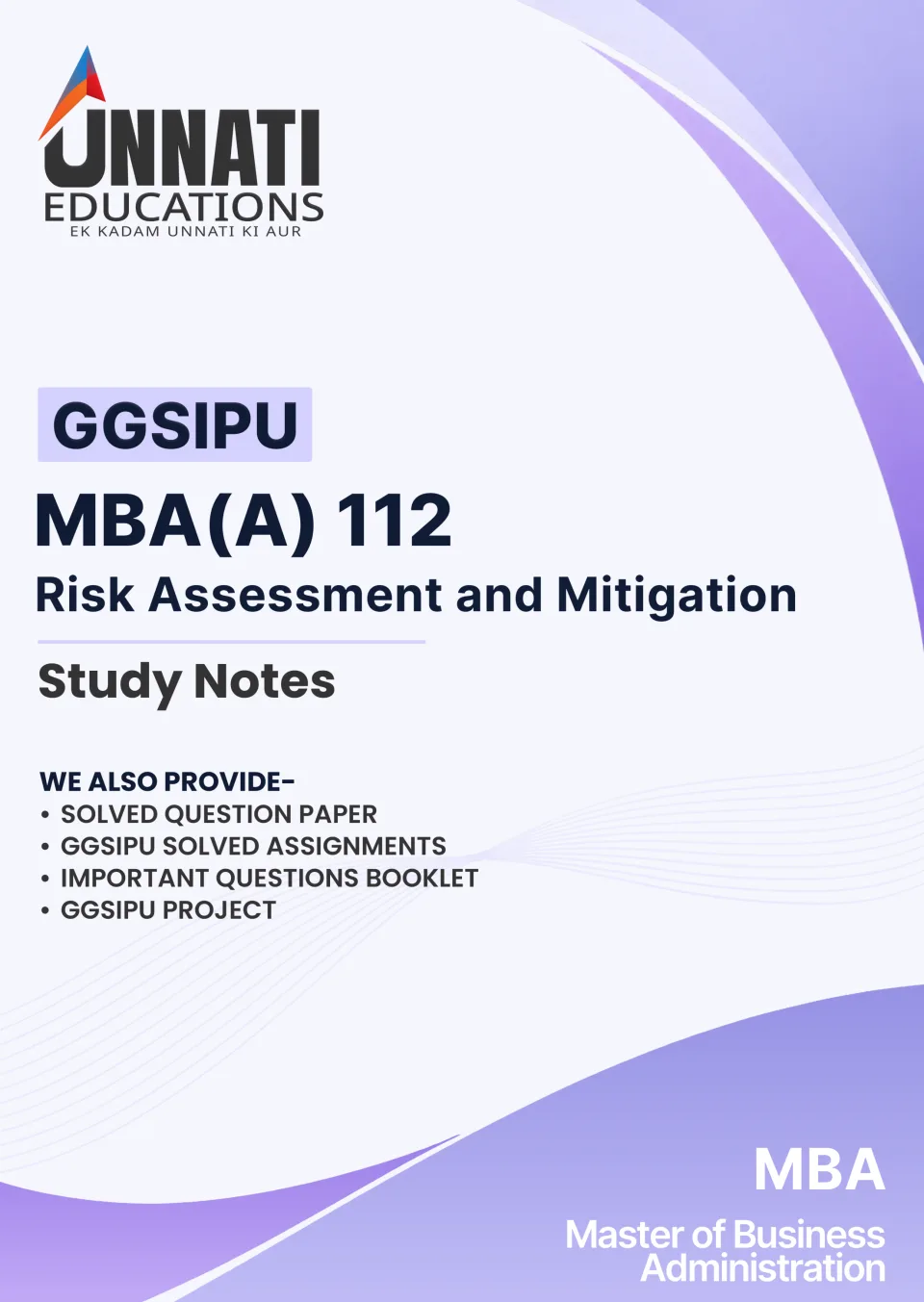
MBA(A) 112 Risk Assessment and Mitigation Notes from Unnati Educations cover all 4 units of this GGSIPU MBA (Analytics) Semester 2 core paper in 49 pages of content, with 26 worked illustrations, 18 figures and 60 exam-style questions. They follow the Scheme and Syllabus 2022-24 onwards. The full notes come as a printed book.
Written by Prateek Talwar, Founder, Unnati Educations · Reviewed by Sheetal Kirola, Academic Head, M.Ed. · Checked against the MBA (Analytics) Scheme and Syllabus 2022-24 onwards (Sem 1 and 2 approved 22.03.2023) · Updated 14 October 2026 · Editorial policy
Scheme: 2022-24 onwards | Applies to: batches under this scheme | Verified against: syllMBAAnalytics180225.pdf
MBA(A) 112 Risk Assessment and Mitigation at a glance: GGSIPU MBA (Analytics) Sem 2 credits, units and exam pattern
MBA(A) 112 teaches you to spot, measure, reduce and report the risk inside business algorithms such as credit-scoring models. These GGSIPU MBA (Analytics) Sem 2 Risk Assessment and Mitigation notes follow its four official units in order. It sits with ten other GGSIPU MBA (Analytics) Semester 2 papers.
Item | Official detail |
|---|---|
Code and title | MBA(A) 112 Risk Assessment and Mitigation (printed "MBA (A) - 112L" on its course page) |
Course and semester | MBA (Analytics), Semester 2 |
Category and credits | Core · 3 credits · L 3, T/P nil |
Teaching hours | 42 (10 + 10 + 11 + 11) |
Internal assessment | 25 marks: Class Test-I 15 + presentation / viva-voce / group discussion 10 |
End-term marks and pattern | Not printed in the official PDF |
Applies to | Scheme and Syllabus 2022-24 onwards |
Paired lab | None |
MBA(A) 112 snapshot from the official MBA (Analytics) scheme and syllabus
Item
Code and title
Official detail
MBA(A) 112 Risk Assessment and Mitigation (printed "MBA (A) - 112L" on its course page)
Item
Course and semester
Official detail
MBA (Analytics), Semester 2
Item
Category and credits
Official detail
Core · 3 credits · L 3, T/P nil
Item
Teaching hours
Official detail
42 (10 + 10 + 11 + 11)
Item
Internal assessment
Official detail
25 marks: Class Test-I 15 + presentation / viva-voce / group discussion 10
Item
End-term marks and pattern
Official detail
Not printed in the official PDF
Item
Applies to
Official detail
Scheme and Syllabus 2022-24 onwards
Item
Paired lab
Official detail
None
End-term and re-appear rules sit in Ordinance 11 (examinations and results).
MBA(A) 112 Risk Assessment and Mitigation Notes unit-wise: 26 worked illustrations and 60 exam questions across 4 units
The units form one chain: find what can go wrong, measure the deviation, choose controls, then act. Notes for every other paper sit under GGSIPU MBA (Analytics) notes.
MBA(A) 112 Unit 1: Introduction
Also covered as "Introduction to Algorithmic Risk", pages 4 to 17. It maps business and data risks, defines model risk through SR 11-7, and works through flawed data, flawed assumptions, coding errors and small samples, ending with the impact chain to rupee loss. Count: 3 illustrations, 7 figures, 2 case-study boxes.
Item | Model A (correct data) | Model B (flawed data) |
|---|---|---|
Defaulters approved | 100 | 200 |
Credit loss at ₹2,00,000 each | ₹2.00 crore | ₹4.00 crore |
Total cost of model errors | ₹3.90 crore | ₹5.90 crore |
Quick look: cost of a data flaw in a credit model, 10,000 applications (from page 15)
Item
Defaulters approved
Model A (correct data)
100
Model B (flawed data)
200
Item
Credit loss at ₹2,00,000 each
Model A (correct data)
₹2.00 crore
Model B (flawed data)
₹4.00 crore
Item
Total cost of model errors
Model A (correct data)
₹3.90 crore
Model B (flawed data)
₹5.90 crore
MBA(A) 112 Unit 2: Risk Estimation
Pages 18 to 30. You test a model with many inputs, measure deviation with RMSE, MAPE and the confusion matrix, then estimate risk with sensitivity and stress tests, Monte Carlo, VaR, the Kupiec test and PSI. Count: 11 illustrations, 4 figures.
Zone | Exceptions | Meaning |
|---|---|---|
Green | 0 to 4 | Model acceptable |
Yellow | 5 to 9 | Doubtful; capital add-on; review |
Red | 10 or more | Rejected; must be corrected |
Quick look: Basel traffic-light zones for a 99% VaR model over 250 days (from page 27)
Zone
Green
Exceptions
0 to 4
Meaning
Model acceptable
Zone
Yellow
Exceptions
5 to 9
Meaning
Doubtful; capital add-on; review
Zone
Red
Exceptions
10 or more
Meaning
Rejected; must be corrected
MBA(A) 112 Unit 3: Mitigation
Also covered as "Mitigation of Model Risk", pages 31 to 41. It covers residual risk, Paul Hopkin's 4 Ts and controls grouped by timing and model area. A 12-row table matches each model risk to its checks and measures, then data validation, assumption tests, parallel runs and monitoring triggers. Count: 7 illustrations, 3 figures, 1 case-study box.
Option | Cost (₹ lakh) | Residual loss (₹ lakh) | Within appetite? |
|---|---|---|---|
A: Automated data validation | 8 | 30 | No |
B: Independent validation + monitoring | 12 | 20 | No |
C: A + B together | 20 | 10 | Yes |
Quick look: choosing controls when inherent loss is ₹50 lakh and appetite is ₹15 lakh (from page 39)
Option
A: Automated data validation
Cost (₹ lakh)
8
Residual loss (₹ lakh)
30
Within appetite?
No
Option
B: Independent validation + monitoring
Cost (₹ lakh)
12
Residual loss (₹ lakh)
20
Within appetite?
No
Option
C: A + B together
Cost (₹ lakh)
20
Residual loss (₹ lakh)
10
Within appetite?
Yes
MBA(A) 112 Unit 4: Measures of Mitigation
Also covered as "Structured Corrective Action", pages 42 to 52. A finding becomes a CAPA item with severity, SMART action, owner, RACI roles, due date and success measure. Then come communication, escalation, closure and operational risk under the Basel event types. Count: 5 illustrations, 4 figures, 1 integrated NBFC case.
Severity | Typical deadline | Reported to |
|---|---|---|
High (Critical) | 30 days, plus an immediate interim measure | Board risk committee, CRO |
Medium | 90 days | Model risk committee, business head |
Low | 180 days | Model owner, validation team |
Quick look: severity rating and deadline for a corrective action (from page 43)
Severity
High (Critical)
Typical deadline
30 days, plus an immediate interim measure
Reported to
Board risk committee, CRO
Severity
Medium
Typical deadline
90 days
Reported to
Model risk committee, business head
Severity
Low
Typical deadline
180 days
Reported to
Model owner, validation team
MBA(A) 112 exam corner: 36 short-answer and 24 long-answer questions by unit
Each unit ends with nine short-answer (2 to 5 marks) and six long-answer (10 to 15 marks) practice questions, answered through the unit text.
Unit | Short answer (2–5 marks) | Long answer (10–15 marks) | Illustrations |
|---|---|---|---|
I | 9 | 6 | 3 |
II | 9 | 6 | 11 |
III | 9 | 6 | 7 |
IV | 9 | 6 | 5 |
MBA(A) 112 exam questions and worked illustrations by unit
Unit
I
Short answer (2–5 marks)
9
Long answer (10–15 marks)
6
Illustrations
3
Unit
II
Short answer (2–5 marks)
9
Long answer (10–15 marks)
6
Illustrations
11
Unit
III
Short answer (2–5 marks)
9
Long answer (10–15 marks)
6
Illustrations
7
Unit
IV
Short answer (2–5 marks)
9
Long answer (10–15 marks)
6
Illustrations
5
Unit I: A lender expects a 5% default rate. Find the sample for ±1% at 95% confidence. Pointer: n = Z² × p(1 − p) ÷ E² = 1,825 accounts.
Unit II: A ₹10 crore portfolio has daily σ = 1.2%. Find 1-day and 10-day 99% VaR. Pointer: ₹27.91 lakh, then × √10 = ₹88.26 lakh.
Unit III: What is the four-fifths rule? Pointer: a group approval-rate ratio below 0.80 signals possible adverse impact.
Unit IV: How are mitigation measures turned into structured corrective action? Pointer: the nine-step process plus a filled CAPA table.
The MBA(A) 112 notes list 36 short-answer and 24 long-answer questions across 4 units, plus 26 worked illustrations. More practice sits in the MBA(A) 112 important questions.
The 5 Whys for a PD model that underestimates defaults: excerpt from page 44 of the MBA(A) 112 notes
Excerpt from page 44
Root-cause analysis (RCA)
A corrective action works only if it removes the root cause, not just the symptom. Three simple tools are widely used for this: the 5 Whys, the fishbone diagram and Pareto analysis.
The 5 Whys
Keep asking "Why?" about five times until you reach the basic cause. The example below continues a case from Unit II, where a PD model predicted 10 defaults but 18 actually happened (z = 2.56).
Why were defaults higher than predicted? The model gave low PDs to new-to-credit, gig-economy borrowers.
Why were their PDs low? Declared income was the strongest variable, and it was high for this group.
Why was declared income misleading? It was self-declared and never verified for this segment.
Why was it not verified? The data-validation rule exempted loans below ₹2 lakh to speed up approval.
Why was this exemption not caught? It was added after validation, and the change was never reviewed by the risk team.
Root cause: weak change-management control over data-validation rules, not the model formula itself.
A symptom-level fix such as "recalibrate PD" would hide the problem until the next rule change. So the corrective action is to bring validation-rule changes under change management, while the correction is to recalibrate the model and re-score the affected segment.
Fishbone (Ishikawa) diagram
Possible causes are grouped under main categories. For a model failure, the traditional "6 M" headings are adapted to six groups:
Data: missing, stale, biased or leaked records
Method: wrong assumptions or technique
Machine / code: bugs, versions, deployment
People: skills, overrides, key-person dependence
Process: change control and validation gaps
Environment: economy, regulation, drift
All six branches point to one effect: the model output deviates from actuals. Drawing the diagram in a team meeting stops people from blaming the first cause they think of.
Pareto analysis (80/20 rule)
When there are many findings, a Pareto chart shows which few causes produce most of the problems, so corrective action is focused there first.
Do the MBA(A) 112 notes cover the full GGSIPU syllabus?
Yes. Every topic in the four official units of MBA(A) 112 has a matching section, and the course outcomes on business, data and operational risk are covered too.
Official unit | Official topics | Where in the notes | Status |
|---|---|---|---|
I Introduction | Factors contributing to algorithmic risk: flawed data or assumptions, coding errors, insufficient sample sizes; impact of risk factors on the outcome of the algorithmic model | Sections 6 to 12 (pp. 8 to 16) | Covered |
II Risk Estimation | Compute deviation from expected outcomes by testing with multiple inputs; techniques to estimate risks when the model deviates | Sections 2 to 9 (pp. 18 to 28) | Covered |
III Mitigation | Categorise mitigation measures for each type of model risk; select suitable checks and mitigation measures | Sections 2 to 3 (pp. 31 to 33); section 13 (pp. 38 to 39) | Covered |
IV Measures of Mitigation | Translate mitigation measures into a structured corrective action communicated to the organisation | Sections 2 to 7 (pp. 43 to 49) | Covered |
CO1 and CO4 | Business and data related risks; operational risk and countermeasures | Unit I section 2 (pp. 4 to 5); Unit IV section 8 (pp. 49 to 50) | Covered |
MBA(A) 112 official syllabus mapped to the notes
Official unit
I Introduction
Official topics
Factors contributing to algorithmic risk: flawed data or assumptions, coding errors, insufficient sample sizes; impact of risk factors on the outcome of the algorithmic model
Where in the notes
Sections 6 to 12 (pp. 8 to 16)
Status
Covered
Official unit
II Risk Estimation
Official topics
Compute deviation from expected outcomes by testing with multiple inputs; techniques to estimate risks when the model deviates
Where in the notes
Sections 2 to 9 (pp. 18 to 28)
Status
Covered
Official unit
III Mitigation
Official topics
Categorise mitigation measures for each type of model risk; select suitable checks and mitigation measures
Where in the notes
Sections 2 to 3 (pp. 31 to 33); section 13 (pp. 38 to 39)
Status
Covered
Official unit
IV Measures of Mitigation
Official topics
Translate mitigation measures into a structured corrective action communicated to the organisation
Where in the notes
Sections 2 to 7 (pp. 43 to 49)
Status
Covered
Official unit
CO1 and CO4
Official topics
Business and data related risks; operational risk and countermeasures
Where in the notes
Unit I section 2 (pp. 4 to 5); Unit IV section 8 (pp. 49 to 50)
Status
Covered
Verify it yourself: MBA (Analytics) Scheme and Syllabus 2022-24 onwards (PDF, ipu.ac.in).
The notes add the standard tools each official line needs, such as VaR and PSI under risk estimation. Every course in GGSIPU notes is mapped to its official PDF the same way.
Who writes and checks the MBA(A) 112 risk assessment notes?
Prateek Talwar, author: Founder, Unnati Educations. Associate Company Secretary (ACS), ICSI, membership no. 58704, since 15 May 2019; B.Com, University of Delhi (School of Open Learning), 2012. Wrote the MBA(A) 112 notes.
Sheetal Kirola, reviewer: Academic Head, Unnati Educations, M.Ed., 7 years of experience. Checked the units against the official course page.
The 2026-27 edition maps the 2022-24 onwards scheme. Last updated 14 October 2026; see our editorial policy.
The same team prepares GGSIPU important questions for every course.
MBA(A) 112 and the GGSIPU MBA (Analytics) Sem 2 papers it connects to
MBA(A) 112 has no paired lab; all credits are on the GGSIPU MBA (Analytics) syllabus page.
The MBA(A) 112 Risk Assessment and Mitigation IPU notes also help with these Sem 2 papers:
MBA(A) 104 Business Research: Unit II sample size uses the same n = Z²p(1 − p) ÷ E² formula as Unit I, page 12.
MBA(A) 102 Corporate Finance: Unit III sensitivity and scenario analysis match pages 21 to 23.
MBA(A) 108 Econometrics: Unit II tests for autocorrelation, heteroscedasticity and unit roots are the assumption checks on page 35.
MBA(A) 106 Data Visualization: reporting to the right audience mirrors page 47.
The other Sem 2 papers: MBA(A) 110 Business Performance Modelling, MBA(A) 114 Data Modelling with Python, MBA(A) 116 MOOCs/Open elective, MBA(A) 118 Minor Project, MBA(A) 152 Data Visualization Lab and MBA(A) 154 Data Modelling with Python Lab.
How to write MBA(A) 112 answers: risk-to-control tables, CAPA plans and rupee-value illustrations
MBA(A) 112 rewards structure. The four exam tips in the notes say the same thing: show risk, then check, then action, and put a number on it.
Unit I: for flawed data, write meaning plus GIGO, a table of data flaws, the six quality dimensions and the impact on outcome with one real example. End with how it is checked, linking to Unit III.
Unit II: RMSE is always at least MAE. If RMSE is much larger, say so: the model makes a few very large errors.
Unit III: for "categorise" questions, reproduce the risk, check and mitigation table for at least six risk types, then add the preventive, detective and corrective split.
Unit IV: include a CAPA table with owner, date and success measure, an audience-wise communication matrix and a short memo.
Worked example: residual risk after layered controls (from page 31)
A pricing model has an inherent expected loss of ₹50 lakh a year. A preventive data-validation check stops 60% of errors: 50 × 0.40 = ₹20 lakh. A detective daily check catches half the rest: 20 × 0.50 = ₹10 lakh. Control effectiveness = 1 − 10/50 = 80%. Write the formula first (residual risk = inherent risk × (1 − control effectiveness)), then the steps, then one line of meaning: layered controls beat any single control.
Two slips to avoid: judging a rare-event model by accuracy alone (calling everyone "non-default" scores 90% and catches nobody), and trusting in-sample error. Practise this format on GGSIPU MBA (Analytics) important questions.
MBA(A) 112 risk assessment notes FAQs
How do I get the full MBA(A) 112 notes?
Send a WhatsApp message to 9899436384 using the "Get Full Notes" button on this page. The MBA(A) 112 notes are sold as a printed book only and are not available as a PDF. Once your order is confirmed, the book reaches you within a maximum of 5 to 7 days, depending on your location.
Do the MBA(A) 112 notes follow the current MBA (Analytics) scheme?
Yes. The notes follow the MBA (Analytics) Scheme and Syllabus 2022-24 onwards, whose first and second semesters were approved by the Academic Council on 22.03.2023. The unit titles, Introduction, Risk Estimation, Mitigation and Measures of Mitigation, match the official course page. If your institute notifies a revised syllabus, compare its MBA(A) 112 page with the syllabus table above.
Which MBA(A) 112 unit has the most numericals?
Unit II, Risk Estimation, has 11 of the 26 worked illustrations. They cover forecast errors, a credit confusion matrix, sensitivity and scenarios for a profit model, Monte Carlo simulation, parametric and historical VaR, the Kupiec test, model-based test cases and software estimation error. Unit III follows with 7, mostly on residual risk, control selection and data-quality scoring.
How many marks is MBA(A) 112 out of, and what is the passing mark?
The official MBA (Analytics) PDF prints internal assessment for MBA(A) 112 out of 25 marks: Class Test-I for 15 and an individual presentation, viva-voce or group discussion for 10. It does not print the end-term marks or a pass percentage for this paper. For end-term minimums and re-appear rules, read GGSIPU Ordinance 11 on ipu.ac.in and your institute's notices.
Is MBA(A) 112 a coding paper?
No. MBA(A) 112 is a 3-credit core theory paper with no lab attached. The notes show where Excel, R and Python help, for example =NORM.INV(RAND(),μ,σ) for simulation or sklearn for a confusion matrix, in one tools table on page 29. Answers are written as concepts, tables and numericals worked by hand, not as programs, so coding is not needed.
Do the MBA(A) 112 notes give answers to the important exam questions?
The 60 questions at the end of the units are practice questions without separate model answers. Each maps to a unit section, so you build the answer from its text, tables and illustration. Three numericals print final answers: sample size (1,825 accounts), forecast error measures (ME 1.67, RMSE 6.43) and 1-day and 10-day 99% VaR for a ₹10 crore portfolio.
Get the full MBA(A) 112 Risk Assessment and Mitigation Notes on WhatsApp
The full Risk Assessment and Mitigation notes in English run to 53 pages with cover and index, sold as a printed book only, not as a PDF.
Unit | Pages in the book |
|---|---|
I Introduction | 4 to 17 (14) |
II Risk Estimation | 18 to 30 (13) |
III Mitigation | 31 to 41 (11) |
IV Measures of Mitigation | 42 to 52 (11) |
MBA(A) 112 notes: pages by unit
Unit
I Introduction
Pages in the book
4 to 17 (14)
Unit
II Risk Estimation
Pages in the book
18 to 30 (13)
Unit
III Mitigation
Pages in the book
31 to 41 (11)
Unit
IV Measures of Mitigation
Pages in the book
42 to 52 (11)
Delivery: a maximum of 5 to 7 days after your order is confirmed, depending on your location.
Order the MBA(A) 112 printed notes book on WhatsApp (4 units, 53 pages)
Unnati Educations is an independent education provider based in Vikaspuri, Delhi. We are not affiliated with, authorised by, or endorsed by Guru Gobind Singh Indraprastha University (GGSIPU). 'GGSIPU' and 'IPU' are used only to describe the syllabus our notes follow. For official information, visit ipu.ac.in.
Ready for the full notes?
Discuss coverage and delivery with our team.