
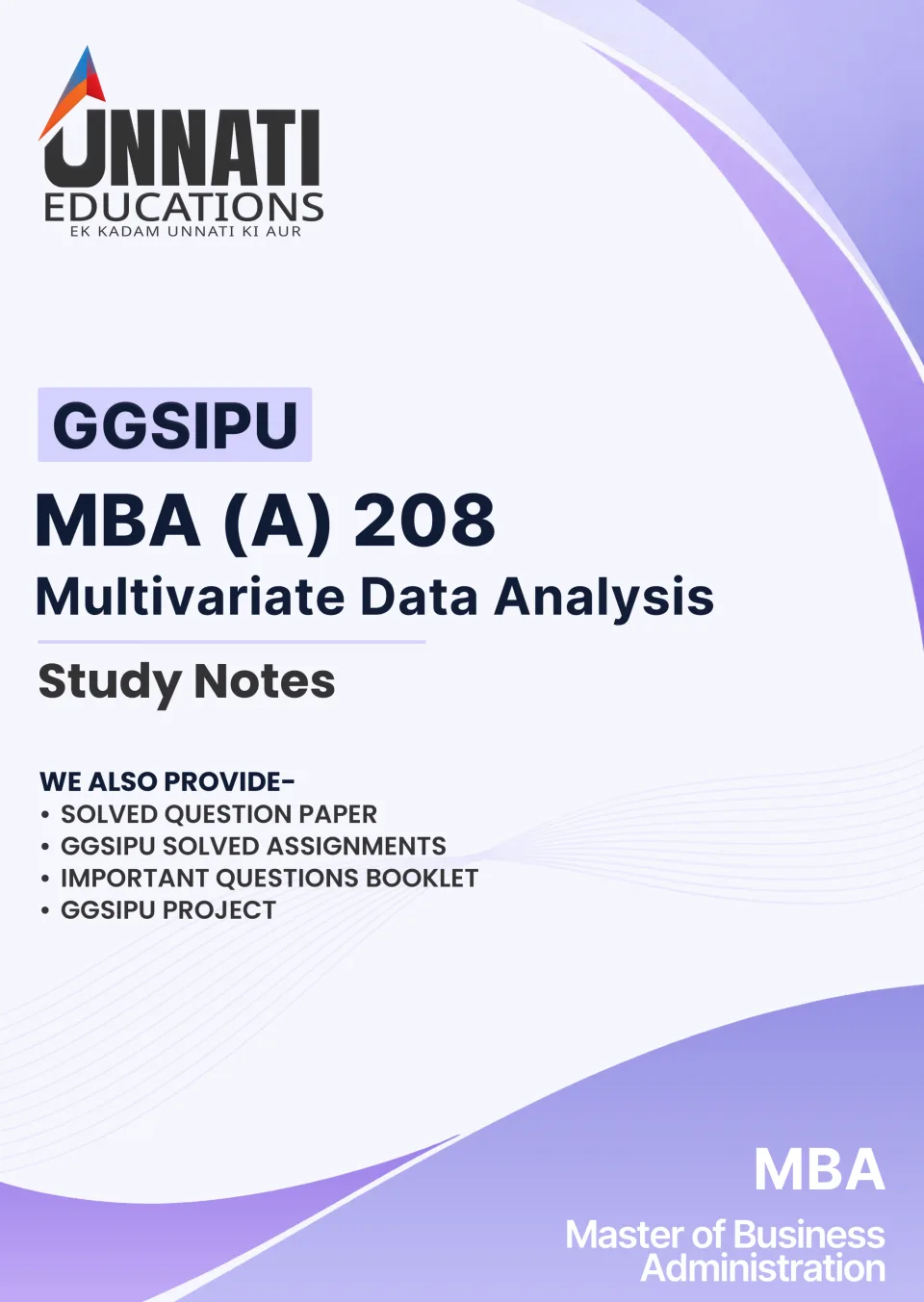
MBA(A) 208 Multivariate Data Analysis Notes from Unnati Educations cover all four units of this GGSIPU MBA (Analytics) Semester 4 core paper in one 89-page printed book: 28 solved illustrations, 39 figures and 63 exam-style questions, from bubble plots and Q-Q plots to path coefficients and SEM fit indices. The syllabus applies to the 2022-24 batch onwards.
Written by Prateek Talwar, Founder, Unnati Educations (ACS) · Reviewed by Sheetal Kirola, Academic Head, M.Ed. · Checked against syllMBAAnalytics180225.pdf · Updated 26 October 2026 · Editorial policy
Scheme: MBA (Analytics) Scheme and Syllabus 2022-24 onwards | Applies to: batch 2022-24 onwards | Verified against: syllMBAAnalytics180225.pdf (Semesters 3-4 approved 19.07.2023)
MBA(A) 208 Multivariate Data Analysis at a glance: GGSIPU MBA (Analytics) Sem 4 credits, units and exam pattern
| Course and semester | MBA (Analytics), Fourth Semester |
| Category and credits | Core · L 3, no T/P · 3 credits · 42 lecture hours (10 + 12 + 10 + 10) |
| Internal assessment | 25 marks: Class Test-I 15 + presentation, viva-voce or group discussion 10 |
| End-term marks and pattern | Not printed in the official PDF |
| Applies to | Scheme and Syllabus 2022-24 onwards |
| Units | 4 |
| Paired lab | None |
Its four course outcomes ask for business use of multivariate analysis, hands-on projects, time- and cost-efficient planning, and awareness of model development and validation. The PDF states that the scheme follows Ordinance 11 on examinations.
MBA(A) 208 is the only core paper this term; codes, credits and electives for the rest are on the GGSIPU MBA (Analytics) Semester 4 papers page.
MBA(A) 208 Multivariate Data Analysis Notes unit-wise: 28 solved illustrations and 39 figures across 4 units
These MBA(A) 208 Multivariate Data Analysis IPU notes move from describing many variables, to shrinking and grouping them, to testing models and SEM. Each unit ends with a revision table and question list. Other papers: GGSIPU MBA (Analytics) notes.
MBA(A) 208 Unit 1: Exploratory Data Analysis
Pages 5-26. The variate, the n × p data matrix and the dependence vs interdependence split come first. One five-store data set (ad spend, sales, price) then runs through the mean vector, covariance and correlation matrices and Mahalanobis distance. Enhanced scatterplots and Q-Q and chi-square plots close the unit. 33 sub-sections, 5 solved illustrations, 9 figures, 16 exam questions.
| Total variance, trace(S) = 10 + 142.5 + 8.5 | 161 |
| Generalised variance |S| | 7.5 |
| |R|, close to 0 = near-perfect multicollinearity | 0.0006 |
MBA(A) 208 Unit 2: Exploratory Multivariate Techniques
Pages 27-49, the longest unit. PCA covers eigenvalues, loadings, scores, the scree plot and the biplot. Correspondence analysis is worked on a brand-by-attribute table, then MDS with Kruskal's stress, then cluster analysis with five linkage methods, dendrograms, K-means and the elbow method. 39 sub-sections, 7 solved illustrations, 13 figures, 16 exam questions.
Quick look: principal components of S = [5 2; 2 2] (from page 30)
- |S − λI| = 0 gives λ² − 7λ + 6 = 0, so λ1 = 6, λ2 = 1.
- Eigenvector for λ1: (0.894, 0.447), so Y1 = 0.894X1 + 0.447X2.
- PC1 explains 6 ÷ 7 = 85.7% of total variance.
MBA(A) 208 Unit 3: Confirmatory Multivariate Techniques
Pages 50-70. The generalized linear model is built from its three parts, then logistic and Poisson regression show the link function at work. Least-squares regression, one-way MANOVA with Wilks' Lambda, log-linear models with G² selection, and Markov chains follow. 21 sub-sections, 9 solved illustrations (the most of any unit), 8 figures, 15 exam questions.
| Income | η | p (buys premium plan) |
|---|---|---|
| ₹30,000 | −1.6 | 0.168 |
| ₹50,000 | 0 | 0.50 |
| ₹70,000 | 1.6 | 0.832 |
Quick look: logit(p) = −4 + 0.08 × Income (from page 54)
- Income
- ₹30,000
- η
- −1.6
- p (buys premium plan)
- 0.168
- Income
- ₹50,000
- η
- 0
- p (buys premium plan)
- 0.50
- Income
- ₹70,000
- η
- 1.6
- p (buys premium plan)
- 0.832
MBA(A) 208 Unit 4: Structural Equation Models and Path Analysis
Pages 71-88. SEM terms come first, then EFA steps, rotation, and CR, AVE and HTMT for the measurement model. Path analysis uses Wright's tracing rules and mediation, followed by path diagram symbols and a service quality, satisfaction and loyalty SEM. 31 sub-sections, 7 solved illustrations, 9 figures, 16 exam questions.
| Direct effect p31 | 0.333 |
| Indirect p21 × p32 = 0.50 × 0.533 | 0.267 |
| Total (= r13); 44% mediated | 0.600 |
Fit indices for structural equation models: excerpt from page 85 of the MBA(A) 208 notes
Excerpt from page 85
Why one fit index is never enough
After an SEM is estimated, the question is whether the model-implied covariance matrix is close enough to the sample covariance matrix. No single number answers this well, so researchers report a family of indices: absolute fit, incremental fit (improvement over a null model with no relationships) and parsimony-adjusted measures. Each family answers a different question, so a sound report quotes at least one index from each.
The main indices and their cut-offs
The chi-square test checks whether the model fits perfectly; non-significance (p > 0.05) is ideal, but large samples make chi-square significant almost automatically. Divided by its degrees of freedom it becomes the normed chi-square: below 3 is good, below 5 acceptable. RMSEA, the error of approximation per degree of freedom, is good at 0.06 or less, acceptable up to 0.08 and poor above 0.10.
SRMR, the average standardised residual, should be 0.08 or less; GFI should reach 0.90 and AGFI 0.80. NFI should be at least 0.90, while CFI and TLI need 0.95 for good fit and 0.90 for acceptable fit. AIC and BIC have no cut-off: the smaller value wins when models are compared.
Worked case: a 15-item CFA model
A 15-item confirmatory factor model is estimated on 300 respondents: χ² = 180 with 84 degrees of freedom. The null model gives χ² = 2,400 with 105 degrees of freedom.
| Index | Working | Value | Verdict |
|---|---|---|---|
| χ²/df | 180 ÷ 84 | 2.14 | Good |
| RMSEA | √[(180 − 84) ÷ (84 × 299)] | 0.062 | Acceptable |
| CFI | 1 − (180 − 84) ÷ (2,400 − 105) | 0.958 | Good |
| TLI | (22.857 − 2.143) ÷ (22.857 − 1) | 0.948 | Acceptable |
| NFI | (2,400 − 180) ÷ 2,400 | 0.925 | Good |
Fit indices for the 15-item CFA model (excerpt, page 85)
- Index
- χ²/df
- Working
- 180 ÷ 84
- Value
- 2.14
- Verdict
- Good
- Index
- RMSEA
- Working
- √[(180 − 84) ÷ (84 × 299)]
- Value
- 0.062
- Verdict
- Acceptable
- Index
- CFI
- Working
- 1 − (180 − 84) ÷ (2,400 − 105)
- Value
- 0.958
- Verdict
- Good
- Index
- TLI
- Working
- (22.857 − 2.143) ÷ (22.857 − 1)
- Value
- 0.948
- Verdict
- Acceptable
- Index
- NFI
- Working
- (2,400 − 180) ÷ 2,400
- Value
- 0.925
- Verdict
- Good
The chi-square is significant, as is common with 300 cases, but the other indices together show an acceptable-to-good fit, so the model can be retained.
MBA(A) 208 exam corner: 40 two-to-five-mark and 23 ten-to-fifteen-mark questions by unit
Each unit ends with "Important Exam Questions": short answers marked "2–5 Marks" and long answers marked "10–15 Marks". These are exam-style practice questions; the answers sit in that unit's sections.
| Unit | 2–5 Marks | 10–15 Marks | Solved illustrations |
|---|---|---|---|
| Unit 1 | 10 | 6 | 5 |
| Unit 2 | 10 | 6 | 7 |
| Unit 3 | 10 | 5 | 9 |
| Unit 4 | 10 | 6 | 7 |
MBA(A) 208 questions and solved illustrations by unit
- Unit
- Unit 1
- 2–5 Marks
- 10
- 10–15 Marks
- 6
- Solved illustrations
- 5
- Unit
- Unit 2
- 2–5 Marks
- 10
- 10–15 Marks
- 6
- Solved illustrations
- 7
- Unit
- Unit 3
- 2–5 Marks
- 10
- 10–15 Marks
- 5
- Solved illustrations
- 9
- Unit
- Unit 4
- 2–5 Marks
- 10
- 10–15 Marks
- 6
- Solved illustrations
- 7
The MBA(A) 208 notes list 40 short-answer and 23 long-answer exam questions across 4 units, plus 28 solved illustrations.
- Unit 1: Why is Mahalanobis distance preferred to Euclidean distance? Pointer: d² = (x − x̄)′S⁻¹(x − x̄) adjusts for scale and correlation; the store values (0.53 to 2.13) stay below the 9.21 cut-off (page 12).
- Unit 2: What is stress in MDS? Pointer: quote Kruskal's 0.20 poor to 0 perfect scale and pick dimensions at the elbow (page 40).
- Unit 3: Why MANOVA instead of separate ANOVAs? Pointer: four 5% tests push Type I error to about 18.5% (page 58).
- Unit 4: Explain CR and AVE. Pointer: formulas, cut-offs 0.7 and 0.5, then Fornell-Larcker (page 76).
More practice with fuller answers will sit in the MBA(A) 208 important questions.
Who writes and checks the MBA(A) 208 multivariate analysis notes?
- Prateek Talwar, author: Founder, Unnati Educations · Associate Company Secretary (ACS), ICSI, membership no. 58704, since 15 May 2019 · B.Com, University of Delhi (SOL), 2012 · profile. Wrote all four MBA(A) 208 units.
- Sheetal Kirola, reviewer: Academic Head, Unnati Educations · M.Ed. · 7 years of experience · profile. Reviewed unit order and the clarity of definitions, tables and figures.
The 2026-27 edition of these GGSIPU MBA (Analytics) Sem 4 Multivariate Data Analysis notes is mapped to the Scheme and Syllabus 2022-24 onwards and includes the five-store data set, the CR and AVE case and the fit-index case. Last updated 26 October 2026 (editorial policy).
The same team prepares GGSIPU important questions for every course it covers.
Do the MBA(A) 208 notes cover the full GGSIPU syllabus?
Yes. Every topic in the four official units of MBA(A) 208 has its own section in the notes; no gap was found.
| Official unit | Official topics | Notes | Status |
|---|---|---|---|
| I: Exploratory Data Analysis | Basic multivariate statistics: mean, variance, covariance, correlation; aims: data exploration and inference; enhanced scatterplots: bubble plots, smoothing, density estimates, bivariate boxplots; probability plots: quantile and normal plots | Sections 1-5, pp. 5-24 | Covered |
| II: Exploratory Multivariate Techniques | PCA: data dimension reduction, linear combination of variables, eigenvalues and vectors, loadings; correspondence analysis: two-dimensional tables, multiple correspondence analysis; multidimensional scaling; cluster analysis | Sections 1-5, pp. 27-47 | Covered |
| III: Confirmatory Multivariate Techniques | Generalized linear models: linear and non-linear models, link function and error distribution; regression and MANOVA; log-linear models; categorical and binary response, sampling scheme, likelihood function, model selection; transition models: longitudinal study, Markov chains | Sections 1-5, pp. 50-68 | Covered |
| IV: Structural Equation Models and path analysis | Basic factor analysis; path analysis; path diagrams; structural equation models; assessment of fit | Sections 1-6, pp. 71-86 | Covered |
Official MBA(A) 208 syllabus mapped to the notes
- Official unit
- I: Exploratory Data Analysis
- Official topics
- Basic multivariate statistics: mean, variance, covariance, correlation; aims: data exploration and inference; enhanced scatterplots: bubble plots, smoothing, density estimates, bivariate boxplots; probability plots: quantile and normal plots
- Notes
- Sections 1-5, pp. 5-24
- Status
- Covered
- Official unit
- II: Exploratory Multivariate Techniques
- Official topics
- PCA: data dimension reduction, linear combination of variables, eigenvalues and vectors, loadings; correspondence analysis: two-dimensional tables, multiple correspondence analysis; multidimensional scaling; cluster analysis
- Notes
- Sections 1-5, pp. 27-47
- Status
- Covered
- Official unit
- III: Confirmatory Multivariate Techniques
- Official topics
- Generalized linear models: linear and non-linear models, link function and error distribution; regression and MANOVA; log-linear models; categorical and binary response, sampling scheme, likelihood function, model selection; transition models: longitudinal study, Markov chains
- Notes
- Sections 1-5, pp. 50-68
- Status
- Covered
- Official unit
- IV: Structural Equation Models and path analysis
- Official topics
- Basic factor analysis; path analysis; path diagrams; structural equation models; assessment of fit
- Notes
- Sections 1-6, pp. 71-86
- Status
- Covered
Official source: MBA (Analytics) Scheme and Syllabus 2022-24 onwards (PDF), pages 85-86.
Every course in GGSIPU notes is mapped to its official PDF the same way.
How to write MBA(A) 208 answers: formula-first short notes, matrix numericals and diagram-led ten-mark answers
MBA(A) 208 questions mix theory and calculation, and the exam tips in the notes follow one pattern: define, write the formula, show it on a small data set, then interpret.
1. Classify with a diagram. For "classify multivariate techniques", draw Figure 1.1 and give both the dependence and interdependence tables with at least four techniques each, naming whether the dependent variable is metric or non-metric (page 7).
2. Sketch, do not paint. A bivariate boxplot needs only two tilted ellipses, a "+" at the centre and a few "×" outliers, labelled hinge (50%) and fence (page 21).
3. Show every table in a numerical. In correspondence analysis, compute row profiles, expected frequencies and total inertia (χ² ÷ n), then sketch the map and say which brand sits with which attribute (page 37).
4. State the direction of a statistic. Wilks' Lambda runs the other way round: a smaller Λ means bigger group differences. Write Λ = |W| ÷ |B + W| and add that it lies between 0 and 1 (page 61).
Worked example (page 11). Asked for the correlation between ad spend and sales in the store data, write r12 = s12 ÷ (s1 × s2) = 37.5 ÷ (3.162 × 11.937) = 0.993. Then add the line examiners look for: such a high correlation between two predictors signals multicollinearity before any regression is run. That sentence turns plain arithmetic into a proper analytics answer.
A common slip in Unit 1 answers is to quote total variance (161 for the store data) as the spread of the data cloud; the generalised variance (7.5) is the measure that accounts for correlation.
Practise the define, formula, numbers, interpretation format on GGSIPU MBA (Analytics) important questions.
MBA(A) 208 and the GGSIPU MBA (Analytics) Sem 4 papers it connects to
MBA(A) 208 has no paired lab; its place in the programme is clearest in the GGSIPU MBA (Analytics) syllabus.
Same-semester papers: MBA(A) 202 Major Project Report, MBA(A) 204 Project Management, MBA(A) 206 Ancient Management Philosophy and Indian Ethos (NUES), and Electives III and IV.
- Unit 4 (CR, AVE, SEM) → MBA(A) 202 Major Project Report: survey-based projects need these checks.
- Unit 2 (cluster analysis, MDS maps) → MBA(A) 216 Marketing Analytics: segmentation and positioning.
- Unit 4 (training, skill, performance path model) → MBA(A) 210 Strategic HR Analytics.
MBA(A) 208 multivariate analysis notes FAQs
How do I get the full MBA(A) 208 notes?
Tap the "Get Full Notes" button to message 9899436384 on WhatsApp. The full MBA(A) 208 notes are sold as a printed book only; they are not available as a PDF. Delivery takes a maximum of 5-7 days, and the exact time depends on your location. Mention your course, semester and paper code so the right book is sent.
How is MBA(A) 208 marked, and what is the passing mark?
The official MBA (Analytics) scheme fixes internal assessment at 25 marks: Class Test-I for 15 and a presentation, viva-voce or group discussion for 10. The same PDF does not print the end-term marks or a pass percentage for MBA(A) 208, so we do not quote one. End-term minimums and re-appear rules are set by Ordinance 11 on ipu.ac.in.
Which MBA(A) 208 unit has the most solved illustrations?
Unit 3, Confirmatory Multivariate Techniques, has 9 of the 28 solved illustrations in the MBA(A) 208 notes: a logistic probability, a Poisson complaint count, a least-squares line, a one-way MANOVA on ad formats, a likelihood case, two log-linear tests, a log-linear trend and a brand-switching Markov chain. Units 2 and 4 have 7 each; Unit 1 has 5.
Do I need SPSS, R or AMOS to study MBA(A) 208 from these notes?
No. The MBA(A) 208 notes work every illustration by hand on small data sets, such as a 2 × 2 covariance matrix or five customers on two variables. Where software matters, they show how to read typical output, like a PCA eigenvalue table, and compare CB-SEM in AMOS or LISREL with PLS-SEM in SmartPLS. They are study notes, not a software manual.
Which batch does the MBA(A) 208 syllabus in these notes apply to?
The notes follow the MBA (Analytics) Scheme and Syllabus marked "2022-24 onwards". Its first and second semesters were approved by the Academic Council on 22.03.2023 and its third and fourth semesters on 19.07.2023. If your institute has issued a newer MBA(A) 208 syllabus, compare its unit list with the coverage table above before ordering.
Is MBA(A) 208 a theory paper or does it have a practical?
MBA(A) 208 is a core theory paper with 3 lecture hours a week and 3 credits; the scheme lists no tutorial or practical hours and no paired lab. Its course outcomes still ask for hands-on project work, which is why the notes use business data such as store sales, financial ratios and customer surveys for each technique.
Get the full MBA(A) 208 Multivariate Data Analysis Notes on WhatsApp
| Unit | Pages | Solved illustrations |
|---|---|---|
| Unit 1 | 22 | 5 |
| Unit 2 | 23 | 7 |
| Unit 3 | 21 | 9 |
| Unit 4 | 18 | 7 |
Inside the printed MBA(A) 208 notes book
- Unit
- Unit 1
- Pages
- 22
- Solved illustrations
- 5
- Unit
- Unit 2
- Pages
- 23
- Solved illustrations
- 7
- Unit
- Unit 3
- Pages
- 21
- Solved illustrations
- 9
- Unit
- Unit 4
- Pages
- 18
- Solved illustrations
- 7
Format: printed Multivariate Data Analysis notes in English, 89 pages, 39 figures and a revision table per unit. Not available as a PDF. Delivery: a maximum of 5-7 days; the rest depends on your location.
Order the MBA(A) 208 notes book on WhatsApp (4 units, 89 pages)
Unnati Educations is an independent education provider based in Vikaspuri, Delhi. We are not affiliated with, authorised by, or endorsed by Guru Gobind Singh Indraprastha University (GGSIPU). 'GGSIPU' and 'IPU' are used only to describe the syllabus our notes follow. For official information, visit ipu.ac.in.
Ready for the full notes?
Discuss coverage and delivery with our team.