
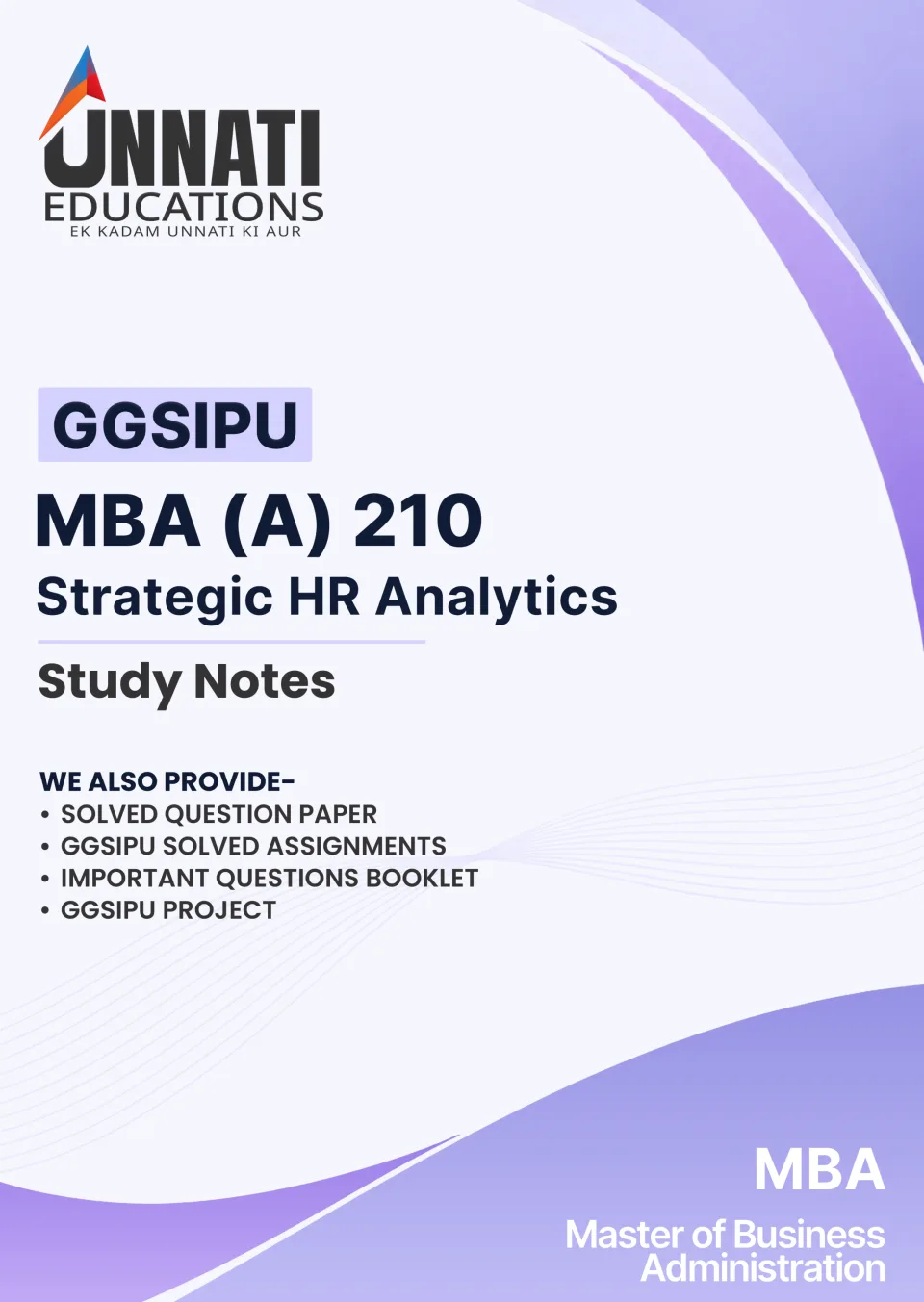
MBA(A) 210 Strategic HR Analytics Notes cover all 4 units of the GGSIPU MBA (Analytics) Semester 4 HR elective in a 69-page book, with 27 solved illustrations, 5 case studies, 24 figures and 64 exam questions. They follow the official Scheme and Syllabus 2022-24 onwards.
Written by Prateek Talwar, Founder, Unnati Educations (ACS, B.Com) · Reviewed by Sheetal Kirola, Academic Head, M.Ed. · Checked against syllMBAAnalytics180225.pdf · Updated 26 October 2026 · Editorial policy
Scheme: MBA (Analytics) Scheme and Syllabus 2022-24 onwards | Applies to: 2022-24 onwards batches (Sem 3 and 4 approved 19.07.2023) | Verified against: syllMBAAnalytics180225.pdf
MBA(A) 210 Strategic HR Analytics at a glance: GGSIPU MBA (Analytics) Sem 4 credits, units and exam pattern
This is an HR-stream elective in Semester 4 of the GGSIPU MBA (Analytics) programme. The official PDF prints the code as MBA (A)-210 on the syllabus page and MBA(A) 210 in the scheme table.
| Item | Official detail |
|---|---|
| Course and semester | MBA (Analytics), Semester 4, Electives of HR (with MBA(A) 212 and 214) |
| Category and credits | Skill Enhancement elective · L 3 · 3 credits · 42 hours (11 + 10 + 10 + 11) |
| Internal assessment | 25 marks: Class Test-I 15 + presentation, viva-voce or group discussion 10 |
| End-term marks and pattern | Not printed in the official PDF (scheme follows Ordinance 11) |
| Applies to | Scheme and Syllabus 2022-24 onwards |
| Units | 4 |
| Paired lab | None |
MBA(A) 210 snapshot from the official MBA (Analytics) scheme and syllabus PDF
- Item
- Course and semester
- Official detail
- MBA (Analytics), Semester 4, Electives of HR (with MBA(A) 212 and 214)
- Item
- Category and credits
- Official detail
- Skill Enhancement elective · L 3 · 3 credits · 42 hours (11 + 10 + 10 + 11)
- Item
- Internal assessment
- Official detail
- 25 marks: Class Test-I 15 + presentation, viva-voce or group discussion 10
- Item
- End-term marks and pattern
- Official detail
- Not printed in the official PDF (scheme follows Ordinance 11)
- Item
- Applies to
- Official detail
- Scheme and Syllabus 2022-24 onwards
- Item
- Units
- Official detail
- 4
- Item
- Paired lab
- Official detail
- None
End-term rules sit in Ordinance 11 (ipu.ac.in). Students choose two electives from their stream for the Elective III and IV slots, listed with the core papers under GGSIPU MBA (Analytics) Semester 4 papers.
MBA(A) 210 Strategic HR Analytics Notes unit-wise: 27 solved illustrations and 5 case studies across 4 units
Each unit ends with a Quick Revision table and exam questions. Notes for the other papers are under GGSIPU MBA (Analytics) notes.
MBA(A) 210 Unit 1: Making HR Measurement Strategic
Explains why activity-counting HR reports "hit the wall", then builds Talentship, HC BRidge, LAMP, the HR Scorecard and Bersin's four maturity levels. It closes with correlation, regression, research design, significance, reliability and validity.
Pages 5 to 22 · 7 sections · 4 solved illustrations · 2 case studies · 7 figures · 16 exam questions.
| Measure | Working (₹ crore, 2,500 FTEs) | Result |
|---|---|---|
| Adjusted profit | 500 − (400 − 150) | ₹250 crore |
| HCVA | 250 crore ÷ 2,500 | ₹10 lakh per employee |
| HCROI | 250 ÷ 150 | 1.67 per ₹1 of pay |
Quick look: Fitz-enz human capital measures (from page 14)
- Measure
- Adjusted profit
- Working (₹ crore, 2,500 FTEs)
- 500 − (400 − 150)
- Result
- ₹250 crore
- Measure
- HCVA
- Working (₹ crore, 2,500 FTEs)
- 250 crore ÷ 2,500
- Result
- ₹10 lakh per employee
- Measure
- HCROI
- Working (₹ crore, 2,500 FTEs)
- 250 ÷ 150
- Result
- 1.67 per ₹1 of pay
MBA(A) 210 Unit 2: Measurement of Costs
Puts a rupee value on absenteeism (the eight-step Cascio and Boudreau method), presenteeism (Stanford Presenteeism Scale, WLQ, WHO-HPQ, WPAI) and turnover, from separation costs to leaver-versus-replacement performance gaps, with separate rates for pivotal talent pools.
Pages 23 to 40 · 14 sections · 8 solved illustrations, the largest a ₹1.62 crore turnover costing (page 37) · 1 case study · 7 figures · 16 exam questions.
| Measure | Working | Result |
|---|---|---|
| Overall turnover | 120 ÷ 850 × 100 | 14.12% |
| First-year turnover | 40 ÷ 220 × 100 | 18.18% |
| Retention rate | 700 ÷ 800 × 100 | 87.50% |
Quick look: turnover rates, 800 opening and 900 closing staff (from page 33)
- Measure
- Overall turnover
- Working
- 120 ÷ 850 × 100
- Result
- 14.12%
- Measure
- First-year turnover
- Working
- 40 ÷ 220 × 100
- Result
- 18.18%
- Measure
- Retention rate
- Working
- 700 ÷ 800 × 100
- Result
- 87.50%
MBA(A) 210 Unit 3: Employee Wellness and Welfare
Treats employee health as a business cost: worksite health promotion (WHP) and O'Donnell's three levels, medical inflation of about 12 to 14% a year in India, cost-shifting versus prevention, and Edington's "don't get worse" risk groups. WHP is judged through cost-effectiveness, ROI, NPV and break-even analysis.
Pages 41 to 54 · 8 sections · 5 solved illustrations, including a difference-in-differences check on self-selection (page 49) · 1 case study · 7 figures · 16 exam questions.
| Programme | Cost | Quitters | Cost per quitter |
|---|---|---|---|
| A: group counselling | ₹3,00,000 | 30 | ₹10,000 |
| B: counselling + nicotine replacement + incentives | ₹5,00,000 | 40 | ₹12,500 |
| B over A | ₹2,00,000 | 10 more | ₹20,000 per extra quitter |
Quick look: two smoking-cessation programmes compared (from page 47)
- Programme
- A: group counselling
- Cost
- ₹3,00,000
- Quitters
- 30
- Cost per quitter
- ₹10,000
- Programme
- B: counselling + nicotine replacement + incentives
- Cost
- ₹5,00,000
- Quitters
- 40
- Cost per quitter
- ₹12,500
- Programme
- B over A
- Cost
- ₹2,00,000
- Quitters
- 10 more
- Cost per quitter
- ₹20,000 per extra quitter
MBA(A) 210 Unit 4: Measuring Job Performance
The most numerical unit. It solves six ways to estimate SDy, the rupee standard deviation of job performance, from the 40% rule to CREPID, then applies the utility formula to training with Boudreau's adjustments and ends with Kirkpatrick and Phillips evaluation.
Pages 55 to 68 · 6 sections · 10 solved illustrations · 1 case study · 3 figures · 16 exam questions.
Quick look: utility of training 100 sales executives (from page 61)
- N = 100, T = 2 years, dt = 0.50, SDy = ₹2,40,000, C = ₹20,000.
- Gross gain = 100 × 2 × 0.50 × 2,40,000 = ₹2.4 crore; cost = ₹20 lakh.
- ΔU = ₹2.2 crore; Boudreau's adjustments (page 62) roughly halve it.
Bradford Factor and absence measures in HR analytics: excerpt from page 26 of the MBA(A) 210 notes
Excerpt from page 26
Common absence measures
Absence data become useful only when they are turned into standard measures. The absence (lost-time) rate is days lost ÷ (average employees × scheduled working days) × 100, the share of scheduled time that is lost. The frequency rate counts spells of absence per employee, so it tells how often people are away.
The severity rate divides days lost by employees or by spells, so it tells how long each absence lasts. An individual absence rate tracks one person's record, while absence cost per employee and absence cost as a % of payroll show the financial burden.
The Bradford Factor
The Bradford Factor, developed at the Bradford University School of Management in the UK, starts from a simple observation: frequent short, unplanned absences disrupt work more than one long absence, because nobody can plan for them. It therefore squares the number of spells: B = S² × D, where S is the number of separate spells in a rolling 52-week period and D is the total days absent.
Illustration: three employees, ten days each
Employee A had one illness lasting 10 days: B = 1 × 10 = 10. Employee B was away in 5 spells of 2 days: B = 25 × 10 = 250. Employee C took 10 single days off, mostly Mondays: B = 100 × 10 = 1,000. All three lost exactly 10 days, yet C's pattern is the most disruptive, and the score makes that visible.
Using the score fairly
Many firms set trigger points, for example 51 for an informal talk, 201 for a written warning and 501 for a final review. The notes add a caution: genuine chronic illness and disability must be treated fairly and in line with the law, so the score starts a conversation rather than deciding a penalty.
How to write MBA(A) 210 answers: rupee cost tables, utility formulas and ten-mark theory answers
Strong answers pair a framework, a formula and a small worked figure, as the notes' exam tips show.
- Unit 1 frameworks: open with "hitting the wall", contrast HRM with Talentship, draw the HC BRidge chain and end with the Disney sweepers.
- Unit 2 costing: show hidden costs with the iceberg figure, then control measures and a short Cascio and Boudreau calculation.
- Unit 3 ROI: write net benefit, ROI and BCR, solve a numerical, then add two dilemmas such as self-selection and time lag.
- Unit 4 SDy: explain at least three methods with a mini numerical each and learn all six CREPID steps; in break-even questions, state ΔU = 0 first.
Worked example: HCROI
Unit 1 asks: revenue ₹800 crore, operating expenses ₹600 crore, compensation and benefits ₹200 crore. Adjusted profit = 800 − (600 − 200) = ₹400 crore. HCROI = 400 ÷ 200 = 2.0, so every ₹1 of pay returns ₹2 of adjusted profit. Formula first, working second, one line of meaning last.
A common slip: absent-day wages are cash lost only if work is lost or someone else is paid (page 25). Practise this format on GGSIPU MBA (Analytics) important questions.
MBA(A) 210 exam corner: 40 two-to-five-mark and 24 ten-to-fifteen-mark questions by unit
The MBA(A) 210 notes list 40 short-answer and 24 long-answer exam questions across 4 units, plus 27 solved illustrations. The questions carry no year tags.
| Unit | Short Answer (2–5 Marks) | Long Answer (10–15 Marks) | Solved illustrations |
|---|---|---|---|
| 1 | 10 | 6 | 4 |
| 2 | 10 | 6 | 8 |
| 3 | 10 | 6 | 5 |
| 4 | 10 | 6 | 10 |
MBA(A) 210 exam questions and solved illustrations by unit
- Unit
- 1
- Short Answer (2–5 Marks)
- 10
- Long Answer (10–15 Marks)
- 6
- Solved illustrations
- 4
- Unit
- 2
- Short Answer (2–5 Marks)
- 10
- Long Answer (10–15 Marks)
- 6
- Solved illustrations
- 8
- Unit
- 3
- Short Answer (2–5 Marks)
- 10
- Long Answer (10–15 Marks)
- 6
- Solved illustrations
- 5
- Unit
- 4
- Short Answer (2–5 Marks)
- 10
- Long Answer (10–15 Marks)
- 6
- Solved illustrations
- 10
- Unit 1: Explain the LAMP framework with a suitable example. Pointer: pages 11 to 13; use the weak-versus-strategic turnover table.
- Unit 2: Opening staff 400, closing 460, separations 43 (voluntary 30); find overall and voluntary turnover. Pointer: average 430, so 10% and 6.98%.
- Unit 3: A WHP programme costs ₹25 lakh and yields ₹60 lakh. Pointer: net benefit ₹35 lakh, ROI 140%, BCR 2.4 : 1.
- Unit 4: N = 40, T = 3, dt = 0.4, SDy = ₹1,50,000, C = ₹25,000. Pointer: ₹72 lakh gain minus ₹10 lakh cost gives ΔU = ₹62 lakh.
More practice sits in the MBA(A) 210 important questions.
MBA(A) 210 and the GGSIPU MBA (Analytics) Sem 4 papers it connects to
MBA(A) 210 has no lab; its units sit in the GGSIPU MBA (Analytics) syllabus beside these Semester 4 papers.
- MBA(A) 208 Multivariate Data Analysis: its correlation work supports Unit 1's regression.
- MBA(A) 214 Performance and Compensation Management: pairs with Unit 4's rupee value of job performance.
- MBA(A) 212 Managing Organizational Development: OD interventions are HRD programmes that Unit 4 values through utility and break-even analysis.
- MBA(A) 202 Major Project Report: absence or turnover costing (Unit 2) makes a measurable project topic.
Also in Sem 4: MBA(A) 204 Project Management, MBA(A) 206 Ancient Management Philosophy and Indian Ethos, and the marketing and finance electives.
Who writes and checks the MBA(A) 210 HR analytics notes?
- Prateek Talwar, author: Founder, Unnati Educations · Associate Company Secretary (ACS), ICSI, membership no. 58704, since 15 May 2019 · B.Com, University of Delhi (School of Open Learning), 2012 · author profile. His core area, management and finance, underpins this paper's costing and ROI work.
- Sheetal Kirola, subject reviewer: Academic Head, Unnati Educations · M.Ed. · 7 years of experience · reviewer profile.
The 2026-27 edition of these GGSIPU MBA (Analytics) Sem 4 Strategic HR Analytics notes is mapped to the Scheme and Syllabus 2022-24 onwards; figures quoted here were checked against the notes. Updated 26 October 2026 under our editorial policy. The same team prepares GGSIPU important questions for every course.
Do the MBA(A) 210 notes cover the full GGSIPU syllabus?
Yes. Every topic in the four official units has a matching section in the notes; no gap was found.
| Official unit | Official topics | Where in the notes | Status |
|---|---|---|---|
| I: Making HR measurement Strategic | Decision frameworks, data measurement and analysis, LAMP Framework, traditional vs contemporary HR measures, levels of sophistication, fundamental analytical concepts | Sections 2 to 7, pages 6 to 21 | Covered |
| II: Measurement of Costs | Absenteeism costs, measures and control, presenteeism, turnover costs and rates, pivotal talent pools, separation, selection and training costs | Sections 1 to 14, pages 23 to 37 | Covered |
| III: Employee Wellness and welfare | WHP, healthcare costs and control strategies, health vs financial outcomes, WHP analytics, measurement dilemmas, ROI, future of WHPs | Sections 1 to 8, pages 41 to 53 | Covered |
| IV: Measuring Job Performance | Economic value of job performance, estimation methods (SD), utility and break-even analysis of HRD programs, cost-benefit analysis of training | Sections 1 to 6, pages 55 to 66 | Covered |
MBA(A) 210 official units mapped to the notes
- Official unit
- I: Making HR measurement Strategic
- Official topics
- Decision frameworks, data measurement and analysis, LAMP Framework, traditional vs contemporary HR measures, levels of sophistication, fundamental analytical concepts
- Where in the notes
- Sections 2 to 7, pages 6 to 21
- Status
- Covered
- Official unit
- II: Measurement of Costs
- Official topics
- Absenteeism costs, measures and control, presenteeism, turnover costs and rates, pivotal talent pools, separation, selection and training costs
- Where in the notes
- Sections 1 to 14, pages 23 to 37
- Status
- Covered
- Official unit
- III: Employee Wellness and welfare
- Official topics
- WHP, healthcare costs and control strategies, health vs financial outcomes, WHP analytics, measurement dilemmas, ROI, future of WHPs
- Where in the notes
- Sections 1 to 8, pages 41 to 53
- Status
- Covered
- Official unit
- IV: Measuring Job Performance
- Official topics
- Economic value of job performance, estimation methods (SD), utility and break-even analysis of HRD programs, cost-benefit analysis of training
- Where in the notes
- Sections 1 to 6, pages 55 to 66
- Status
- Covered
Official source: MBA (Analytics) Scheme and Syllabus 2022-24 onwards (official PDF). Every course in GGSIPU notes is mapped to its official PDF the same way.
MBA(A) 210 HR analytics notes FAQs
How do I get the full MBA(A) 210 notes?
Send a WhatsApp message to 9899436384 with the code MBA(A) 210, and the team will confirm your order. The full Strategic HR Analytics notes come only as a printed book, not as a PDF. Delivery takes a maximum of 5 to 7 days, and the exact time depends on your location.
What is the passing mark for MBA(A) 210 Strategic HR Analytics?
The official MBA (Analytics) PDF prints internal assessment for MBA(A) 210 as 25 marks: Class Test-I for 15 and a presentation, viva-voce or group discussion for 10. It does not print the end-term marks or a pass percentage, so we do not state one. Minimum marks, re-appear and result rules are set by GGSIPU Ordinance 11, available on ipu.ac.in.
Is MBA(A) 210 a compulsory paper in MBA (Analytics) Semester 4?
No. MBA(A) 210 is one of three Electives of HR in Semester 4, alongside MBA(A) 212 Managing Organizational Development and MBA(A) 214 Performance and Compensation Management. The scheme asks students to select any two electives from their stream for the Elective III and Elective IV slots, each carrying 3 credits, so mainly HR-stream students study this paper.
Which unit of MBA(A) 210 has the most numericals?
Unit 4, Measuring Job Performance, has the most, with 10 solved illustrations covering SDy methods, CREPID, utility, adjusted utility, break-even and training cost-benefit analysis. Unit 2 follows with 8, from the cost of absenteeism to a full turnover costing. Unit 3 has 5 ROI and wellness numericals, and Unit 1 has 4, including correlation and regression on store data.
How much statistics do I need for MBA(A) 210?
MBA(A) 210 needs basic statistics, not advanced maths. Unit 1 explains mean, median, standard deviation, correlation, simple regression, p-values and effect size, and solves an engagement-versus-sales example where r = 0.94. Unit 4 reuses standard deviation to estimate SDy and effect size. If you can work out an average and a percentage, the step-by-step workings in the notes are easy to follow.
Which books does the MBA(A) 210 syllabus suggest?
The official syllabus for MBA(A) 210 lists five readings, led by Cascio and Boudreau's Investing in People: Financial Impact of HR Initiatives, plus Isson and Harriot's People Analytics in the Era of Big Data. The notes follow the Cascio and Boudreau approach throughout, from LAMP to utility analysis, in simple English with Indian rupee examples.
Get the full MBA(A) 210 Strategic HR Analytics Notes on WhatsApp
These MBA(A) 210 Strategic HR Analytics IPU notes are printed as a book and delivered to your address; they are not sold as a PDF.
| Part | Pages | Page count | Solved illustrations |
|---|---|---|---|
| Unit 1 | 5 to 22 | 18 | 4 |
| Unit 2 | 23 to 40 | 18 | 8 |
| Unit 3 | 41 to 54 | 14 | 5 |
| Unit 4 | 55 to 68 | 14 | 10 |
| Covers and index | 1 to 4, 69 | 5 | 0 |
Pages and solved illustrations per unit in the MBA(A) 210 notes book
- Part
- Unit 1
- Pages
- 5 to 22
- Page count
- 18
- Solved illustrations
- 4
- Part
- Unit 2
- Pages
- 23 to 40
- Page count
- 18
- Solved illustrations
- 8
- Part
- Unit 3
- Pages
- 41 to 54
- Page count
- 14
- Solved illustrations
- 5
- Part
- Unit 4
- Pages
- 55 to 68
- Page count
- 14
- Solved illustrations
- 10
- Part
- Covers and index
- Pages
- 1 to 4, 69
- Page count
- 5
- Solved illustrations
- 0
Format: printed Strategic HR Analytics notes in English, with 24 figures and 5 case studies. Delivery: maximum 5 to 7 days; the rest depends on your location.
Order the MBA(A) 210 notes book on WhatsApp (4 units, 69 pages)
Unnati Educations is an independent education provider based in Vikaspuri, Delhi. We are not affiliated with, authorised by, or endorsed by Guru Gobind Singh Indraprastha University (GGSIPU). 'GGSIPU' and 'IPU' are used only to describe the syllabus our notes follow. For official information, visit ipu.ac.in.
Ready for the full notes?
Discuss coverage and delivery with our team.