
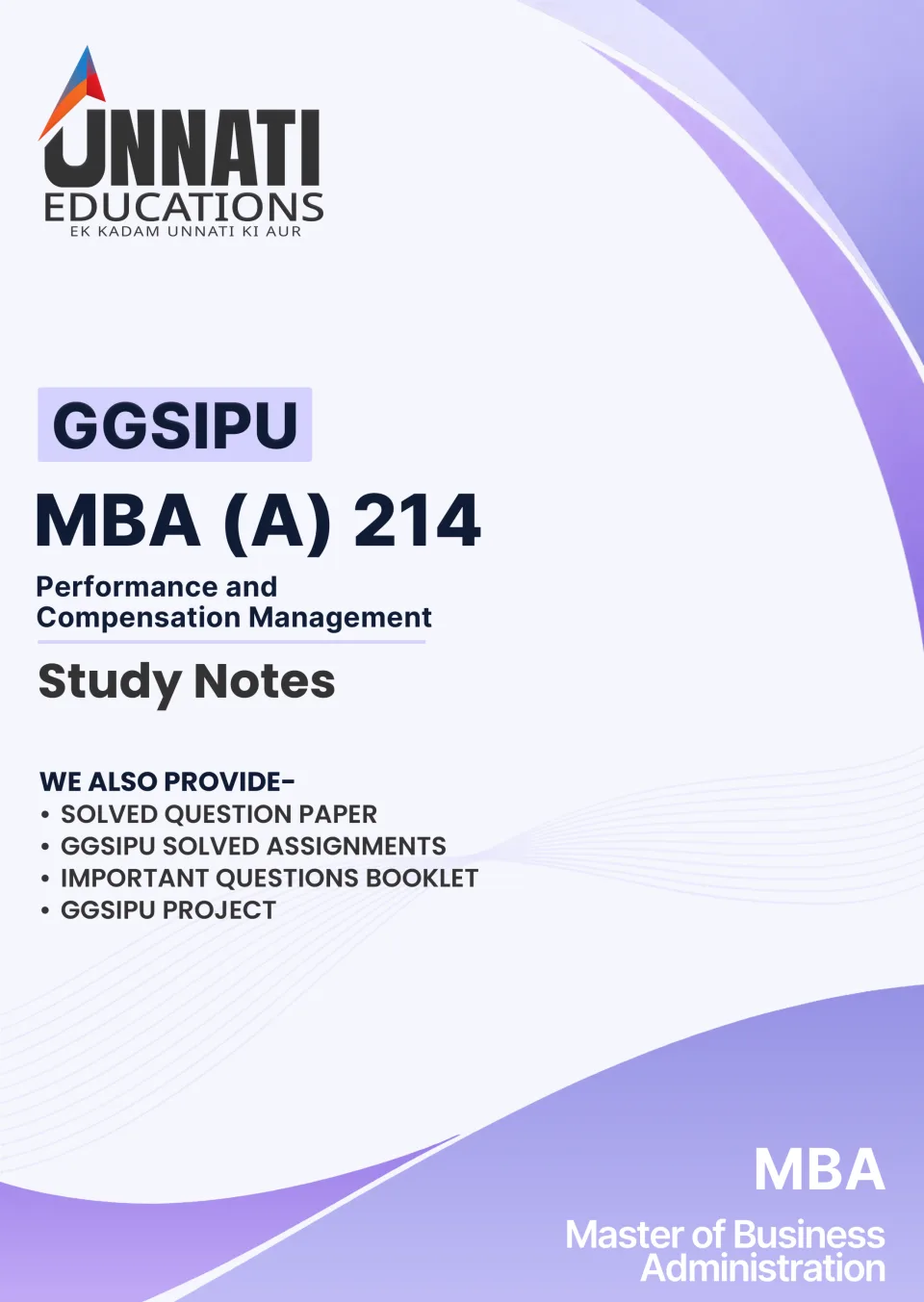
MBA(A) 214 Performance and Compensation Management Notes cover all 4 units of this MBA (Analytics) Semester 4 HR elective in a 73-page printed book: 26 sections, 38 diagrams, 7 worked illustrations, 4 case studies and 66 exam questions. They follow the Scheme and Syllabus 2022-24 onwards, for batches studying under that scheme.
Written by Prateek Talwar, Founder, Unnati Educations · Reviewed by Sheetal Kirola, Academic Head, M.Ed. · Checked against syllMBAAnalytics180225.pdf (Sem 3-4 approved 19.07.2023) · Updated 26 October 2026 · Editorial policy
Scheme: MBA (Analytics) Scheme and Syllabus 2022-24 onwards | Applies to: batches under the 2022-24 onwards scheme | Verified against: syllMBAAnalytics180225.pdf, Sem 3-4 approved 19.07.2023
MBA(A) 214 Performance and Compensation Management at a glance: GGSIPU MBA (Analytics) Sem 4 credits, units and exam pattern
MBA(A) 214 is one of three HR-stream electives (with 210 and 212); students pick any two. It is listed with the other GGSIPU MBA (Analytics) Semester 4 papers.
| Category and credits | Elective of HR (slot typed "Skill Enhancement"); L 3, T/P nil; 3 credits; 42 hours (10 + 11 + 10 + 11) |
|---|---|
| Marks | Internal 25: Class Test-I 15 + presentation / viva-voce / group discussion 10. End-term marks and total: not printed in the official PDF |
| End-term pattern | Paper-setter instructions not printed; the scheme follows GGSIPU Ordinance 11 |
| Applies to | Scheme and Syllabus 2022-24 onwards (Sem 3-4 approved 19.07.2023) |
| Paired lab | None |
MBA(A) 214 Performance and Compensation Management Notes unit-wise: 7 worked illustrations and 66 exam questions across 4 units
Units I and II deal with pay, III and IV with performance; each ends with a Quick Revision table. Notes for the other papers of the programme are under GGSIPU MBA (Analytics) notes.
MBA(A) 214 Unit 1: Basics of Compensation Management
Pages 4-20, 5 sections, 9 diagrams, 2 illustrations. It opens with Milkovich and Newman's total compensation formula, then economic and behavioural wage theories and the 1948 fair-wage concepts. Then come rewards versus benefits, Indian statutory benefits, eight pay styles with broadbanding, and pay structures from the 7th CPC Pay Matrix to a private CTC.
| Item | Working | Result |
|---|---|---|
| Range spread | (60,000 − 40,000) ÷ 40,000 × 100 | 50% |
| Compa-ratio at ₹45,000 | 45,000 ÷ midpoint 50,000 × 100 | 90%, room to rise |
| Compa-ratio at ₹56,000 | 56,000 ÷ 50,000 × 100 | 112%, slower increments |
Quick look: range spread and compa-ratio, grade ₹40,000 to ₹60,000 (from page 16)
- Item
- Range spread
- Working
- (60,000 − 40,000) ÷ 40,000 × 100
- Result
- 50%
- Item
- Compa-ratio at ₹45,000
- Working
- 45,000 ÷ midpoint 50,000 × 100
- Result
- 90%, room to rise
- Item
- Compa-ratio at ₹56,000
- Working
- 56,000 ÷ 50,000 × 100
- Result
- 112%, slower increments
MBA(A) 214 Unit 2: Compensation Techniques
Pages 21-38, 6 sections, 8 diagrams, 4 illustrations. It compares skill-based, competency-based and team pay (iceberg model, free riders), tables all eight Pay Commissions, and works through PBR plans from Halsey to Improshare. It ends with merit matrices, employer tax duties under the Income-tax Act, 2025, old versus new regime, and expatriate pay with tax equalisation.
| Worker | Halsey | Rowan |
|---|---|---|
| 8 hours taken (20% saved) | ₹900 | ₹960 |
| 4 hours taken (60% saved) | ₹700 | ₹640 |
Quick look: Halsey versus Rowan, standard 10 hours at ₹100 an hour (from page 27)
- Worker
- 8 hours taken (20% saved)
- Halsey
- ₹900
- Rowan
- ₹960
- Worker
- 4 hours taken (60% saved)
- Halsey
- ₹700
- Rowan
- ₹640
Rowan pays more below 50% time saved, Halsey above it.
MBA(A) 214 Unit 3: Foundations of Performance Management
Pages 39-55, 7 sections, 11 diagrams. It contrasts PM with appraisal, covers the Aguinis and Armstrong models, and handles the official block on measurement planning: Campbell's model, task versus contextual performance, SMART standards, KRA and KPI tables for a Sales Manager, an appraisal-form layout, and methods from ranking to BARS, 360-degree feedback and OKRs.
Quick look: paired comparison for four employees (from page 50)
- Pairs needed: 4 × 3 ÷ 2 = 6.
- Note each pair's winner and count wins: C 3, A 2, B 1, D 0.
- Rank: C, A, B, D. For 20 employees it would take 190 comparisons.
MBA(A) 214 Unit 4: Performance Management Implementation
Pages 56-72, 8 sections, 10 diagrams, the largest unit. It covers roll-out, rater training, PIPs and Maier's interview styles, then the official development-issues block: the GROW model, T.V. Rao's potential appraisal, the nine-box grid, PM in MNCs, Organ's OCB, succession planning and e-PM tools such as Darwinbox.
| Error | Example |
|---|---|
| Halo effect | A strong presenter rated high on every factor |
| Central tendency | Everyone rated 3 out of 5 |
| Recency effect | One mistake in March outweighs 11 good months |
Quick look: three rating errors (from page 60)
- Error
- Halo effect
- Example
- A strong presenter rated high on every factor
- Error
- Central tendency
- Example
- Everyone rated 3 out of 5
- Error
- Recency effect
- Example
- One mistake in March outweighs 11 good months
MBA(A) 214 exam corner: 40 two-to-five-mark and 26 ten-to-fifteen-mark exam questions by unit
Each unit of these GGSIPU MBA (Analytics) Sem 4 Performance and Compensation Management notes ends with "Short Answer Questions (2–5 Marks)" and "Long Answer Questions (10–15 Marks)". They have no model answers or year tags; the unit's sections answer them.
| Unit | Short (2–5 Marks) | Long (10–15 Marks) | Illustrations |
|---|---|---|---|
| I | 10 | 6 | 2 |
| II | 10 | 6 | 4 |
| III | 10 | 6 | 1 |
| IV | 10 | 8 | 0 |
MBA(A) 214 exam questions and worked material per unit
- Unit
- I
- Short (2–5 Marks)
- 10
- Long (10–15 Marks)
- 6
- Illustrations
- 2
- Unit
- II
- Short (2–5 Marks)
- 10
- Long (10–15 Marks)
- 6
- Illustrations
- 4
- Unit
- III
- Short (2–5 Marks)
- 10
- Long (10–15 Marks)
- 6
- Illustrations
- 1
- Unit
- IV
- Short (2–5 Marks)
- 10
- Long (10–15 Marks)
- 8
- Illustrations
- 0
Unit I: "What is a compensation structure? Explain the steps in designing it and discuss Indian practices in the public and private sectors." Six design steps (page 15), then the 7th CPC matrix beside a private CTC.
Unit II: "What is tax equalization? How is it different from tax protection?" Equalisation leaves the expatriate paying home tax only; protection means never worse off (page 36).
Unit III: "Distinguish between KRA and KPI with an example." KRA is the result area, KPI its measure: sales growth against monthly sales versus target (page 47).
Unit IV: "What is the nine-box grid?" A 3 × 3 matrix of performance and potential, with a talent action for each box (pages 64-65).
The MBA(A) 214 notes carry 40 two-to-five-mark and 26 ten-to-fifteen-mark exam questions across 4 units, plus 7 worked illustrations.
For more practice on this paper, see the MBA(A) 214 important questions.
Who writes and checks the MBA(A) 214 performance and compensation notes?
- Prateek Talwar, author · Founder, Unnati Educations · Associate Company Secretary (ACS), ICSI, membership no. 58704, since 15 May 2019 · B.Com, University of Delhi (School of Open Learning), 2012 · author profile
- Sheetal Kirola, subject reviewer · Academic Head, Unnati Educations · M.Ed. · 7 years of experience · reviewer profile
Prateek wrote all four units of these MBA(A) 214 Performance and Compensation Management IPU notes; Sheetal reviewed the HR terms and language of the appraisal, coaching and career sections. The 2026-27 edition is mapped to Semester 4, Electives of HR, and reflects the Income-tax Act, 2025, the Budget 2025 slabs and the 8th CPC set up in 2025. Last updated 26 October 2026; see the editorial policy.
The same team prepares GGSIPU important questions for each course it covers.
How to write MBA(A) 214 answers: wage-plan calculations, comparison tables and appraisal-form layouts
The book's six Exam Tip boxes each point to a format; three patterns stand out.
1. Tables for theory. For the foundations of compensation, page 7 asks for three economic theories (subsistence, wage fund, marginal productivity) and three behavioural ones (Herzberg, Vroom, Adams) in one table. Public versus private pay and PM versus PA work the same way.
2. Take a position. On team pay, page 23 says to name the free-rider problem and suggest a hybrid such as 70% team and 30% individual bonus.
3. Draw the form. For "design an appraisal form", page 49 suggests a table of KRAs, weightage, KPIs, actual, rating and weighted score, plus a competency block, a 5-point scale and a development plan.
Worked example: Taylor's differential piece rate (page 28)
Normal rate ₹10 a piece, standard 50 units a day. Lower rate 83% = ₹8.30; higher rate 125% = ₹12.50. Worker X makes 45 units: 45 × ₹8.30 = ₹373.50. Worker Y makes 55 units: 55 × ₹12.50 = ₹687.50. Ten more units bring almost 84% more pay, so end with the point that the plan motivates strongly but is harsh on slow workers.
Set out every calculation as formula, values, working and a one-line conclusion, and practise it on GGSIPU MBA (Analytics) important questions.
MBA(A) 214 and the GGSIPU MBA (Analytics) Sem 4 papers it connects to
MBA(A) 214 has no lab paper; types and credits of every Semester 4 paper are on the full MBA (Analytics) syllabus page.
| MBA(A) 214 unit | Sem 4 paper | Shared idea |
|---|---|---|
| Unit I pay policy line (page 15) | MBA(A) 208 Multivariate Data Analysis | Regression of job-evaluation points on market pay |
| Units III-IV appraisal data | MBA(A) 210 Strategic HR Analytics | Money value of job performance (210 Unit IV) |
| Unit IV coaching and development | MBA(A) 212 Managing Organizational Development | Team building and other OD interventions |
Where MBA(A) 214 units meet other Semester 4 papers
- MBA(A) 214 unit
- Unit I pay policy line (page 15)
- Sem 4 paper
- MBA(A) 208 Multivariate Data Analysis
- Shared idea
- Regression of job-evaluation points on market pay
- MBA(A) 214 unit
- Units III-IV appraisal data
- Sem 4 paper
- MBA(A) 210 Strategic HR Analytics
- Shared idea
- Money value of job performance (210 Unit IV)
- MBA(A) 214 unit
- Unit IV coaching and development
- Sem 4 paper
- MBA(A) 212 Managing Organizational Development
- Shared idea
- Team building and other OD interventions
Also in Semester 4: MBA(A) 202 Major Project Report, MBA(A) 204 Project Management, MBA(A) 206 Ancient Management Philosophy and Indian Ethos (NUES) and the marketing and finance electives 216 to 226. From Semester 3, MBA(A) 219 Talent Management ends with competency-based succession planning, which Unit IV takes further.
Lead, match and lag pay policies in compensation strategy: excerpt from page 9 of the MBA(A) 214 notes
Excerpt from page 9
Meaning of compensation strategy
A compensation strategy is the set of basic pay decisions an organisation takes to support its business strategy: how much to pay compared with the market, what mix of fixed and variable pay to use, what to reward (the job, the skill or the performance), and how pay decisions are made and communicated.
Milkovich and Newman describe four strategic pay decisions, plus administration:
- Objectives: efficiency, fairness and compliance.
- Internal alignment: pay relations among jobs inside the firm.
- External competitiveness: pay compared with competitors.
- Employee contributions: pay for performance, seniority or skill.
- Administration: planning, budgeting and communication.
Pay-level strategies: lead, match and lag
External competitiveness decides whether the organisation pays above, equal to or below the market. Because market pay keeps rising during the year, the pay level chosen at the time of revision decides how competitive the firm stays until the next revision.
| Policy | Meaning | Advantages | Disadvantages | Typical users |
|---|---|---|---|---|
| Lead (above market) | Pay higher than competitors throughout the year | Attracts and keeps top talent; fewer vacancies; higher morale | High labour cost; may not raise productivity by itself | Investment banks, top IT product firms, MNCs |
| Match (meet market) | Pay equal to the market average | Neutral cost; fair image; easy to defend | No special edge in hiring | Most large Indian companies, many PSUs at entry level |
| Lag (below market) | Pay below market, often balanced by other returns | Lower labour cost | Harder hiring; higher attrition | Small firms, start-ups (offset by ESOPs), NGOs |
| Flexible / mixed | Lead for critical jobs, match or lag for others; or lead on total rewards but lag on cash | Spends money where it matters most | Complex; may look unfair inside the firm | Tech firms paying a premium for AI and data scientists |
Lead, match, lag and mixed pay policies (excerpt from page 9)
- Policy
- Lead (above market)
- Meaning
- Pay higher than competitors throughout the year
- Advantages
- Attracts and keeps top talent; fewer vacancies; higher morale
- Disadvantages
- High labour cost; may not raise productivity by itself
- Typical users
- Investment banks, top IT product firms, MNCs
- Policy
- Match (meet market)
- Meaning
- Pay equal to the market average
- Advantages
- Neutral cost; fair image; easy to defend
- Disadvantages
- No special edge in hiring
- Typical users
- Most large Indian companies, many PSUs at entry level
- Policy
- Lag (below market)
- Meaning
- Pay below market, often balanced by other returns
- Advantages
- Lower labour cost
- Disadvantages
- Harder hiring; higher attrition
- Typical users
- Small firms, start-ups (offset by ESOPs), NGOs
- Policy
- Flexible / mixed
- Meaning
- Lead for critical jobs, match or lag for others; or lead on total rewards but lag on cash
- Advantages
- Spends money where it matters most
- Disadvantages
- Complex; may look unfair inside the firm
- Typical users
- Tech firms paying a premium for AI and data scientists
The choice is not fixed for every job. A firm can lead for scarce roles and match for the rest, as long as it can explain the difference to its own staff.
Do the MBA(A) 214 notes cover the full GGSIPU syllabus?
Yes. Every topic printed for MBA(A) 214 has its own numbered section in the notes, in the official order.
| Official unit | Official topics | Notes | Status |
|---|---|---|---|
| I Basics of Compensation Management | Definition and foundation; sector strategies; rewards, incentives, benefits; styles; structure | Sections 1-5, pp 4-20 | Covered |
| II Compensation Techniques | Knowledge, team, competency pay; wage boards, pay commissions; PBR; tax planning; international pay | Sections 1-6, pp 21-38 | Covered |
| III Foundations of Performance Management | Concept and philosophy; PM models; measurement; job descriptions, KRAs, KPIs; appraisal forms and methods | Sections 1-7, pp 39-55 | Covered |
| IV Performance Management Implementation | Implementation, monitoring, reviews; coaching; potential appraisal; PM in MNC; career and succession; technology | Sections 1-8, pp 56-72 | Covered |
Official MBA(A) 214 syllabus mapped to the notes
- Official unit
- I Basics of Compensation Management
- Official topics
- Definition and foundation; sector strategies; rewards, incentives, benefits; styles; structure
- Notes
- Sections 1-5, pp 4-20
- Status
- Covered
- Official unit
- II Compensation Techniques
- Official topics
- Knowledge, team, competency pay; wage boards, pay commissions; PBR; tax planning; international pay
- Notes
- Sections 1-6, pp 21-38
- Status
- Covered
- Official unit
- III Foundations of Performance Management
- Official topics
- Concept and philosophy; PM models; measurement; job descriptions, KRAs, KPIs; appraisal forms and methods
- Notes
- Sections 1-7, pp 39-55
- Status
- Covered
- Official unit
- IV Performance Management Implementation
- Official topics
- Implementation, monitoring, reviews; coaching; potential appraisal; PM in MNC; career and succession; technology
- Notes
- Sections 1-8, pp 56-72
- Status
- Covered
Official source: MBA (Analytics) Scheme and Syllabus 2022-24 onwards, MBA(A) 214 on PDF pages 89-90.
The scheme's elective list calls it "Performance and Compensation Management"; its course page says "Compensation and Performance Management". Same code, same content. Every course in GGSIPU notes is checked against its official PDF this way.
MBA(A) 214 performance and compensation notes FAQs
How do I get the full MBA(A) 214 notes?
Tap "Get Full Notes" at the top of this page or the WhatsApp box at the end, and send the prefilled message. The MBA(A) 214 notes come only as a printed book of 73 pages; they are not available as a PDF. Delivery takes a maximum of 5-7 days, and the rest depends on your location.
Is MBA(A) 214 the same paper as "Compensation and Performance Management"?
Yes. MBA(A) 214 appears as "Performance and Compensation Management" in the Semester 4 elective list, and as "Compensation and Performance Management" on its own course page and in the CO-PO table of the same official PDF. The code, 3 credits and four units are identical, and these notes follow the course-page unit titles and topics.
Does MBA(A) 214 have a lab or practical paper?
No. MBA(A) 214 is a theory elective of 3 credits with 3 lecture hours a week and no T/P hours. It sits in the Electives of HR stream with MBA(A) 210 Strategic HR Analytics and MBA(A) 212, and students choose any two of the three. Its calculations are hand-worked: wage plans, compa-ratios, merit increases and tax savings.
Which unit of MBA(A) 214 has the most calculations?
Unit II. It holds 4 of the book's 7 worked illustrations: Halsey versus Rowan, Taylor's differential piece rate, a merit matrix, and the tax saved through an employer NPS contribution of 14% of basic plus DA. It also gives the formulas for Merrick, Emerson, Barth, Scanlon, Rucker and Improshare. Unit I adds compa-ratio and a CTC break-up.
What is the passing mark for MBA(A) 214?
The official PDF prints only the internal part of MBA(A) 214: 25 marks, made of Class Test-I (15) and an individual presentation, viva-voce or group discussion (10). It does not print the end-term marks, the paper total or a pass percentage. Minimum marks and re-appear rules come from Ordinance 11 of the university, so check it or ask your institute.
Are the MBA(A) 214 notes updated for the new tax law?
Yes. The tax-planning section notes that the Income-tax Act, 2025 replaced the 1961 Act from 1 April 2026, keeping old section numbers for reference. It compares the old and new regimes with the Budget 2025 slabs, the ₹75,000 standard deduction and the ₹12 lakh rebate, and shows which package parts, such as employer NPS, work in both regimes.
Get the full MBA(A) 214 Performance and Compensation Management Notes on WhatsApp
| Unit | Pages | Sections |
|---|---|---|
| I Basics of Compensation Management | 4-20 (17) | 5 |
| II Compensation Techniques | 21-38 (18) | 6 |
| III Foundations of Performance Management | 39-55 (17) | 7 |
| IV Performance Management Implementation | 56-72 (17) | 8 |
Pages and sections in the full MBA(A) 214 book
- Unit
- I Basics of Compensation Management
- Pages
- 4-20 (17)
- Sections
- 5
- Unit
- II Compensation Techniques
- Pages
- 21-38 (18)
- Sections
- 6
- Unit
- III Foundations of Performance Management
- Pages
- 39-55 (17)
- Sections
- 7
- Unit
- IV Performance Management Implementation
- Pages
- 56-72 (17)
- Sections
- 8
Inside the 73 pages: 38 diagrams, 7 worked illustrations, 4 Indian case studies, 4 Quick Revision tables and 66 exam questions. These are Performance and Compensation Management notes in English, sold as a printed book only, not as a PDF. Delivery: a maximum of 5-7 days; the rest depends on your location.
Unnati Educations is an independent education provider based in Vikaspuri, Delhi. We are not affiliated with, authorised by, or endorsed by Guru Gobind Singh Indraprastha University (GGSIPU). 'GGSIPU' and 'IPU' are used only to describe the syllabus our notes follow. For official information, visit ipu.ac.in.
Ready for the full notes?
Discuss coverage and delivery with our team.