
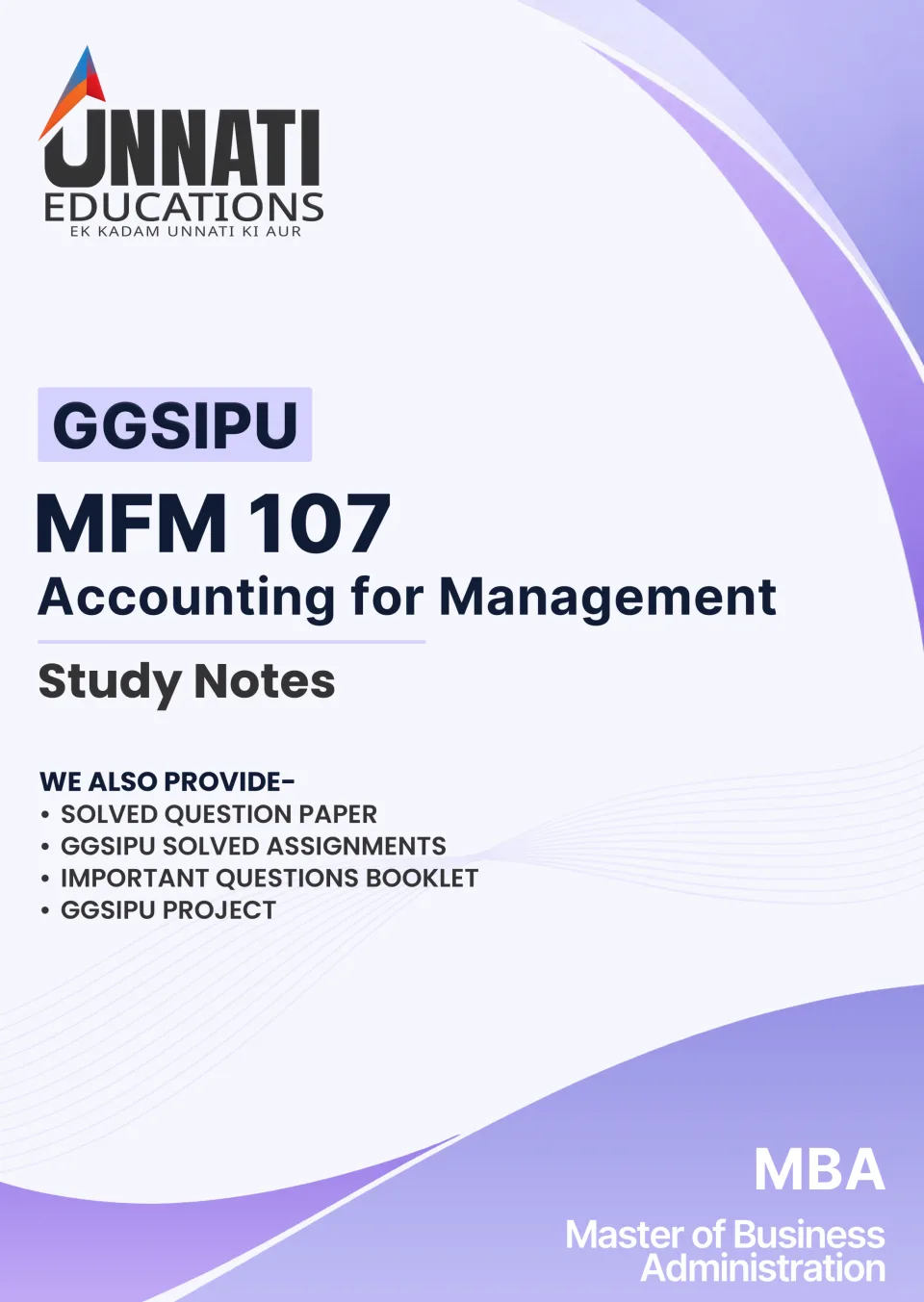
MFM 107 Accounting for Management Notes are a printed book for GGSIPU MBA (Financial Management) Semester 1. They cover all 4 official units with 38 worked illustrations, 81 end-of-unit practice questions and a quick revision table for every unit, mapped to the MBA (FM) scheme for batches admitted from 2021-22 onwards.
Written and reviewed by Prateek Talwar · Checked against the MBA (Financial Management) scheme and syllabus, dated 20 May 2022 · Verified 13 October 2026 · Updated 14 October 2026 · Editorial policy
Scheme: MBA (FM) scheme and syllabus 2021-22 onwards | Applies to: batches admitted 2021-22 onwards | Verified against: MBA-Financial Management.pdf, ipu.ac.in, dated 20 May 2022
MFM 107 Accounting for Management at a glance: GGSIPU MBA FM Sem 1 credits, units and exam pattern
MFM 107 is a three-credit core paper joining financial, cost and management accounting. It sits with eight other GGSIPU MBA FM Semester 1 papers.
Code and title | MFM 107 (MFM-107 on the syllabus page) · Accounting for Management |
|---|---|
Course and semester | MBA (Financial Management), First Semester |
Category and credits | Core · 3 credits · L-T-P: 3-0-0 |
Marks | 100: 25 internal + 75 end-term |
Pass mark | Not printed in the supplied scheme details; see GGSIPU Ordinance 11 for applicable rules. |
Applies to | Batches admitted 2021-22 onwards under this scheme |
End-term pattern | Not printed in the supplied scheme details |
Units and hours | 4 units, 42 teaching hours: Unit I 12; Units II, III and IV 10 each |
Paired lab | None |
Refer to pages 3, 5 and 16 of the MBA (Financial Management) scheme and syllabus for the source's scheme references.
MFM 107 Accounting for Management Notes unit-wise: 38 worked illustrations across 4 units
The supplied unit page ranges run from page 5 to page 83. Each unit ends with a quick revision table and an exam-question list. The book is offered as printed notes, with a sample PDF listed in the page plan.
MFM 107 Unit 1: Financial Accounting
Unit 1 (pages 5 to 29) covers accounting concepts and an AS to Ind AS comparison, journal entries using golden rules and the accounting equation, cash book, ledger, the Ravi Traders trial balance, suspense-account rectification, depreciation and final accounts with adjustments. It has 13 sections, 10 worked illustrations, 10 short-answer questions and 8 long-answer questions.
Quick look: SLM vs WDV on one machine (from page 22)
Year ending | SLM depreciation (₹) | SLM book value (₹) | WDV depreciation (₹) | WDV book value (₹) |
|---|---|---|---|---|
31.03.2024 | 36,000 | 1,64,000 | 40,000 | 1,60,000 |
31.03.2025 | 36,000 | 1,28,000 | 32,000 | 1,28,000 |
31.03.2026 | 36,000 | 92,000 | 25,600 | 1,02,400 |
Quick look: ₹2,00,000 machine, residual value ₹20,000, useful life 5 years (from page 22)
Year ending
31.03.2024
SLM depreciation (₹)
36,000
SLM book value (₹)
1,64,000
WDV depreciation (₹)
40,000
WDV book value (₹)
1,60,000
Year ending
31.03.2025
SLM depreciation (₹)
36,000
SLM book value (₹)
1,28,000
WDV depreciation (₹)
32,000
WDV book value (₹)
1,28,000
Year ending
31.03.2026
SLM depreciation (₹)
36,000
SLM book value (₹)
92,000
WDV depreciation (₹)
25,600
WDV book value (₹)
1,02,400
Assuming the machine is sold for ₹95,000 after year three, the SLM profit is ₹3,000 and the WDV loss is ₹7,400. The WDV column uses a 20% annual rate; this is not a rate calculated to reach the stated residual value exactly after five years.
MFM 107 Unit 2: Cost Accounting
Unit 2 (pages 30 to 47) covers cost classification and cost sheets; material control using FIFO, LIFO, weighted average pricing, EOQ, ABC analysis and stock levels; labour costing, wage plans and labour turnover; and overhead distribution, machine-hour rates and over- or under-absorption. It has 14 sections, 9 worked illustrations, 11 short-answer questions and 9 long-answer questions.
Quick look: Halsey vs Rowan for a job completed two hours early (from page 41)
Plan | Working | Earnings (₹) | Earnings per hour (₹) |
|---|---|---|---|
Time rate | 8 × 50 | 400 | 50.00 |
Halsey (50%) | 400 + 50% × 2 × 50 | 450 | 56.25 |
Rowan | 400 + (2 ÷ 10) × 8 × 50 | 480 | 60.00 |
Quick look: 10 standard hours, 8 actual hours, ₹50 per hour (from page 41)
Plan
Time rate
Working
8 × 50
Earnings (₹)
400
Earnings per hour (₹)
50.00
Plan
Halsey (50%)
Working
400 + 50% × 2 × 50
Earnings (₹)
450
Earnings per hour (₹)
56.25
Plan
Rowan
Working
400 + (2 ÷ 10) × 8 × 50
Earnings (₹)
480
Earnings per hour (₹)
60.00
MFM 107 Unit 3: Performance Evaluation Techniques
Unit 3 (pages 48 to 64) covers budgetary control and functional budgets, fixed versus flexible budgets using Sigma Ltd at 60%, 80% and 100% capacity, performance budgeting, standard costing and variance analysis, the Balanced Scorecard and responsibility centres. Zero based budgeting is explained in the excerpt below. It has 11 sections, 6 worked illustrations, 11 short-answer questions and 9 long-answer questions.
Quick look: material variances for Product Z (from page 57)
Variance | Working | Amount (₹) |
|---|---|---|
Material price variance | (10 − 11) × 4,200 | 4,200 (A) |
Material usage variance | (4,000 − 4,200) × 10 | 2,000 (A) |
Material cost variance | 40,000 − 46,200 | 6,200 (A) |
Quick look: standard 4 kg at ₹10 per unit of output, actual 4,200 kg at ₹11; standard output quantity 1,000 units
Variance
Material price variance
Working
(10 − 11) × 4,200
Amount (₹)
4,200 (A)
Variance
Material usage variance
Working
(4,000 − 4,200) × 10
Amount (₹)
2,000 (A)
Variance
Material cost variance
Working
40,000 − 46,200
Amount (₹)
6,200 (A)
The variance reconciliation is ₹4,200 adverse + ₹2,000 adverse = ₹6,200 adverse. The 4,000 kg standard quantity assumes output of 1,000 units at 4 kg each.
MFM 107 Unit 4: Decision Making Techniques
Unit 4 (pages 65 to 83) uses a Kiran Industries data set for ratio analysis, Du Pont analysis and EVA. It also covers common size statements, marginal versus absorption costing, CVP and break-even analysis, profit planning, make-or-buy, special orders, key-factor decisions, activity based costing, target costing, life cycle costing and uniform costing. It has 16 sections, 13 worked illustrations, 12 short-answer questions and 11 long-answer questions.
Quick look: product mix when machine hours are the key factor (from page 76)
Contribution per unit: Product X ₹80; Product Y ₹60.
Contribution per machine hour: X = ₹80 ÷ 4 = ₹20; Y = ₹60 ÷ 2 = ₹30. Therefore, Y ranks first.
Produce 3,000 units of Y to meet its stated maximum demand, using 6,000 of the available 10,000 machine hours.
Use the remaining 4,000 hours to produce 1,000 units of X.
Total contribution = (3,000 × ₹60) + (1,000 × ₹80) = ₹2,60,000.
Profit = ₹2,60,000 − ₹1,50,000 fixed cost = ₹1,10,000, assuming no other relevant constraints or costs.
MFM 107 exam corner: 44 short-answer and 37 long-answer questions by unit
Each unit closes with short-answer and long-answer practice lists without model answers. The book separately includes 38 worked illustrations with solutions.
Unit | Short-answer | Long-answer / numerical | Worked illustrations |
|---|---|---|---|
Unit 1: Financial Accounting | 10 | 8 | 10 |
Unit 2: Cost Accounting | 11 | 9 | 9 |
Unit 3: Performance Evaluation | 11 | 9 | 6 |
Unit 4: Decision Making | 12 | 11 | 13 |
Total | 44 | 37 | 38 |
MFM 107 exam questions and worked illustrations per unit
Unit
Unit 1: Financial Accounting
Short-answer
10
Long-answer / numerical
8
Worked illustrations
10
Unit
Unit 2: Cost Accounting
Short-answer
11
Long-answer / numerical
9
Worked illustrations
9
Unit
Unit 3: Performance Evaluation
Short-answer
11
Long-answer / numerical
9
Worked illustrations
6
Unit
Unit 4: Decision Making
Short-answer
12
Long-answer / numerical
11
Worked illustrations
13
Unit
Total
Short-answer
44
Long-answer / numerical
37
Worked illustrations
38
The question counts describe practice material in the notes, not an officially confirmed end-term question pattern.
One question per unit, with answer pointers:
Unit 1: What is a contra entry? Give two examples. Pointer: A contra entry affects both the cash and bank columns of a cash book, such as cash deposited into the bank or cash withdrawn from the bank for office use. It is marked C and does not require a duplicate ledger posting (page 14).
Unit 2: Distinguish between allocation and apportionment of overheads. Pointer: Allocation assigns the entire overhead to one cost centre, whereas apportionment divides a common overhead among cost centres using a suitable basis, such as floor area (page 42).
Unit 3: What is idle time variance? Why is it always adverse? Pointer: Idle time variance = idle hours × standard wage rate, expressed as adverse because paid hours are not used for productive work under the usual variance convention (page 57).
Unit 4: Define EVA. How is it different from accounting profit? Pointer: EVA = NOPAT − (capital employed × WACC). Unlike conventional accounting profit, EVA deducts a charge for the overall cost of capital, including equity (pages 76 and 77).
The MFM 107 notes list 44 short-answer and 37 long-answer questions across 4 units, plus 38 worked illustrations with solutions.
Additional practice is listed under MFM 107 important questions.
Zero based budgeting in management accounting: excerpt from page 54 of the MFM 107 notes
Excerpt from page 54
What zero based budgeting means
Zero based budgeting (ZBB) is a method in which every activity has to be justified afresh each time a budget is prepared, as if the activity were being started for the first time. The budget begins from a zero base, not from last year's figures. CIMA describes it as a method that needs each cost element to be specifically justified, as though the activities it relates to were being undertaken for the first time.
Where it came from
ZBB was developed by Peter A. Pyhrr at Texas Instruments in the USA around 1969-70. Jimmy Carter later adopted it as Governor of Georgia and then in the US federal government. In India, the Department of Science and Technology first applied it in 1983, and the Government of India adopted it for all ministries from 1986-87.
Steps in ZBB
Define objectives: what the organisation and each unit must achieve.
Identify decision units: activities or cost centres that can be evaluated separately.
Prepare decision packages: for each activity, its purpose, costs, benefits, alternatives and the consequences of not doing it.
Rank the packages through cost-benefit evaluation, in order of priority.
Allocate resources to packages in rank order until funds run out.
Monitor and evaluate performance against the approved package.
Traditional (incremental) budgeting vs ZBB
Basis | Traditional budgeting | Zero based budgeting |
|---|---|---|
Starting point | Last year's budget or actual | Zero: every rupee justified |
Focus | Increase or decrease over the previous year | Need and cost-benefit of each activity |
Existing activities | Accepted as given | Re-examined every time |
Approach | Accounting-oriented, monetary | Decision-oriented, considers alternatives |
Inefficiencies | May be carried forward | Reviewed for possible elimination |
Effort and time | Less | Much more |
Traditional budgeting compared with zero based budgeting (excerpt, page 54)
Basis
Starting point
Traditional budgeting
Last year's budget or actual
Zero based budgeting
Zero: every rupee justified
Basis
Focus
Traditional budgeting
Increase or decrease over the previous year
Zero based budgeting
Need and cost-benefit of each activity
Basis
Existing activities
Traditional budgeting
Accepted as given
Zero based budgeting
Re-examined every time
Basis
Approach
Traditional budgeting
Accounting-oriented, monetary
Zero based budgeting
Decision-oriented, considers alternatives
Basis
Inefficiencies
Traditional budgeting
May be carried forward
Zero based budgeting
Reviewed for possible elimination
Basis
Effort and time
Traditional budgeting
Less
Zero based budgeting
Much more
The trade-off is that ZBB can identify spending that incremental budgets carry forward, but it requires managers to rebuild the case for activities and therefore takes more time and effort.
Do the MFM 107 notes cover the full GGSIPU syllabus?
The supplied syllabus map matches the listed topics of all four MFM 107 units to sections of the notes.
Official unit | Official topics | Where in the notes | Status |
|---|---|---|---|
I: Financial Accounting (12 hours) | Scope and nature, concepts, principles and standards, accounting cycle, journalising, subsidiary books, ledger, trial balance, rectification of errors, capital and revenue, depreciation, final accounts with adjustments | Sections 1–11, pages 5–27 | Covered in supplied map |
II: Cost Accounting (10 hours) | Classification of cost, cost sheet, material cost, perpetual inventory, inventory valuation, EOQ, ABC analysis, stock levels, labour costing, overheads, over- and under-absorption | Sections 1–12, pages 30–44 | Covered in supplied map |
III: Performance Evaluation Techniques (10 hours) | Budgetary control, performance budgeting, classification of budgets, fixed and flexible budgets, zero based budgeting, standard costing and variance analysis, Balanced Scorecard, responsibility accounting | Sections 1–9, pages 48–61 | Covered in supplied map |
IV: Decision Making Techniques (10 hours) | Financial statement analysis, ratio analysis, common size, Du Pont, marginal costing and its decision uses, CVP, profit planning, management accounting for decision making, EVA, activity based, target, life cycle and uniform costing | Sections 1–14, pages 65–81 | Covered in supplied map |
MFM 107 official units and topics mapped to the notes
Official unit
I: Financial Accounting (12 hours)
Official topics
Scope and nature, concepts, principles and standards, accounting cycle, journalising, subsidiary books, ledger, trial balance, rectification of errors, capital and revenue, depreciation, final accounts with adjustments
Where in the notes
Sections 1–11, pages 5–27
Status
Covered in supplied map
Official unit
II: Cost Accounting (10 hours)
Official topics
Classification of cost, cost sheet, material cost, perpetual inventory, inventory valuation, EOQ, ABC analysis, stock levels, labour costing, overheads, over- and under-absorption
Where in the notes
Sections 1–12, pages 30–44
Status
Covered in supplied map
Official unit
III: Performance Evaluation Techniques (10 hours)
Official topics
Budgetary control, performance budgeting, classification of budgets, fixed and flexible budgets, zero based budgeting, standard costing and variance analysis, Balanced Scorecard, responsibility accounting
Where in the notes
Sections 1–9, pages 48–61
Status
Covered in supplied map
Official unit
IV: Decision Making Techniques (10 hours)
Official topics
Financial statement analysis, ratio analysis, common size, Du Pont, marginal costing and its decision uses, CVP, profit planning, management accounting for decision making, EVA, activity based, target, life cycle and uniform costing
Where in the notes
Sections 1–14, pages 65–81
Status
Covered in supplied map
Official source identified in the page plan: MBA (Financial Management) scheme and syllabus, 2021-22 onwards, dated 20 May 2022; MFM 107 is listed on page 16.
The mapping describes the source's content audit; the underlying printed notes have not been independently inspected here.
Who writes and checks the MFM 107 accounting notes?
Prateek Talwar, author: Founder, Unnati Educations; Associate Company Secretary (ACS), ICSI, membership no. 58704, since 15 May 2019; B.Com, University of Delhi (School of Open Learning), 2012. Author profile
Prateek Talwar is also listed as the reviewer of the MFM 107 notes. The 2026-27 edition dates its cases to 2026, including the Ravi Traders trial balance as on 30 April 2026, and cites AS 10 for depreciation.
Last updated 14 October 2026. See the editorial policy.
For practice beyond these 81 questions, the same team prepares GGSIPU important questions.
MFM 107 and the GGSIPU MBA FM Sem 1 papers it connects to
Paired lab: None.
MFM 103 Quantitative Techniques: The EOQ formula in Unit 2 and break-even algebra in Unit 4 use related mathematical methods.
MFM 105 Managerial Economics: Fixed, variable and marginal costs connect with Units 2 and 4.
MFM 115 Legal Aspects of Business: Companies Act, 2013, Schedules II and III connect with Unit 1.
MFM 111 Marketing Management: Target costing in Unit 4 begins with the market price.
Group | Papers |
|---|---|
Related papers | MFM 103 Quantitative Techniques; MFM 105 Managerial Economics; MFM 111 Marketing Management; MFM 115 Legal Aspects of Business |
Other theory papers | MFM 101 Management Process and Organisational Behaviour; MFM 109 Information Technology Management; MFM 113 Communication in Organizations |
Practical paper | MFM 117 Information Technology Management Lab |
Other MBA (FM) Semester 1 papers (2021-22 onwards scheme)
Group
Related papers
Group
Other theory papers
Group
Practical paper
Papers
MFM 117 Information Technology Management Lab
In the next semester, Unit 4's ratios, Du Pont analysis and EVA connect with MFM 104 Financial Management.
How to write MFM 107 answers: journal entries, cost sheets, variance workings and long-answer theory
MFM 107 mixes numericals and theory. Accurate entries, complete workings and structured explanations help make answers easier to assess. The notes include tips and key-point boxes for these areas.
Journal entries. Use the page 11 memory aid, DEAD-CLIC: debit increases Expenses, Assets and Drawings; credit increases Liabilities, Income and Capital. Add a narration in brackets under each entry.
Cost sheets. The page 34 tip distinguishes "20% on sales" from "20% on cost". For cost of sales ₹80,000 and profit of 20% on sales, profit on cost = 20 ÷ 80 = 25%. Therefore, profit is ₹20,000 and sales are ₹1,00,000. Calculating 20% of ₹80,000 would incorrectly give ₹16,000.
Variances and stores ledgers. Mark each variance as adverse (A) or favourable (F) and reconcile its components. Labour cost variance can be analysed through rate, idle-time and efficiency variances (page 57). In stores-ledger questions, the page 37 check is that the same total material available is allocated differently between issues and closing inventory under FIFO, LIFO and weighted average, subject to consistent transaction records.
Budgets. Identify the key limiting factor first. The page 49 tip explains that it determines which budget is prepared first: the sales budget when demand limits activity, or the material budget when raw material is scarce. For flexible budgets, split semi-variable costs into fixed and variable components before preparing the columns, as in the Sigma Ltd illustration.
Long-answer theory. Start with a definition, explain the features in short points, add a comparison table where relevant, and finish with an example. The notes include comparisons such as bin card versus stores ledger and fixed versus flexible budgets.
Practise the same answer format using GGSIPU MBA FM important questions.
MFM 107 accounting notes FAQs
How do I get the full MFM 107 notes?
Order the printed book on WhatsApp at 9899436384 using the "Get Full Notes" button at the top of the page. The MFM 107 notes are offered as a printed book, not as a full PDF. Delivery takes 5 to 7 days at most, depending on your location. The page plan also lists an eight-page sample PDF; its live availability should be confirmed.
Do the MFM 107 notes follow the current MBA (FM) syllabus?
The notes are mapped to the MBA (Financial Management) scheme and syllabus for batches admitted from 2021-22 onwards, dated 20 May 2022 in the supplied page plan. The syllabus map above identifies corresponding sections and pages for all four units. Check whether a newer scheme applies to your admission batch.
How many marks is MFM 107 out of, and what is the passing mark?
MFM 107 is marked out of 100: 25 internal and 75 end-term. The internal component is described as a 15-mark class test plus 10 marks for other assessment activities. The supplied scheme details do not state a passing percentage, so consult GGSIPU Ordinance 11 for the applicable examination rules.
Are the MFM 107 exam questions in the notes solved?
The book is described as containing 38 fully worked illustrations. Its 81 end-of-unit questions, comprising 44 short-answer and 37 long-answer or numerical questions, are practice questions without model answers. They refer back to topics covered in the corresponding units.
Which MFM 107 unit needs the most numerical practice?
Unit 4, Decision Making Techniques, contains the most worked illustrations at 13 of 38. Topics include ratios, Du Pont analysis, marginal versus absorption costing, CVP, make-or-buy decisions, special orders, key-factor analysis, EVA, activity based costing, target costing and life cycle costing. Unit 1 has 10 illustrations, Unit 2 has 9 and Unit 3 has 6.
Do the MFM 107 notes use AS or Ind AS?
Both. Unit 1 includes a comparison of ten Accounting Standards and their Ind AS counterparts, including AS 2 and Ind AS 2 for inventories, and AS 10 and Ind AS 16 for property, plant and equipment. It also explains that the former AS 6 depreciation requirements were incorporated into AS 10.
Get the full MFM 107 Accounting for Management Notes on WhatsApp
The full book provides English Accounting for Management notes in printed and bound form. It is not sold as a full PDF.
Part | Pages | Worked illustrations | Exam questions |
|---|---|---|---|
Cover and index | 1–4 (4) | — | — |
5–29 (25) | 10 | 18 | |
30–47 (18) | 9 | 20 | |
48–64 (17) | 6 | 20 | |
65–83 (19) | 13 | 23 | |
Total documented | 1–83 (83) | 38 | 81 |
What the printed MFM 107 notes book contains
Part
Cover and index
Pages
1–4 (4)
Worked illustrations
—
Exam questions
—
Pages
5–29 (25)
Worked illustrations
10
Exam questions
18
Pages
30–47 (18)
Worked illustrations
9
Exam questions
20
Pages
48–64 (17)
Worked illustrations
6
Exam questions
20
Pages
65–83 (19)
Worked illustrations
13
Exam questions
23
Part
Total documented
Pages
1–83 (83)
Worked illustrations
38
Exam questions
81
The source describes an 84-page book, but its supplied cover and unit ranges account for only 83 pages. The final page allocation needs confirmation.
Delivery: within 5 to 7 days at most; the exact time may vary with your location.
Order the MFM 107 notes book on WhatsApp (4 units, 84 pages)
Unnati Educations is an independent education provider based in Vikaspuri, Delhi. We are not affiliated with, authorised by, or endorsed by Guru Gobind Singh Indraprastha University (GGSIPU). 'GGSIPU' and 'IPU' are used only to describe the syllabus our notes follow. For official information, visit ipu.ac.in.
Ready for the full notes?
Discuss coverage and delivery with our team.