
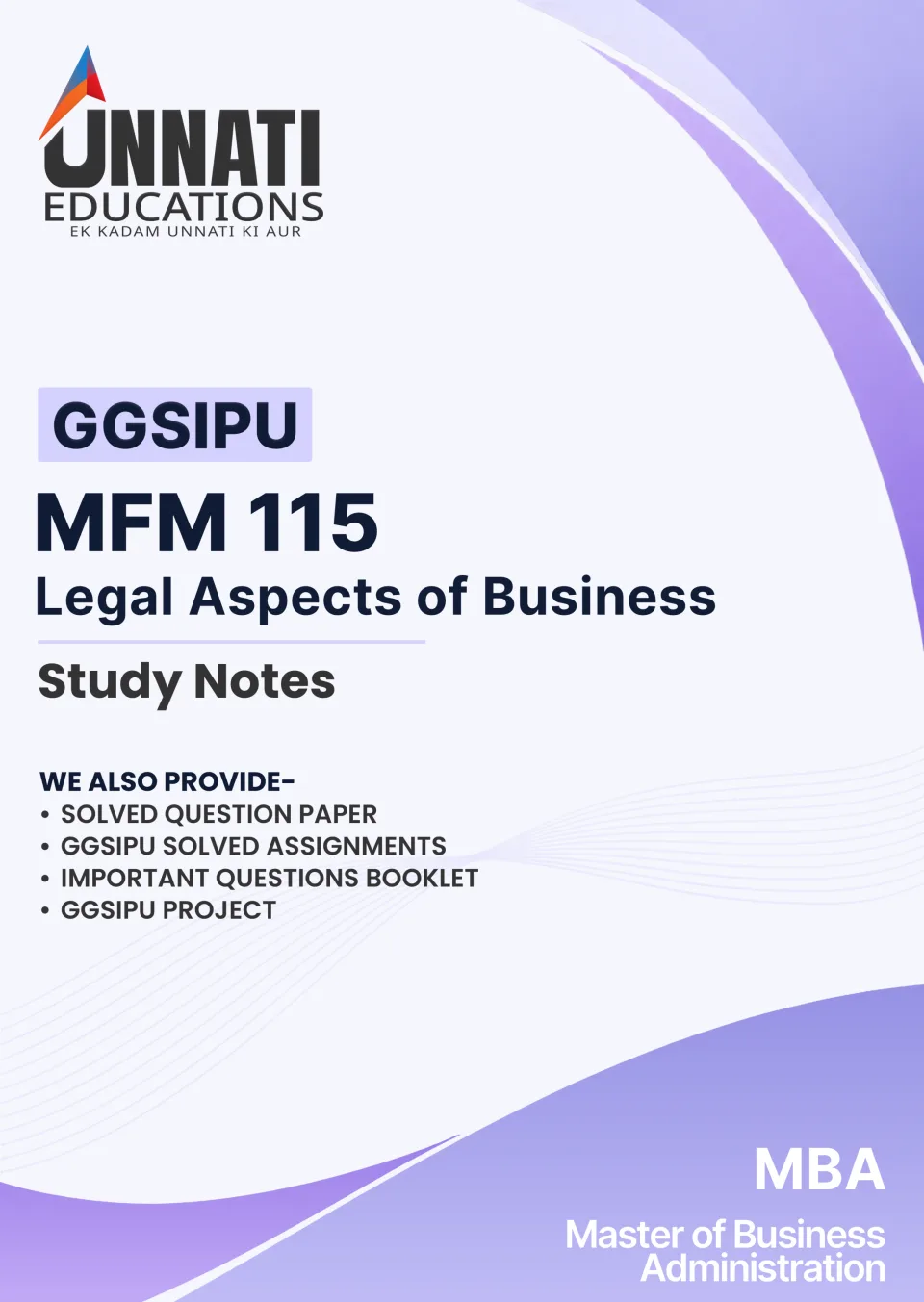
MFM 115 Legal Aspects of Business Notes from Unnati Educations are a 70-page printed book for GGSIPU MBA (Financial Management) Semester 1. They cover all 4 official units, from courts and alternative dispute resolution to contracts, business forms, SEBI, labour laws, consumer protection and competition law. The notes include 16 diagrams, 15 case-law boxes and 61 exam-style questions, mapped to the MBA (FM) scheme for batches admitted from 2021-22 onwards.
Written by Prateek Talwar, Founder, Unnati Educations · Reviewed by Prateek Talwar, Associate Company Secretary (ACS), ICSI · Checked against the MBA (Financial Management) Scheme and Syllabus 2021-22 Onwards · Updated 14 October 2026 · Editorial policy
Scheme: MBA (Financial Management) 2021-22 Onwards | Applies to: batches admitted 2021-22 onwards | Verified against: GGSIPU MBA (Financial Management) syllabus PDF
MFM 115 Legal Aspects of Business at a glance: GGSIPU MBA FM Sem 1 credits, units and exam pattern
MFM 115 is the dedicated business law paper in GGSIPU MBA (Financial Management) Semester 1. It covers legal systems, contracts, business organisations and laws governing relationships with stakeholders. The supplied scheme identifies 42 teaching hours, with the largest allocation going to business forms.
Code and title | MFM 115 (also written MFM-115) · Legal Aspects of Business |
|---|---|
Course and semester | MBA (Financial Management), Semester 1 |
Category and credits | Core · 3 credits · L-T-P: 3-0-0 |
Marks | 100: 25 internal (15-mark class test and 10 marks for other assessment activities) + 75 end-term |
Pass mark | Not stated in the supplied syllabus details. Consult GGSIPU Ordinance 11 for applicable examination rules. |
Applies to | Batches admitted from 2021-22 onwards under this scheme |
End-term pattern | 75 marks; the supplied syllabus does not specify a question-paper pattern |
Units and hours | 4 units: 10 + 10 + 12 + 10 = 42 teaching hours |
Paired lab | None |
The internal assessment includes a compulsory written class test and additional evaluation activities during the semester. The syllabus does not provide a separate MFM 115 passing percentage.
MFM 115 Legal Aspects of Business Notes unit-wise: 61 exam questions and 15 case-law boxes across 4 units
The printed MFM 115 notes contain four units covering the Indian legal system, contract law, business forms and stakeholder-related legislation. Each unit includes an examination question list and revision material. Across the book, the supplied inventory records 16 diagrams, 15 case-law boxes and 61 exam-style questions.
MFM 115 Unit 1: Introduction to Law and Legal Systems
Unit 1 (pages 4 to 22) introduces the meaning, sources and classification of law, the structure of Indian courts, tribunals including NCLT and SAT, the Commercial Courts Act, 2015, alternative dispute resolution (ADR), Article 19(1)(g) and reasonable restrictions under Article 19(6), and the role of regulators in business. The notes also discuss criminal court structures under the Bharatiya Nagarik Suraksha Sanhita (BNSS). It has 10 sections, 4 diagrams, 3 case-law boxes and 15 exam questions.
Quick look: Civil law vs criminal law (from page 6)
Basis | Civil law | Criminal law |
|---|---|---|
Primary objective | Enforcement of rights and remedies, including compensation | Determining criminal liability and imposing lawful penalties |
Standard of proof | Preponderance of probabilities | Beyond reasonable doubt |
Typical parties | Plaintiff versus defendant | State versus accused |
Civil law and criminal law compared
Basis
Primary objective
Civil law
Enforcement of rights and remedies, including compensation
Criminal law
Determining criminal liability and imposing lawful penalties
Basis
Standard of proof
Civil law
Preponderance of probabilities
Criminal law
Beyond reasonable doubt
Basis
Typical parties
Civil law
Plaintiff versus defendant
Criminal law
State versus accused
MFM 115 Unit 2: Laws Governing Contracts
Unit 2 (pages 23 to 37) covers the Indian Contract Act, 1872, including the meaning of a contract under Section 2(h), essentials of a valid contract, performance, discharge, breach and remedies. It also covers the Sale of Goods Act, 1930, including conditions and warranties and the rights of an unpaid seller. It has 12 sections, 4 diagrams, 3 case-law boxes and 15 exam questions.
Quick look: Kinds of damages for breach of contract (from page 29)
Kind | Meaning |
|---|---|
Ordinary damages | Compensation for loss arising naturally in the usual course of events |
Special damages | Compensation for loss arising from special circumstances known to both parties when contracting |
Nominal damages | A small award where a legal right is infringed but substantial loss is not established |
Liquidated damages (Section 74) | Reasonable compensation, subject to the statutory limit of the sum named in the contract |
Damages for breach of contract
Kind
Ordinary damages
Meaning
Compensation for loss arising naturally in the usual course of events
Kind
Special damages
Meaning
Compensation for loss arising from special circumstances known to both parties when contracting
Kind
Nominal damages
Meaning
A small award where a legal right is infringed but substantial loss is not established
Kind
Liquidated damages (Section 74)
Meaning
Reasonable compensation, subject to the statutory limit of the sum named in the contract
MFM 115 Unit 3: Laws Governing Business Forms
Unit 3 (pages 38 to 54) compares Hindu Undivided Family businesses, partnerships, companies and limited liability partnerships. It discusses the Indian Partnership Act, 1932; Companies Act, 2013; company incorporation through SPICe+; Memorandum and Articles of Association; directors; winding up; the Insolvency and Bankruptcy Code, 2016; and the Limited Liability Partnership Act, 2008. It has 5 main sections with 19 subtopics, 4 diagrams, 5 case-law boxes and 16 exam questions.
Quick look: Partners' rights when the partnership agreement is silent (from page 41)
Right | Section | Default rule |
|---|---|---|
Share of profits | 13(b) | Partners share profits equally, subject to agreement |
Interest on advances beyond agreed capital | 13(d) | 6% per annum |
Remuneration for conducting business | 13(a) | No entitlement unless otherwise agreed |
Selected default rules under the Indian Partnership Act, 1932
Right
Share of profits
Section
13(b)
Default rule
Partners share profits equally, subject to agreement
Right
Interest on advances beyond agreed capital
Section
13(d)
Default rule
6% per annum
Right
Remuneration for conducting business
Section
13(a)
Default rule
No entitlement unless otherwise agreed
MFM 115 Unit 4: Laws Governing Relations with Various Stakeholders
Unit 4 (pages 55 to 69) examines the relationship between businesses and investors, employees, consumers and markets. Topics include the SEBI Act, 1992, securities and IPO regulation, the four Labour Codes, the Consumer Protection Act, 2019, and the Competition Act, 2002. It has 4 sections, 4 diagrams, 4 case-law boxes and 15 exam questions.
Quick look: Consumer complaint jurisdiction (from page 63)
Commission | Value of consideration paid | Appeal destination and period |
|---|---|---|
District Commission | Up to ₹50 lakh | State Commission, generally within 45 days |
State Commission | Above ₹50 lakh and up to ₹2 crore | National Commission, generally within 30 days |
National Commission | Above ₹2 crore | Supreme Court, generally within 30 days |
Consumer Commissions and pecuniary jurisdiction in the supplied notes
Commission
District Commission
Value of consideration paid
Up to ₹50 lakh
Appeal destination and period
State Commission, generally within 45 days
Commission
State Commission
Value of consideration paid
Above ₹50 lakh and up to ₹2 crore
Appeal destination and period
National Commission, generally within 30 days
Commission
National Commission
Value of consideration paid
Above ₹2 crore
Appeal destination and period
Supreme Court, generally within 30 days
These thresholds are reproduced from the supplied notes and should be checked against applicable rules and notifications before being relied upon for an actual complaint.
Alternate dispute resolution in business law: excerpt from page 15 of the MFM 115 notes
Excerpt from page 15
1.8 Alternate Dispute Resolution (ADR) Mechanisms
Alternate Dispute Resolution (ADR) refers to methods of resolving disputes outside ordinary court litigation. Businesses may prefer ADR because it can offer greater procedural flexibility, confidentiality and opportunities to preserve commercial relationships.
The legal framework discussed in the notes includes Article 39A of the Constitution, Section 89 of the Code of Civil Procedure, 1908, the Arbitration and Conciliation Act, 1996, the Legal Services Authorities Act, 1987, the Mediation Act, 2023, and Section 12A of the Commercial Courts Act, 2015.
Advantages of ADR
Depending on the dispute and procedure, ADR may reduce delays and formalities, allow parties to select an appropriately qualified neutral, provide greater control over the process and support confidentiality. Negotiated settlements can help preserve business relationships. Enforceability depends on the particular ADR mechanism and the applicable law.
Section 89 CPC: Settlement of disputes outside court
Section 89 provides for court referral to specified settlement processes where appropriate. The notes discuss arbitration, conciliation, judicial settlement including Lok Adalat, and mediation. In Afcons Infrastructure Ltd. v. Cherian Varkey Construction Co. (2010), the Supreme Court explained the operation of Section 89 and the suitability of different categories of disputes for ADR.
1. Negotiation
Negotiation is direct discussion between parties or their representatives, without a required neutral third party. It is flexible and informal. A binding resolution generally depends on the parties reaching an enforceable agreement.
2. Mediation
A neutral mediator facilitates communication and helps parties explore possible settlements without imposing a decision. The notes discuss the Mediation Act, 2023, including institutional and online mediation, pre-litigation mediation and the framework for mediated settlement agreements.
The supplied excerpt describes a 120-day period, extendable by 60 days, and discusses the enforceability of mediated settlement agreements. The application of these provisions depends on the Act's operative commencement and relevant rules.
3. Conciliation
The supplied notes discuss conciliation under Part III, Sections 61–81, of the Arbitration and Conciliation Act, 1996. They describe the conciliator's role in facilitating settlement, the status of a signed settlement agreement under Section 74, confidentiality under Section 75, and restrictions on the conciliator's later role under Section 80. The applicable legal framework should be checked for subsequent legislative changes.
How to write MFM 115 answers: section numbers, case laws and comparison tables for ten-to-fifteen-mark law questions
For longer MFM 115 answers, a useful structure is to identify the relevant statute, state the applicable provision, explain the legal principle, add an appropriate decided case and apply the rule to the question. The notes contain eight Exam Tip boxes with suggested answer structures.
Start with the statutory definition. For example, Section 2(h) of the Indian Contract Act, 1872 defines a contract; Section 4 of the Indian Partnership Act, 1932 defines partnership; and Section 2(7) of the Consumer Protection Act, 2019 defines a consumer.
Use relevant case law. State the case name, year and the principle for which it is cited. Examples in the notes include Hadley v. Baxendale for remoteness of contractual damages and Salomon v. A. Salomon & Co. Ltd. (1897) for separate corporate personality.
Worked example: Who is an unpaid seller? Discuss the rights of an unpaid seller. (page 36)
Define an unpaid seller: Explain both situations in Section 45 of the Sale of Goods Act, 1930: the whole price has not been paid or tendered, or a negotiable instrument received as conditional payment has been dishonoured.
Classify the rights: Separate rights against the goods from rights against the buyer personally.
Explain rights against the goods: Discuss lien under Sections 47–49, stoppage in transit under Sections 50–52 and resale under Section 54.
Explain personal remedies: Discuss suit for price under Section 55, damages for non-acceptance under Section 56 and interest under Section 61, where applicable.
Finish with a comparison: Distinguish lien from stoppage in transit by possession, buyer insolvency and the stage at which the right operates.
Use section numbers carefully and distinguish remedies against the goods from remedies against the buyer personally. The supplied notes recommend this answer structure on page 36.
MFM 115 exam corner: 32 two-to-five-mark and 29 ten-to-fifteen-mark questions by unit
The MFM 115 notes contain short-answer and long-answer practice questions at the end of each unit. The supplied material does not identify them as verified previous-year examination questions.
Unit | Short-answer questions (2–5 marks) | Long-answer questions (10–15 marks) | Case-law boxes |
|---|---|---|---|
Unit I: Law and Legal Systems | 8 | 7 | 3 |
Unit II: Contracts | 8 | 7 | 3 |
Unit III: Business Forms | 8 | 8 | 5 |
Unit IV: Stakeholders | 8 | 7 | 4 |
Total | 32 | 29 | 15 |
MFM 115 exam questions and case-law boxes by unit
Unit
Unit I: Law and Legal Systems
Short-answer questions (2–5 marks)
8
Long-answer questions (10–15 marks)
7
Case-law boxes
3
Unit
Unit II: Contracts
Short-answer questions (2–5 marks)
8
Long-answer questions (10–15 marks)
7
Case-law boxes
3
Unit
Unit III: Business Forms
Short-answer questions (2–5 marks)
8
Long-answer questions (10–15 marks)
8
Case-law boxes
5
Unit
Unit IV: Stakeholders
Short-answer questions (2–5 marks)
8
Long-answer questions (10–15 marks)
7
Case-law boxes
4
Unit
Total
Short-answer questions (2–5 marks)
32
Long-answer questions (10–15 marks)
29
Case-law boxes
15
Total: 61 exam-style questions (32 short-answer + 29 long-answer), 15 case-law boxes and 16 diagrams across four units.
One question per unit, with answer pointers:
Unit I: What is the significance of Article 141 of the Constitution? Pointer: Explain that the law declared by the Supreme Court is binding on all courts within the territory of India, making judicial precedent an important source of law.
Unit II: Explain the doctrine of frustration with case law. Pointer: Refer to Section 56 of the Indian Contract Act and Satyabrata Ghose v. Mugneeram Bangur & Co. (1954). Explain that the legal meaning of impossibility can extend beyond literal physical impossibility.
Unit III: Explain the doctrine of ultra vires with reference to the Ashbury Railway case. Pointer: Discuss the historical doctrine concerning acts outside a company's objects and Ashbury Railway Carriage and Iron Co. Ltd. v. Riche (1875). Distinguish that historical principle from the applicable modern statutory framework.
Unit IV: What is a cartel? Why is it presumed to be anti-competitive? Pointer: Explain horizontal agreements under Section 3(3) of the Competition Act, 2002, including price fixing, market sharing and bid rigging, and the statutory presumption of appreciable adverse effect on competition.
These are four examples from the 61 questions included in the notes. A separate MFM 115 important questions page is planned.
MFM 115 and the GGSIPU MBA FM Sem 1 papers it connects to
Paired lab: None. MFM 115 is a theory paper without a dedicated paired law laboratory in the supplied scheme.
Several legal topics overlap with other MBA (FM) subjects:
MFM 105 Managerial Economics: Market structures and competition connect with Unit 4's Competition Act topics.
MFM 111 Marketing Management: Marketing ethics and consumer rights connect with the Consumer Protection Act, 2019.
MFM 101 Management Process and Organisational Behaviour: Organisational decisions connect with the legal responsibilities of businesses.
MFM 113 Communication in Organizations: Business communications can intersect with contractual obligations and dispute resolution.
MFM 102 Corporate Social Responsibility and Corporate Governance, Semester 2: Corporate governance builds on Unit 3's treatment of companies and directors.
Group | Papers |
|---|---|
Management and economics | MFM 101 Management Process and Organisational Behaviour; MFM 105 Managerial Economics |
Quantitative and accounting | MFM 103 Quantitative Techniques; MFM 107 Accounting for Management |
Technology and communication | MFM 109 Information Technology Management; MFM 113 Communication in Organizations; MFM 117 Information Technology Management Lab |
Marketing | MFM 111 Marketing Management |
Other MBA (FM) Semester 1 papers in the supplied scheme
Group
Management and economics
Papers
MFM 101 Management Process and Organisational Behaviour; MFM 105 Managerial Economics
Group
Quantitative and accounting
Papers
MFM 103 Quantitative Techniques; MFM 107 Accounting for Management
Group
Technology and communication
Papers
MFM 109 Information Technology Management; MFM 113 Communication in Organizations; MFM 117 Information Technology Management Lab
Group
Marketing
Papers
MFM 111 Marketing Management
Who writes and checks the MFM 115 Legal Aspects notes?
Prateek Talwar, author: Founder, Unnati Educations; Associate Company Secretary (ACS), ICSI, membership no. 58704, since 15 May 2019; B.Com, University of Delhi (School of Open Learning), 2012. Author profile
Prateek Talwar is also identified as the subject reviewer. The supplied editorial record states that these MFM 115 notes were last checked against the syllabus on 13 October 2026.
The 2026–27 edition includes discussion of the newer Indian criminal laws, the Mediation Act, 2023 and the four Labour Codes. Legal provisions and commencement dates should be checked against the relevant current legislation and notifications. The editorial policy explains the content review approach.
Unnati Educations also prepares important questions for supported GGSIPU courses.
Do the MFM 115 notes cover the full GGSIPU syllabus?
The supplied topic-by-topic mapping identifies corresponding notes sections for all four official MFM 115 units. It records no missing topic, although a separate comparison against the full printed notes would be needed to independently confirm completeness.
Official unit | Official topics | In the notes | Status |
|---|---|---|---|
I. Introduction to Law and Legal Systems | Law and legal systems; courts and tribunals; Commercial Courts Act, 2015; ADR; freedom to conduct business; regulation | Sections 1.1–1.10, pages 4–22 | Mapped |
II. Laws Governing Contracts | Indian Contract Act, 1872; essentials, performance, discharge, breach and remedies; Sale of Goods Act, 1930 | Sections 2.1–2.12, pages 23–37 | Mapped |
III. Laws Governing Business Forms | Partnership Act, 1932; HUF; Companies Act, 2013; Insolvency and Bankruptcy Code, 2016; LLP Act, 2008 | Sections 3.1–3.5, pages 38–54 | Mapped |
IV. Laws Governing Relations with Various Stakeholders | SEBI Act, 1992; securities; Labour Codes; Consumer Protection Act, 2019; Competition Act, 2002 | Sections 4.1–4.4, pages 55–69 | Mapped |
Official MFM 115 syllabus units mapped to the notes
Official unit
I. Introduction to Law and Legal Systems
Official topics
Law and legal systems; courts and tribunals; Commercial Courts Act, 2015; ADR; freedom to conduct business; regulation
In the notes
Sections 1.1–1.10, pages 4–22
Status
Mapped
Official unit
II. Laws Governing Contracts
Official topics
Indian Contract Act, 1872; essentials, performance, discharge, breach and remedies; Sale of Goods Act, 1930
In the notes
Sections 2.1–2.12, pages 23–37
Status
Mapped
Official unit
III. Laws Governing Business Forms
Official topics
Partnership Act, 1932; HUF; Companies Act, 2013; Insolvency and Bankruptcy Code, 2016; LLP Act, 2008
In the notes
Sections 3.1–3.5, pages 38–54
Status
Mapped
Official unit
IV. Laws Governing Relations with Various Stakeholders
Official topics
SEBI Act, 1992; securities; Labour Codes; Consumer Protection Act, 2019; Competition Act, 2002
In the notes
Sections 4.1–4.4, pages 55–69
Status
Mapped
Official reference: GGSIPU MBA (Financial Management) Scheme and Syllabus, 2021-22 Onwards. The supplied mapping places MFM-115 on pages 24–25 and the scheme's marks information on page 3.
The source notes that the official Unit III wording refers to limited liability companies while its listed topics include the Limited Liability Partnership Act, 2008. The notes cover the LLP Act as identified in the topic list.
MFM 115 Legal Aspects notes FAQs
How do I get the full MFM 115 notes?
Use the WhatsApp ordering button to contact Unnati Educations at 9899436384. The full MFM 115 Legal Aspects of Business notes are supplied as a printed book.
Are the MFM 115 notes available as a PDF?
The complete notes are sold as a printed book, not as a downloadable PDF. The page plan also provides for a seven-page sample PDF showing the cover, index pages and selected content pages from the four units.
How is MFM 115 marked, and what is the passing mark?
MFM 115 carries 100 marks: 25 internal and 75 end-term. The internal component comprises a 15-mark class test and 10 marks for other assessment activities. The supplied syllabus does not specify a pass percentage; refer to GGSIPU Ordinance 11 for applicable rules.
Which MFM 115 unit needs the most time?
Unit 3, Laws Governing Business Forms, has the highest official teaching-hour allocation at 12 hours. It also contains the most exam questions (16) and case-law boxes (5). Unit 1 is the longest by printed page range, covering 19 pages.
Do the MFM 115 notes cover the newer criminal laws and Labour Codes?
Yes. The supplied notes include the Bharatiya Nyaya Sanhita, Bharatiya Nagarik Suraksha Sanhita and Bharatiya Sakshya Adhiniyam, as well as the four Labour Codes. The notes record commencement dates of 1 July 2024 for the new criminal laws and 21 November 2025 for the Labour Codes. Students should check the latest official notifications for the application of specific provisions.
Which MFM 115 scheme and batch do these notes follow?
The notes are mapped to the MBA (Financial Management) Scheme and Syllabus labelled 2021-22 Onwards. They are intended for students studying MFM 115 in Semester 1 under that scheme. Students following a revised scheme should compare its units before ordering.
Get the full MFM 115 Legal Aspects of Business Notes on WhatsApp
The MFM 115 notes are offered as a printed English-language book. The supplied inventory identifies 66 unit-content pages across four units, with the remaining printed pages requiring confirmation against the final book.
Part | Pages | Exam questions |
|---|---|---|
Cover and preliminary pages | 1–3 (3) | — |
4–22 (19) | 15 | |
23–37 (15) | 15 | |
38–54 (17) | 16 | |
55–69 (15) | 15 | |
Additional page to confirm | 70 (1) | — |
Total | 70 | 61 |
Pages and exam questions in the MFM 115 printed notes
Part
Cover and preliminary pages
Pages
1–3 (3)
Exam questions
—
Pages
4–22 (19)
Exam questions
15
Pages
23–37 (15)
Exam questions
15
Pages
38–54 (17)
Exam questions
16
Pages
55–69 (15)
Exam questions
15
Part
Additional page to confirm
Pages
70 (1)
Exam questions
—
Part
Total
Pages
70
Exam questions
61
Delivery: within 5 to 7 days at most; the exact time may vary with your location.
Order the MFM 115 printed book on WhatsApp (4 units, 70 pages)
Unnati Educations is an independent education provider based in Vikaspuri, Delhi. We are not affiliated with, authorised by, or endorsed by Guru Gobind Singh Indraprastha University (GGSIPU). 'GGSIPU' and 'IPU' are used only to describe the syllabus our notes follow. For official information, visit ipu.ac.in.
Ready for the full notes?
Discuss coverage and delivery with our team.