
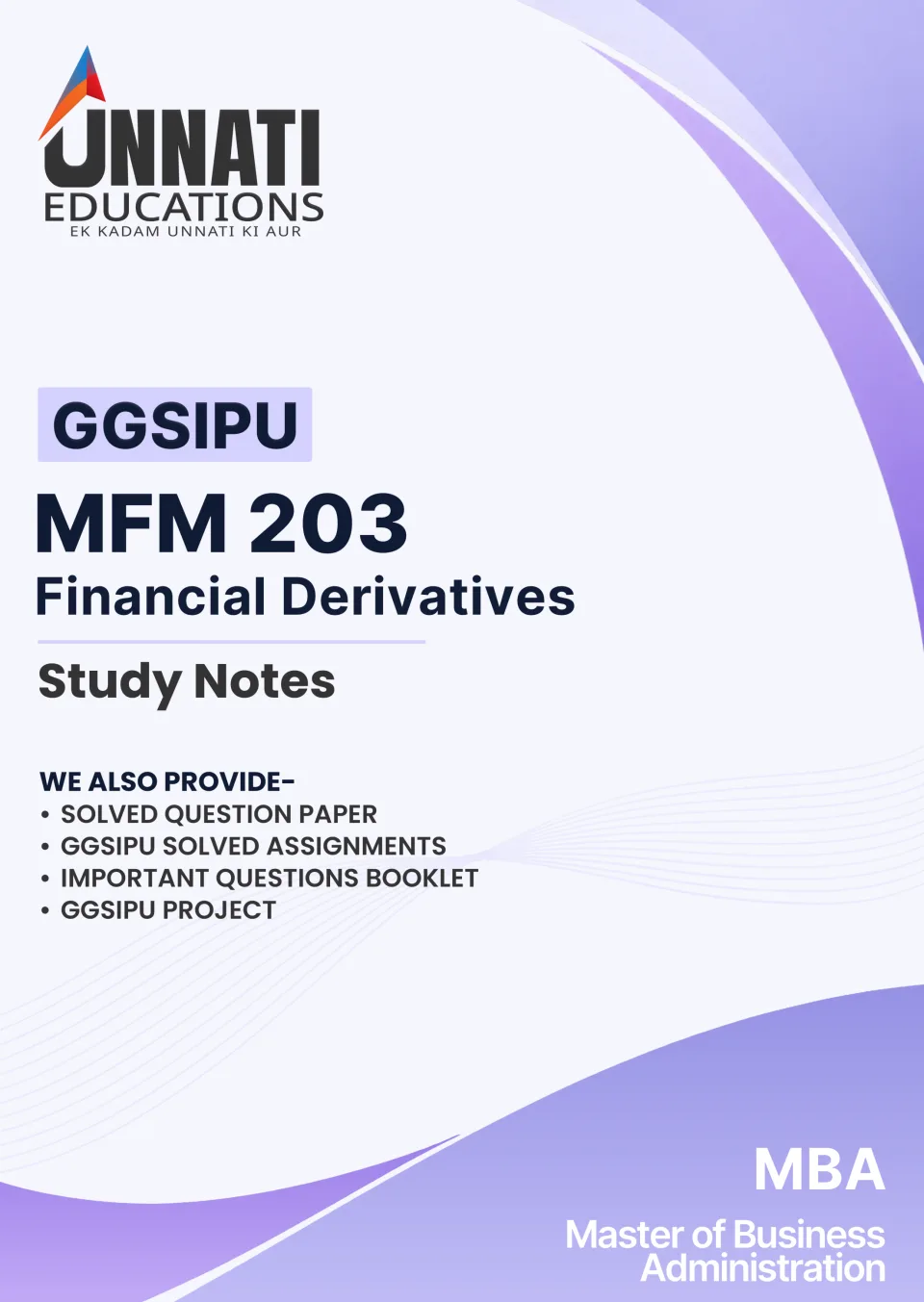
MFM 203 Financial Derivatives Notes cover all four units of the GGSIPU MBA (Financial Management) Semester 3 paper in a 54-page printed English book. The notes include 25 worked illustrations, 12 solved exam questions and 45 additional practice questions. Topics include derivative markets, forwards and futures, options, swaps, hedging, valuation and Indian derivatives regulation. They follow the MBA (FM) syllabus scheme labelled 2021-22 onwards.
Written by Prateek Talwar, Founder, Unnati Educations · Reviewed by Prateek Talwar, Associate Company Secretary (ACS), ICSI · Checked against the MBA (Financial Management) Scheme and Syllabus, 2021-22 onwards · Updated 14 October 2026 · Editorial policy
Scheme: MBA (FM) 2021-22 onwards | Applies to: batches admitted from 2021-22 onwards, subject to their applicable scheme | Verified against: syllabus mapping in the supplied editorial record; official PDF identified as dated 20 May 2022
MFM 203 Financial Derivatives at a glance: GGSIPU MBA (FM) Sem 3 credits, units and exam pattern
MFM 203 is a core paper in the third semester of MBA (Financial Management). It introduces derivative markets, explains forward and futures contracts, develops option pricing and trading strategies, and covers swaps and Indian derivatives regulation.
Code and title | MFM 203 · Financial Derivatives |
|---|---|
Course and semester | MBA (Financial Management), Semester 3 |
Category and credits | Core, 3 credits; 3 lecture hours per week |
Marks | 100: 25 internal (15-mark class test and 10 marks for assignments, presentations or viva) + 75 end-term |
Pass mark | Not specified in the supplied scheme details; consult GGSIPU Ordinance 11 and applicable examination notifications |
Applies to | Batches admitted from 2021-22 onwards under the stated scheme |
End-term pattern | 75 marks; the detailed question-paper pattern is not confirmed in the supplied scheme |
Units and hours | 4 units, 42 teaching hours: 10 + 10 + 10 + 12 |
Paired lab | None |
MFM 203 Financial Derivatives Notes unit-wise: 25 worked illustrations and 12 solved exam questions across 4 units
The notes follow the four units in the supplied syllabus order. Each unit includes a quick revision table, three solved exam questions and additional practice questions. The book contains 25 worked illustrations, 12 solved questions and 45 practice questions.
MFM 203 Unit 1: Financial Derivatives
Unit 1 (pages 4 to 16) introduces financial derivatives through 10 sections. It covers the definition under Section 2(ac) of the Securities Contracts (Regulation) Act, 1956, the development of derivatives markets, forwards, futures, options and swaps. It also introduces weather derivatives, energy derivatives, catastrophe bonds, hedgers, speculators and arbitrageurs. The unit contains 3 worked illustrations, 3 solved exam questions, 6 short-answer questions and 5 long-answer practice questions.
Basis | Exchange-traded derivatives | OTC derivatives |
|---|---|---|
Counterparty risk | Reduced through central clearing, margins and default-management arrangements; not entirely eliminated. | Depends on the counterparty and applicable collateral, clearing and risk-mitigation arrangements. |
Margins | Exchange and clearing-corporation margin requirements, with mark-to-market settlement where applicable. | Collateral and margin requirements depend on the contract and applicable regulatory framework. |
Examples | Nifty futures, exchange-traded stock options and MCX gold futures. | Customised forward contracts, interest rate swaps and forward rate agreements. |
Quick look: exchange-traded versus OTC derivatives (from page 14)
Basis
Counterparty risk
Exchange-traded derivatives
Reduced through central clearing, margins and default-management arrangements; not entirely eliminated.
OTC derivatives
Depends on the counterparty and applicable collateral, clearing and risk-mitigation arrangements.
Basis
Margins
Exchange-traded derivatives
Exchange and clearing-corporation margin requirements, with mark-to-market settlement where applicable.
OTC derivatives
Collateral and margin requirements depend on the contract and applicable regulatory framework.
Basis
Examples
Exchange-traded derivatives
Nifty futures, exchange-traded stock options and MCX gold futures.
OTC derivatives
Customised forward contracts, interest rate swaps and forward rate agreements.
MFM 203 Unit 2: Financial Forward and Futures Contracts
Unit 2 (pages 17 to 29) contains 8 sections and the largest number of worked illustrations: 12 of the book's 25. Topics include forward pricing, forward rate agreements, stock futures, index futures, currency futures, interest rate futures, commodity futures, backwardation, contango, basis, cost-of-carry pricing, long and short hedges, and optimal hedge ratios. It contains 3 solved exam questions, 6 short-answer questions and 5 long-answer practice questions.
Quick look: cost-of-carry pricing for a share without income (from page 24)
Formula: For a non-income-paying asset under continuous compounding, F0 = S0 × erT.
Given: Spot price ₹1,000, annual continuously compounded risk-free rate 10%, time to maturity 6 months.
Substitute: F0 = 1,000 × e0.10 × 0.5.
Fair forward price: Approximately ₹1,051.27.
Dividend adjustment: For an index with a continuous dividend yield q, the corresponding formula is F0 = S0 × e(r − q)T.
The example assumes frictionless markets, no transaction costs and the stated continuously compounded rate. Actual exchange-traded futures prices can differ from theoretical values because of market conditions and trading costs.
MFM 203 Unit 3: Financial Options
Unit 3 (pages 30 to 42) contains 8 sections covering calls and puts, moneyness, interest rate caps and floors, one-step and two-step binomial pricing, the Black-Scholes model, straddles, strangles, spreads, the option Greeks and nine exotic option types discussed in the notes. It includes 5 worked illustrations, 3 solved exam questions, 6 short-answer questions and 6 long-answer practice questions.
Greek | What it measures |
|---|---|
Delta (Δ) | Sensitivity of option value to a small change in the underlying asset price. In the standard Black-Scholes European call model without dividends, delta is N(d1). |
Gamma (Γ) | Rate of change of delta as the underlying asset price changes. |
Theta (Θ) | Sensitivity of option value to the passage of time, under the specified time convention. |
Vega (ν) | Sensitivity of option value to a change in implied volatility. |
Rho (ρ) | Sensitivity of option value to a change in the interest rate. |
Quick look: option Greeks and the risks they measure (from page 38)
Greek
Delta (Δ)
What it measures
Sensitivity of option value to a small change in the underlying asset price. In the standard Black-Scholes European call model without dividends, delta is N(d1).
Greek
Gamma (Γ)
What it measures
Rate of change of delta as the underlying asset price changes.
Greek
Theta (Θ)
What it measures
Sensitivity of option value to the passage of time, under the specified time convention.
Greek
Vega (ν)
What it measures
Sensitivity of option value to a change in implied volatility.
Greek
Rho (ρ)
What it measures
Sensitivity of option value to a change in the interest rate.
Vega and rho values must be interpreted using the model's rate and volatility conventions; a one-percentage-point change is not the same as a one-unit change in decimal form.
MFM 203 Unit 4: Swap Contracts and Regulatory Framework for Derivatives
Unit 4 (pages 43 to 53) contains 6 sections and receives the most teaching hours, at 12. It introduces interest rate swaps and currency swaps, comparative advantage, swap valuation, a rupee-dollar currency swap example and the regulatory framework involving the L.C. Gupta Committee, J.R. Varma Committee, SEBI, RBI and CCIL. The unit contains 5 worked illustrations, 3 solved exam questions, 6 short-answer questions and 5 long-answer practice questions.
Basis | Interest rate swap | Currency swap |
|---|---|---|
Principal | Typically a notional amount used to calculate interest; ordinarily not exchanged in a standard single-currency interest rate swap. | Principal amounts in different currencies may be exchanged initially and re-exchanged at maturity, depending on the contract. |
Interest payments | Payments may be netted when the agreement and payment currency permit. | Cash flows in different currencies are generally exchanged according to the agreement rather than netted as a single-currency amount. |
Risk hedged | Primarily interest rate exposure. | Currency exposure and, depending on structure, interest rate exposure. |
Quick look: interest rate swap versus currency swap (from page 48)
Basis
Principal
Interest rate swap
Typically a notional amount used to calculate interest; ordinarily not exchanged in a standard single-currency interest rate swap.
Currency swap
Principal amounts in different currencies may be exchanged initially and re-exchanged at maturity, depending on the contract.
Basis
Interest payments
Interest rate swap
Payments may be netted when the agreement and payment currency permit.
Currency swap
Cash flows in different currencies are generally exchanged according to the agreement rather than netted as a single-currency amount.
Basis
Risk hedged
Interest rate swap
Primarily interest rate exposure.
Currency swap
Currency exposure and, depending on structure, interest rate exposure.
Futures trading steps and margins on Indian exchanges: excerpt from page 22 of the MFM 203 notes
Excerpt from page 22
Who takes part in futures trading?
Futures trading involves exchanges such as NSE, BSE and MCX; trading members who execute orders; clearing members who meet clearing and settlement obligations; clearing corporations that provide central counterparty services; clients such as hedgers, speculators and arbitrageurs; and regulators including SEBI. The functions of trading and clearing members may be performed by different entities or combined according to their membership arrangements.
The eight steps from account opening to expiry
Open a trading account: Complete KYC and applicable derivatives-segment activation requirements with a registered intermediary.
Provide initial margin: Meet the applicable upfront margin and collateral requirements.
Place an order: Buy a futures contract to establish a long position or sell to establish a short position.
Order matching: The exchange matches eligible orders through its trading system.
Clearing and novation: The clearing corporation assumes the central counterparty role under its rules.
Mark-to-market: Positions are valued using the applicable settlement price, with gains and losses settled under clearing rules.
Meet additional margin requirements: Provide additional funds or collateral when required by the intermediary or clearing framework.
Close or settle: Square off the position before expiry or complete the applicable cash or physical settlement process.
Five margin concepts explained
Initial margin is required to establish a position. SPAN is a risk-based margin methodology discussed in the notes, while exposure or extreme-loss margin provides an additional buffer under applicable rules. Maintenance margin refers to a minimum margin level used in certain margining arrangements. Variation margin addresses changes in exposure or settlement value, and mark-to-market settlement accounts for periodic gains and losses.
The source describes SPAN using a one-day, 99% risk measure and a maintenance-margin top-up process. Those descriptions should be treated as explanations of the framework in the notes, not as universal current requirements for every Indian derivatives segment or product.
MFM 203 exam corner: 12 solved questions plus 24 short-answer and 21 long-answer practice questions by unit
Unit | Solved questions | Short-answer practice | Long-answer practice | Worked illustrations |
|---|---|---|---|---|
Unit 1: Financial Derivatives | 3 | 6 | 5 | 3 |
Unit 2: Forwards and Futures | 3 | 6 | 5 | 12 |
Unit 3: Financial Options | 3 | 6 | 6 | 5 |
Unit 4: Swaps and Regulation | 3 | 6 | 5 | 5 |
Total | 12 | 24 | 21 | 25 |
Exam questions and worked illustrations in the MFM 203 notes
Unit
Unit 1: Financial Derivatives
Solved questions
3
Short-answer practice
6
Long-answer practice
5
Worked illustrations
3
Unit
Unit 2: Forwards and Futures
Solved questions
3
Short-answer practice
6
Long-answer practice
5
Worked illustrations
12
Unit
Unit 3: Financial Options
Solved questions
3
Short-answer practice
6
Long-answer practice
6
Worked illustrations
5
Unit
Unit 4: Swaps and Regulation
Solved questions
3
Short-answer practice
6
Long-answer practice
5
Worked illustrations
5
Unit
Total
Solved questions
12
Short-answer practice
24
Long-answer practice
21
Worked illustrations
25
Total: 12 solved exam questions, 45 additional practice questions (24 short and 21 long), and 25 worked illustrations. The practice labels of 2–5 marks and 10–15 marks do not establish the official university question-paper pattern.
One question per unit, with answer pointers:
Unit 1: What is a financial derivative? Explain its features. Pointer: Explain the definition under Section 2(ac) of the SCRA, 1956, and discuss underlying value, leverage, risk transfer, settlement, hedging and price discovery. Avoid treating every derivative as necessarily zero-sum after costs.
Unit 2: Find the theoretical value of a three-month Nifty future when the spot index is 24,000, the risk-free rate is 7% and the dividend yield is 1.5%. Pointer: Under continuous compounding, use F0 = S0 × e(r − q)T = 24,000 × e0.055 × 0.25 = 24,332.28.
Unit 3: Compare binomial and Black-Scholes option pricing. Pointer: Explain discrete versus continuous-time modelling, backward induction in a binomial tree, and the standard Black-Scholes closed-form model for European-style options.
Unit 4: Explain the main recommendations of the L.C. Gupta Committee. Pointer: Discuss phased introduction of derivatives, index futures, clearing and settlement safeguards, regulatory supervision and the legal recognition of derivatives as securities.
Additional practice questions are included in the printed notes. A separate MFM 203 important-questions page is not linked here because its publication status has not been confirmed.
Who writes and checks the MFM 203 Financial Derivatives notes?
Prateek Talwar, author: Founder, Unnati Educations; Associate Company Secretary (ACS), ICSI, membership no. 58704, since 15 May 2019; B.Com, University of Delhi (School of Open Learning), 2012. Author profile
Prateek Talwar is also identified as the subject reviewer. The supplied editorial record states that the notes were mapped to the MBA (Financial Management) scheme labelled 2021-22 onwards.
The 2026–27 edition discusses exotic options and Indian market examples such as Nifty, USD-INR and MIBOR. Last updated 14 October 2026. See the editorial policy for review and correction information.
Do the MFM 203 notes cover the full GGSIPU syllabus?
The supplied syllabus map identifies corresponding notes sections for all four MFM 203 units. The editorial source claims complete coverage, but independent verification against every page of the printed book is still pending.
Official unit | Official topics | Where in the notes | Status |
|---|---|---|---|
Unit I: Financial Derivatives | History and development; concept, purpose and types; weather, energy and insurance derivatives; market participants; exchange-traded versus OTC derivatives | Sections 1–10, pages 4–14 | Mapped in supplied record |
Unit II: Financial Forward and Futures Contracts | Forwards and FRAs; stock, index, currency, interest rate and commodity futures; trading; pricing theories; cost of carry; valuation; hedging and optimal hedge ratio | Sections 1–8, pages 17–27 | Mapped in supplied record |
Unit III: Financial Options | Types of options; Black-Scholes and binomial models; option trading; straddles, strangles and spreads; Greeks and exotic options | Sections 1–8, pages 30–41 | Mapped in supplied record |
Unit IV: Swap Contracts and Regulatory Framework for Derivatives | Swaps; interest rate and currency swap mechanics; regulation of derivatives in India | Sections 1–6, pages 43–51 | Mapped in supplied record |
MFM 203 official units mapped to the notes
Official unit
Unit I: Financial Derivatives
Official topics
History and development; concept, purpose and types; weather, energy and insurance derivatives; market participants; exchange-traded versus OTC derivatives
Where in the notes
Sections 1–10, pages 4–14
Status
Mapped in supplied record
Official unit
Unit II: Financial Forward and Futures Contracts
Official topics
Forwards and FRAs; stock, index, currency, interest rate and commodity futures; trading; pricing theories; cost of carry; valuation; hedging and optimal hedge ratio
Where in the notes
Sections 1–8, pages 17–27
Status
Mapped in supplied record
Official unit
Unit III: Financial Options
Official topics
Types of options; Black-Scholes and binomial models; option trading; straddles, strangles and spreads; Greeks and exotic options
Where in the notes
Sections 1–8, pages 30–41
Status
Mapped in supplied record
Official unit
Unit IV: Swap Contracts and Regulatory Framework for Derivatives
Official topics
Swaps; interest rate and currency swap mechanics; regulation of derivatives in India
Where in the notes
Sections 1–6, pages 43–51
Status
Mapped in supplied record
Official reference: MBA (Financial Management) Scheme and Syllabus, 2021-22 onwards. The supplied source identifies page 46 as the relevant syllabus page.
How to write MFM 203 answers: strategy payoff tables, hedge ratio steps and swap gain tables
For a Unit 1 definition question, begin with the statutory meaning of derivatives and then explain their purpose, characteristics and principal types. For Unit 2 numericals, write the optimal hedge ratio as h* = ρ × σS / σF, calculate the hedge position and explain whether the appropriate futures position is long or short.
For Unit 3 option strategies, state the market expectation, construction, premium, maximum profit, maximum loss, breakeven points and expiry payoff. For Unit 4 comparative-advantage swaps, compare the borrowing-rate differences and explain how any potential gain is allocated between the parties, allowing for intermediary costs where relevant.
Worked example: long Nifty straddle at 24,000 (Unit 3 strategy section)
A trader buys a call with strike 24,000 for ₹300 and a put with the same strike for ₹280. Total premium paid is ₹580 per index unit. The strategy benefits from a sufficiently large move in either direction.
Construction: Buy one 24,000 call and one 24,000 put with the same expiry.
Total premium: ₹300 + ₹280 = ₹580.
Lower breakeven: 24,000 − 580 = 23,420.
Upper breakeven: 24,000 + 580 = 24,580.
Maximum loss: ₹580 per index unit, when the index expires at 24,000.
Nifty at expiry | Call payoff | Put payoff | Net profit or loss |
|---|---|---|---|
23,000 | 0 | 1,000 | +420 |
23,420 | 0 | 580 | 0 — lower breakeven |
24,000 | 0 | 0 | −580 — maximum loss |
24,580 | 580 | 0 | 0 — upper breakeven |
25,000 | 1,000 | 0 | +420 |
Long straddle payoff at expiry, before transaction costs
Nifty at expiry
23,000
Call payoff
0
Put payoff
1,000
Net profit or loss
+420
Nifty at expiry
23,420
Call payoff
0
Put payoff
580
Net profit or loss
0 — lower breakeven
Nifty at expiry
24,000
Call payoff
0
Put payoff
0
Net profit or loss
−580 — maximum loss
Nifty at expiry
24,580
Call payoff
580
Put payoff
0
Net profit or loss
0 — upper breakeven
Nifty at expiry
25,000
Call payoff
1,000
Put payoff
0
Net profit or loss
+420
The payoff values are per index unit. Actual contract profit or loss also depends on lot size, transaction charges and taxes.
MFM 203 and the GGSIPU MBA (FM) Sem 3 papers it connects to
Paired lab: None. MFM 203 is a 3-credit core theory paper.
MFM 205 Financial Markets and Institutions: Exchanges, market participants and regulators relevant to derivative trading.
MFM 209 Strategic Financial Management: Financial risk management and hedging decisions.
MFM 211 Business Analytics: Volatility, correlation and quantitative inputs relevant to hedging and option analysis.
MFM 227 Business Analytics Lab: Practical analysis that can support quantitative financial modelling.
MFM 217 International Financial Management: Currency forwards, foreign exchange exposure and currency swaps.
Group | Papers |
|---|---|
Entrepreneurship | |
Training | MFM 201 Summer Training Report |
Online learning | MFM 213 MOOCs / Open Elective |
Elective group | Elective papers identified in the supplied scheme as MFM 215–225 |
Other Semester 3 papers mentioned in the supplied MBA (FM) scheme summary
Group
Entrepreneurship
Group
Training
Papers
MFM 201 Summer Training Report
Group
Online learning
Papers
MFM 213 MOOCs / Open Elective
Group
Elective group
Papers
Elective papers identified in the supplied scheme as MFM 215–225
MFM 203 Derivatives notes FAQs
How do I get the full MFM 203 notes?
Use the WhatsApp ordering button below. The full MFM 203 Financial Derivatives notes are supplied as a 54-page printed English book, not as a full-book PDF download. A separate seven-page sample PDF is planned for preview.
What is the passing mark for MFM 203 Financial Derivatives?
MFM 203 carries 100 marks: 25 internal and 75 end-term. The supplied scheme does not specify a separate pass percentage for this paper. Consult GGSIPU Ordinance 11 and applicable university notifications for pass and re-appear requirements.
Is MFM 203 a core paper or an elective in MBA (FM)?
MFM 203 is a core paper in Semester 3 of the supplied MBA (Financial Management) scheme. It carries 3 credits and has 3 lecture hours per week. Elective papers are listed separately.
Which MFM 203 unit has the most numericals?
Unit 2, Financial Forward and Futures Contracts, contains 12 of the 25 worked illustrations. These cover forward pricing, forward rate agreements, daily mark-to-market, beta hedging and optimal hedge ratios. Unit 3 and Unit 4 contain five worked illustrations each.
Which batch does the MFM 203 syllabus apply to?
The notes follow the MBA (Financial Management) scheme labelled 2021-22 onwards. Students admitted in later years should check whether their batch continues under that scheme or a revised one.
Are the MFM 203 notes available as a PDF download?
No. The complete notes are sold as a printed book. The source plans a seven-page watermarked sample PDF showing the cover, index and selected unit pages. The summaries and worked examples on this webpage are free to read.
Get the full MFM 203 Financial Derivatives Notes on WhatsApp
The English printed book covers financial derivative markets, forwards and futures, options, swaps, hedging and Indian regulation. It is listed as 54 pages and includes 25 worked illustrations and 12 solved exam questions.
Part | Pages | Worked illustrations | Solved questions |
|---|---|---|---|
Cover and index | 1–3 (3) | — | — |
4–16 (13) | 3 | 3 | |
17–29 (13) | 12 | 3 | |
30–42 (13) | 5 | 3 | |
43–53 (11) | 5 | 3 | |
Final page to confirm | 54 (1; content not identified) | — | — |
Listed book total | 54 | 25 | 12 |
Documented pages and content in the MFM 203 printed notes
Part
Cover and index
Pages
1–3 (3)
Worked illustrations
—
Solved questions
—
Pages
4–16 (13)
Worked illustrations
3
Solved questions
3
Pages
17–29 (13)
Worked illustrations
12
Solved questions
3
Pages
30–42 (13)
Worked illustrations
5
Solved questions
3
Pages
43–53 (11)
Worked illustrations
5
Solved questions
3
Part
Final page to confirm
Pages
54 (1; content not identified)
Worked illustrations
—
Solved questions
—
Part
Listed book total
Pages
54
Worked illustrations
25
Solved questions
12
The printed notes also contain 45 additional practice questions: 24 short-answer and 21 long-answer questions. Page 54 remains unassigned in the supplied page breakdown and should be checked against the final printed book.
Delivery: within 5 to 7 days at most; the exact time may vary with your location.
Order the MFM 203 notes book on WhatsApp (4 units, 54 pages)
Unnati Educations is an independent education provider based in Vikaspuri, Delhi. We are not affiliated with, authorised by, or endorsed by Guru Gobind Singh Indraprastha University (GGSIPU). 'GGSIPU' and 'IPU' are used only to describe the syllabus our notes follow. For official information, visit ipu.ac.in.
Ready for the full notes?
Discuss coverage and delivery with our team.