
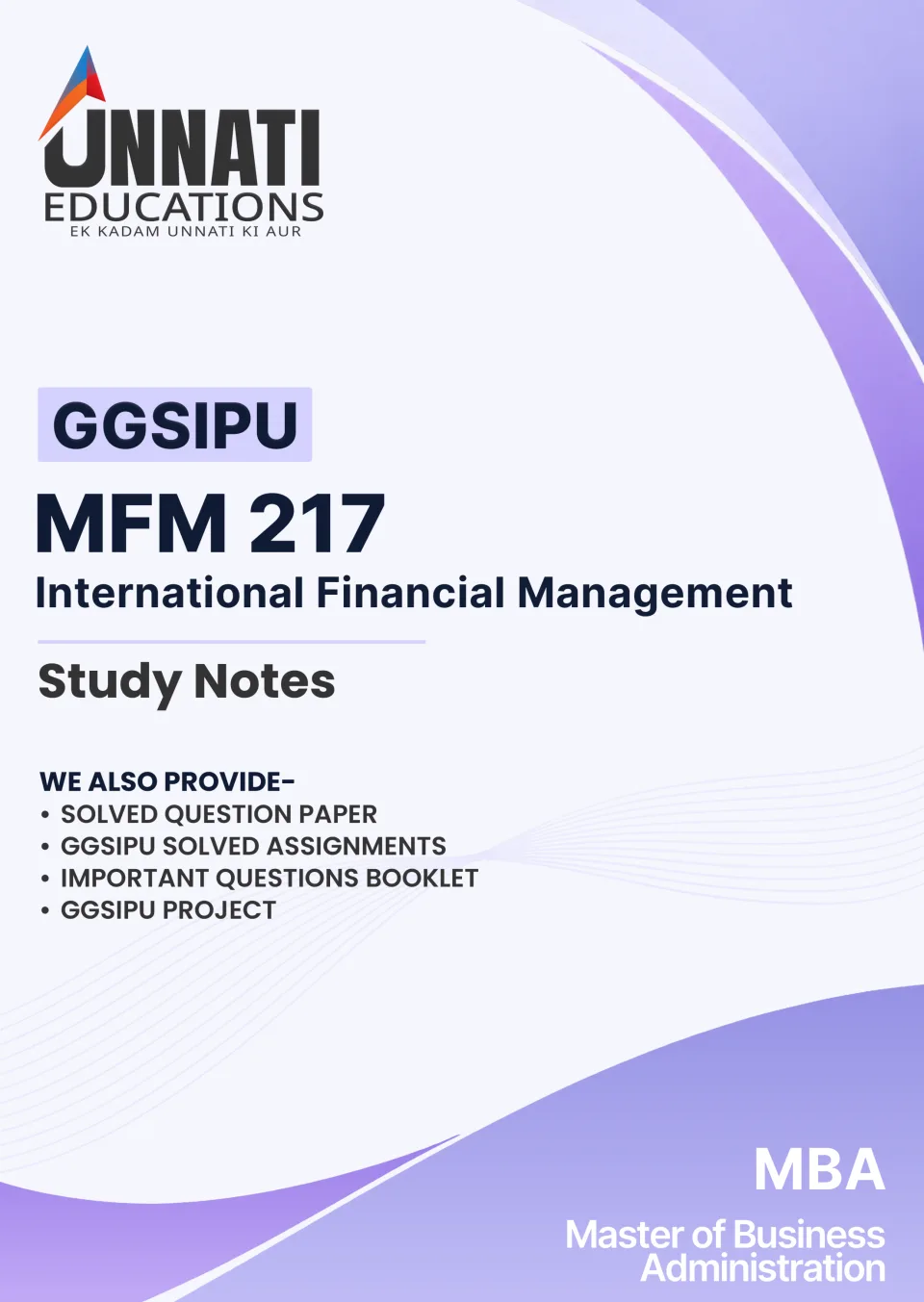
MFM 217 International Financial Management Notes cover all four units of the GGSIPU MBA (Financial Management) Semester 3 elective. The English printed book is listed as 78 pages and contains 25 worked illustrations, 26 fully answered important questions and 76 exam-style practice questions. Topics include international monetary systems, foreign exchange markets, currency quotations and arbitrage, exchange-rate parity theories, currency exposure, forward and money-market hedging, futures, options, swaps and foreign investment appraisal. The notes follow the MBA (FM) scheme labelled 2021-22 onwards.
Written by Prateek Talwar, Founder, Unnati Educations · Reviewed by Prateek Talwar · Checked against the MBA (Financial Management) Scheme and Syllabus, 2021-22 onwards · Updated 14 October 2026 · Editorial policy
Scheme: MBA (FM) 2021-22 onwards | Applies to: batches admitted from 2021-22 onwards | Verified against: supplied syllabus mapping; last recorded check 13 October 2026
MFM 217 International Financial Management at a glance: GGSIPU MBA FM Sem 3 credits, units and exam pattern
MFM 217 is a Semester 3 elective covering international monetary systems, foreign exchange markets, currency risk management and foreign investment appraisal. The supplied scheme lists four units and 42 teaching hours.
Code and title | MFM 217 (also printed MFM-217) · International Financial Management |
|---|---|
Course and semester | |
Category and credits | Elective theory paper, 3 credits; L-3, T/P-0 |
Marks | 100: 25 internal (15 class test + 10 assignments, presentation, viva or participation) + 75 end-term |
Pass mark | Not specified in the supplied scheme details; consult GGSIPU Ordinance 11 and applicable examination notifications |
Applies to | Batches covered by the MBA (FM) scheme labelled 2021-22 onwards |
End-term pattern | 75 marks; detailed official question-paper pattern not confirmed in the supplied syllabus extract |
Units and hours | 4 units, 42 teaching hours: 10 + 12 + 10 + 10 |
Paired lab | None; MFM 227 Business Analytics Lab is associated with Business Analytics, not MFM 217 |
The supplied scheme summary lists MFM 217 among six Semester 3 elective options, with students selecting four under that programme structure. Unit 2 receives the most teaching hours, at 12.
MFM 217 International Financial Management Notes unit-wise: 25 worked illustrations and 26 answered questions across 4 units
The documented unit pages run from page 5 to page 77. Together, the units contain 25 worked illustrations, 26 fully answered questions and 76 practice questions.
MFM 217 Unit 1: Global Financial Environment
Unit 1 (pages 5 to 26) covers international versus domestic finance, the evolution of international monetary systems, fixed and floating exchange rates, India's exchange-rate regime, the IMF, Euro-currency markets, the euro, ADRs, GDRs, external commercial borrowings and the Balance of Payments. It contains 11 sections, 1 worked illustration, 7 answered questions and 17 practice questions.
Basis | Fixed exchange rate | Flexible exchange rate |
|---|---|---|
Rate determination | Maintained against a target or peg through the relevant monetary authority's arrangements | Primarily determined by market demand and supply, subject to possible intervention |
Official fall in value | Devaluation under an adjustable peg | Depreciation through market movements |
Monetary policy | Autonomy can be constrained, particularly with free capital mobility | Greater potential autonomy, depending on capital mobility and policy choices |
Quick look: fixed versus flexible exchange rates (from page 10)
Basis
Rate determination
Fixed exchange rate
Maintained against a target or peg through the relevant monetary authority's arrangements
Flexible exchange rate
Primarily determined by market demand and supply, subject to possible intervention
Basis
Official fall in value
Fixed exchange rate
Devaluation under an adjustable peg
Flexible exchange rate
Depreciation through market movements
Basis
Monetary policy
Fixed exchange rate
Autonomy can be constrained, particularly with free capital mobility
Flexible exchange rate
Greater potential autonomy, depending on capital mobility and policy choices
The policy comparison illustrates the Impossible Trinity: an economy cannot simultaneously maintain a fixed exchange rate, unrestricted capital mobility and an independent monetary policy.
MFM 217 Unit 2: Foreign Exchange Market
Unit 2 (pages 27 to 46) is the main foreign-exchange numerical unit. It covers market participants, spot and forward quotations, swaps, cross rates, arbitrage, India's foreign-exchange market, FEDAI, CCIL, purchasing power parity, interest rate parity, the International Fisher Effect, exchange-rate determination, forecasting and the rupee's real effective exchange rate. It contains 12 sections, 12 worked illustrations, 7 answered questions and 22 practice questions, including 4 numerical questions.
Quick look: an interest rate parity forward rate (from page 39)
Spot USD/INR rate = ₹84.00 per US dollar.
One-year interest rates: India 7%; United States 4.5%.
Illustrative forward rate under covered interest parity = 84 × 1.07 ÷ 1.045 = ₹86.01 per USD.
The dollar's forward premium is approximately 2.39% relative to the ₹84.00 spot rate.
The illustration assumes comparable one-year interest rates, matched maturities and no transaction costs or other market frictions.
MFM 217 Unit 3: Foreign Exchange Risk Exposure
Unit 3 (pages 47 to 63) explains transaction, translation and economic exposure, Value at Risk, internal hedging, forward contracts, money-market hedges, currency futures, options, swaps and the regulatory roles of RBI and SEBI. It includes 10 sections, 8 worked illustrations, 6 answered questions and 20 practice questions, including 3 numerical questions.
Basis | Forward contract | Futures contract |
|---|---|---|
Trading venue | Generally over the counter with a counterparty such as a bank | Exchange-traded |
Contract terms | Can be customised to amount and maturity | Standardised contract specifications |
Settlement and margin | Typically settled according to contractual maturity and terms | Subject to margin requirements and daily mark-to-market settlement |
Quick look: currency forwards versus futures (from page 56)
Basis
Trading venue
Forward contract
Generally over the counter with a counterparty such as a bank
Futures contract
Exchange-traded
Basis
Contract terms
Forward contract
Can be customised to amount and maturity
Futures contract
Standardised contract specifications
Basis
Settlement and margin
Forward contract
Typically settled according to contractual maturity and terms
Futures contract
Subject to margin requirements and daily mark-to-market settlement
MFM 217 Unit 4: Foreign Investment Decision
Unit 4 (pages 64 to 77) covers foreign direct investment motives, the OLI paradigm, international project appraisal, the cost of foreign debt and equity, country risk, international joint ventures, home-currency NPV, adjusted present value and real options. It contains 8 sections, 4 worked illustrations, 6 answered questions and 17 practice questions, including 3 numerical questions.
Quick look: adjusted present value of a foreign project (from page 75)
Base-case all-equity NPV at 14% = −₹6 crore.
Add present value of loan subsidy = ₹4 crore.
Add present value of tax shields = ₹3.5 crore.
Deduct issue costs = ₹0.5 crore.
APV = −6 + 4 + 3.5 − 0.5 = +₹1 crore.
The project has positive APV under the illustration's stated assumptions. This conclusion depends on the validity of the projected cash flows and financing-benefit estimates.
MFM 217 exam corner: 26 solved questions and 76 practice questions by unit
Unit | Answered | Short practice | Long practice | Numerical practice | Worked illustrations |
|---|---|---|---|---|---|
Unit 1 | 7 | 10 | 7 | 0 | 1 |
Unit 2 | 7 | 10 | 8 | 4 | 12 |
Unit 3 | 6 | 10 | 7 | 3 | 8 |
Unit 4 | 6 | 8 | 6 | 3 | 4 |
Total | 26 | 38 | 28 | 10 | 25 |
MFM 217 answered questions, practice questions and worked illustrations
Unit
Unit 1
Answered
7
Short practice
10
Long practice
7
Numerical practice
0
Worked illustrations
1
Unit
Unit 2
Answered
7
Short practice
10
Long practice
8
Numerical practice
4
Worked illustrations
12
Unit
Unit 3
Answered
6
Short practice
10
Long practice
7
Numerical practice
3
Worked illustrations
8
Unit
Unit 4
Answered
6
Short practice
8
Long practice
6
Numerical practice
3
Worked illustrations
4
Unit
Total
Answered
26
Short practice
38
Long practice
28
Numerical practice
10
Worked illustrations
25
Total: 26 fully answered important questions, 76 additional practice questions (38 short + 28 long + 10 numerical) and 25 worked illustrations. Practice-question marks are labelled 2–5 and 10–15 in the notes; these are not independently confirmed as the official examination pattern.
One question per unit, with answer pointers:
Unit 1: Explain the Impossible Trinity in international finance. Pointer: Define the three policy objectives: fixed exchange rate, free capital mobility and independent monetary policy. Explain why only two can be maintained simultaneously and compare different exchange-rate arrangements.
Unit 2: How are direct and indirect currency quotations calculated? Pointer: Identify the home and foreign currencies, express the direct quote as home currency per unit of foreign currency, and take the reciprocal for an indirect quote. In two-way quotations, invert the ask to obtain the reciprocal bid and invert the bid to obtain the reciprocal ask.
Unit 3: What is a money-market hedge? Pointer: For a foreign-currency payable, purchase and deposit the present value of the payable in the foreign currency, financing it in the home currency. For a receivable, borrow the foreign-currency present value, convert it and invest at home.
Unit 4: How should blocked funds be treated in foreign project appraisal? Pointer: Model remittance restrictions, release dates and any permitted local reinvestment separately. Discount the cash flows actually available to the parent, rather than assuming all subsidiary profits can be remitted immediately.
The separate MFM 217 important-questions page is planned; its live publication is not confirmed.
Direct quotes, bid-ask spreads and pips in the forex market: excerpt from page 31 of the MFM 217 notes
Excerpt from page 31, Unit 2: Exchange Rate Quotations
An exchange rate expresses the value of one currency in another. In a currency pair, the first currency is the base currency and the second is the quote currency. For example, USD/INR = 84.25 means one US dollar costs ₹84.25.
Direct and indirect quotations
For a resident of India, a direct quotation states the number of rupees per unit of foreign currency. Thus, USD/INR = 84.00 is a direct quotation. An indirect quotation states foreign-currency units per rupee. Its reciprocal is:
INR/USD = 1 ÷ 84 = 0.01190476 USD per INR.
Direct and indirect depend on the domestic currency of the observer. A quotation convention should not be confused with a universal instruction to buy high or sell low.
American and European terms
American terms express the value of a foreign currency in US dollars, such as GBP/USD = 1.3000. European terms express units of another currency per US dollar, such as USD/JPY = 150.00. These are quotation conventions and differ from the home-currency meaning of direct and indirect quotations.
Bid, ask and spread
Dealers commonly quote a bid and an ask. The bid is the price at which the dealer buys the base currency; the ask is the price at which the dealer sells it.
For USD/INR = 84.20/84.35, the bank buys one US dollar for ₹84.20 and sells one US dollar for ₹84.35.
Measure | Value |
|---|---|
Bid | ₹84.20 |
Ask | ₹84.35 |
Absolute spread | 84.35 − 84.20 = ₹0.15 |
Spread as percentage of ask | 0.15 ÷ 84.35 × 100 = 0.178% |
Bid-ask spread calculation for USD/INR
Measure
Bid
Value
₹84.20
Measure
Ask
Value
₹84.35
Measure
Absolute spread
Value
84.35 − 84.20 = ₹0.15
Measure
Spread as percentage of ask
Value
0.15 ÷ 84.35 × 100 = 0.178%
The spread can vary with market liquidity, volatility, transaction size and the dealer's pricing conditions.
Pips
A pip is a conventional minimum quotation increment for a currency pair, rather than simply the last digit shown on every screen. For EUR/USD quoted to four conventional decimal places, one pip is 0.0001. For USD/JPY quoted to two conventional decimal places, one pip is 0.01. Some platforms display additional fractional-pip digits.
Do the MFM 217 notes cover the full GGSIPU syllabus?
The supplied editorial mapping identifies material for all four official MFM 217 units. The section-to-topic mapping is provided below. Complete coverage has not been independently checked against the final printed book.
Official unit | Official topics | In the notes | Status |
|---|---|---|---|
I: Global Financial Environment | International financial environment, international monetary systems, exchange-rate regimes, IMF, Euro-currency and capital markets, and Balance of Payments | Sections 1–9, pages 5–23; further material and questions to page 26 | Mapped in source |
II: Foreign Exchange Market | Market nature, structure and transactions; quotations, arbitrage, spot and forward markets; India's foreign-exchange market; structural models, forecasting and the rupee exchange rate | Sections 1–10, pages 27–45; further material to page 46 | Mapped in source |
III: Foreign Exchange Risk Exposure | Types of foreign-exchange risk, hedging, swaps, futures, options, derivatives and RBI/SEBI roles | Sections 1–8, pages 47–61; further material to page 63 | Mapped in source |
IV: Foreign Investment Decision | International project appraisal, exchange-rate risk and cost of capital, joint ventures and NPV | Sections 1–6, pages 64–75; further material to page 77 | Mapped in source |
MFM 217 official syllabus topics mapped to the notes
Official unit
I: Global Financial Environment
Official topics
International financial environment, international monetary systems, exchange-rate regimes, IMF, Euro-currency and capital markets, and Balance of Payments
In the notes
Sections 1–9, pages 5–23; further material and questions to page 26
Status
Mapped in source
Official unit
II: Foreign Exchange Market
Official topics
Market nature, structure and transactions; quotations, arbitrage, spot and forward markets; India's foreign-exchange market; structural models, forecasting and the rupee exchange rate
In the notes
Sections 1–10, pages 27–45; further material to page 46
Status
Mapped in source
Official unit
III: Foreign Exchange Risk Exposure
Official topics
Types of foreign-exchange risk, hedging, swaps, futures, options, derivatives and RBI/SEBI roles
In the notes
Sections 1–8, pages 47–61; further material to page 63
Status
Mapped in source
Official unit
IV: Foreign Investment Decision
Official topics
International project appraisal, exchange-rate risk and cost of capital, joint ventures and NPV
In the notes
Sections 1–6, pages 64–75; further material to page 77
Status
Mapped in source
Official reference: MBA (Financial Management) Scheme and Syllabus, 2021-22 onwards. The supplied mapping identifies MFM 217 on page 59.
Who writes and checks the MFM 217 IFM notes?
Prateek Talwar, author: Founder, Unnati Educations; Associate Company Secretary (ACS), ICSI, membership no. 58704, since 15 May 2019; B.Com, University of Delhi (School of Open Learning), 2012. Author profile
Prateek Talwar is also named as the reviewer in the supplied editorial record. The notes are mapped to the MBA (FM) scheme labelled 2021-22 onwards.
The source describes the 2026–27 edition as covering the transition from LIBOR to SOFR, the 2022 Overseas Investment rules, Ind AS 21 and IFSCA in GIFT City. The current legal and regulatory details of those updates have not been independently verified here.
Last updated 14 October 2026; last recorded syllabus check 13 October 2026. See the editorial policy.
MFM 217 and the GGSIPU MBA FM Sem 3 papers it connects to
Paired lab: None. MFM 217 is an elective theory paper without a separately identified practical component.
MFM 203 Financial Derivatives: Connects with currency futures, options, swaps and risk management in Unit 3.
MFM 205 Financial Markets and Institutions: Connects with foreign-exchange markets, quotations and financial-market operations in Unit 2.
MFM 209 Strategic Financial Management: Connects with capital budgeting and international project appraisal in Unit 4.
MFM 225 Fixed Income Securities: Relates to international debt and bond-market topics in Unit 1.
Group | Papers |
|---|---|
Training | MFM 201 Summer Training Report |
Core finance papers | MFM 203 Financial Derivatives; MFM 205 Financial Markets and Institutions; MFM 209 Strategic Financial Management |
Entrepreneurship | |
Analytics | MFM 211 Business Analytics; MFM 227 Business Analytics Lab |
Open elective | MFM 213 MOOCs / Open Elective |
Other elective options | MFM 215 Mergers, Acquisitions and Corporate Restructuring; MFM 219 Venture Capital and Investment Banking; MFM 221 Financial Econometrics; MFM 223 Data Visualization for Decision Making; MFM 225 Fixed Income Securities |
Other MBA (FM) Semester 3 papers and electives in the supplied scheme summary
Group
Training
Papers
MFM 201 Summer Training Report
Group
Core finance papers
Papers
MFM 203 Financial Derivatives; MFM 205 Financial Markets and Institutions; MFM 209 Strategic Financial Management
Group
Entrepreneurship
Group
Analytics
Papers
MFM 211 Business Analytics; MFM 227 Business Analytics Lab
Group
Open elective
Papers
MFM 213 MOOCs / Open Elective
Group
Other elective options
How to write MFM 217 answers: bid-ask forex numericals and ten-to-fifteen-mark flow-chart answers
The notes recommend a stepwise approach to foreign-exchange numericals and structured theory answers. For currency calculations, write the currency pair clearly, identify the base and quote currencies, and determine whether the bank is buying or selling the base currency.
Import and export transactions: An importer buying the base currency from the dealer generally uses the ask; an exporter selling the base currency generally uses the bid. Reverse the logic when the transaction involves the quote currency.
Interest-rate periods: Match the annual interest-rate quotation to the hedge tenor and the problem's compounding convention. Under simple interest, 8% per year for three months becomes 8% × 3/12 = 2%.
Monetary-system theory: Use a chronological flow chart and explain the principal characteristics and limitations of each regime, including the Triffin Dilemma and the Nixon shock where relevant.
Euro-currency: Distinguish a currency deposited outside its home jurisdiction from the euro (€), the currency used in the euro area.
International project appraisal: Show foreign-currency cash flows, tax and remittance adjustments, exchange-rate assumptions, conversion to the parent's currency and the appropriate discount rate.
Worked example: forward versus money-market hedge for a USD 100,000 payable (page 53)
Payable: USD 100,000 due in three months.
Forward hedge: Buy USD 100,000 forward at the ask rate of ₹85.00 per USD. Rupee cost = ₹85,00,000.
Foreign deposit requirement: US annual deposit rate 4.5%; three-month simple rate = 1.125%. Deposit now = 100,000 ÷ 1.01125 = USD 98,887.52 approximately.
Spot purchase: At the spot ask of ₹84.20, the rupee amount required is approximately ₹83,26,328.80, using unrounded intermediate values.
Home-currency financing: Indian borrowing rate for three months = 2%. Repayment = ₹83,26,328.80 × 1.02 = ₹84,92,855.38.
Comparison: Forward hedge ₹85,00,000 − money-market hedge ₹84,92,855.38 = ₹7,144.62 estimated saving with the money-market hedge.
These results assume the stated rates are available, use simple-interest conventions for the three-month period and exclude transaction costs and other financing constraints. Minor differences can arise from rounding the dollar deposit before conversion.
MFM 217 International Finance notes FAQs
How do I get the full MFM 217 notes?
Order the MFM 217 English printed book through the WhatsApp button below. The book is listed as 78 pages covering four units. It is not sold as a complete PDF; an eight-page sample PDF is listed in the page plan. Delivery normally takes up to 5 to 7 days, depending on location.
How many marks is MFM 217 out of, and what is the passing mark?
MFM 217 carries 100 marks: 25 internal and 75 end-term. The internal component is described as 15 marks for a class test and 10 for other assessed activities. A specific passing percentage is not stated in the supplied scheme details. Consult GGSIPU Ordinance 11 and applicable examination notifications.
Is MFM 217 compulsory in MBA FM Semester 3?
No. The supplied scheme summary identifies MFM 217 as one of six Semester 3 elective options, with students selecting four electives under the stated programme structure. If selected, MFM 217 carries three credits and 42 teaching hours, without a paired practical.
Which unit of MFM 217 has the most numericals?
Unit 2, Foreign Exchange Market, has 12 of the 25 worked illustrations, covering quotations, cross rates, swap points, arbitrage, purchasing power parity, interest rate parity, the International Fisher Effect and forecasting. Unit 3 has eight illustrations on exposure and hedging.
Do the MFM 217 notes match the MBA FM syllabus?
The supplied mapping identifies coverage of all four units of the MBA (Financial Management) scheme labelled 2021-22 onwards. It also describes updates on SOFR, overseas investment rules and Ind AS 21. Complete coverage and the current status of regulatory updates have not been independently verified against the final book.
Do the MFM 217 notes show working for hedging and project appraisal?
Yes, according to the supplied content record. Unit 3 compares forward, money-market and option hedges and includes futures and swap illustrations. Unit 4 includes international project appraisal, NPV and APV examples. The final printed illustrations have not been independently checked page by page.
Get the full MFM 217 International Financial Management Notes on WhatsApp
The English printed book is listed as 78 pages, with 25 worked illustrations, 26 answered important questions and 76 practice questions.
Part | Pages |
|---|---|
Cover and index | 1–4 (4) |
5–26 (22) | |
27–46 (20) | |
47–63 (17) | |
64–77 (14) | |
Final page to confirm | 78 (1; content not identified) |
Listed book total | 78 |
MFM 217 printed notes: documented page allocation
Part
Cover and index
Pages
1–4 (4)
Pages
5–26 (22)
Pages
27–46 (20)
Pages
47–63 (17)
Pages
64–77 (14)
Part
Final page to confirm
Pages
78 (1; content not identified)
Part
Listed book total
Pages
78
The supplied ranges account for 77 pages. The content of page 78 needs confirmation against the final printed book.
Delivery: within 5 to 7 days at most; the exact time may vary with your location.
Order the MFM 217 printed notes book on WhatsApp (4 units, 78 pages)
Unnati Educations is an independent education provider based in Vikaspuri, Delhi. We are not affiliated with, authorised by, or endorsed by Guru Gobind Singh Indraprastha University (GGSIPU). 'GGSIPU' and 'IPU' are used only to describe the syllabus our notes follow. For official information, visit ipu.ac.in.
Ready for the full notes?
Discuss coverage and delivery with our team.