
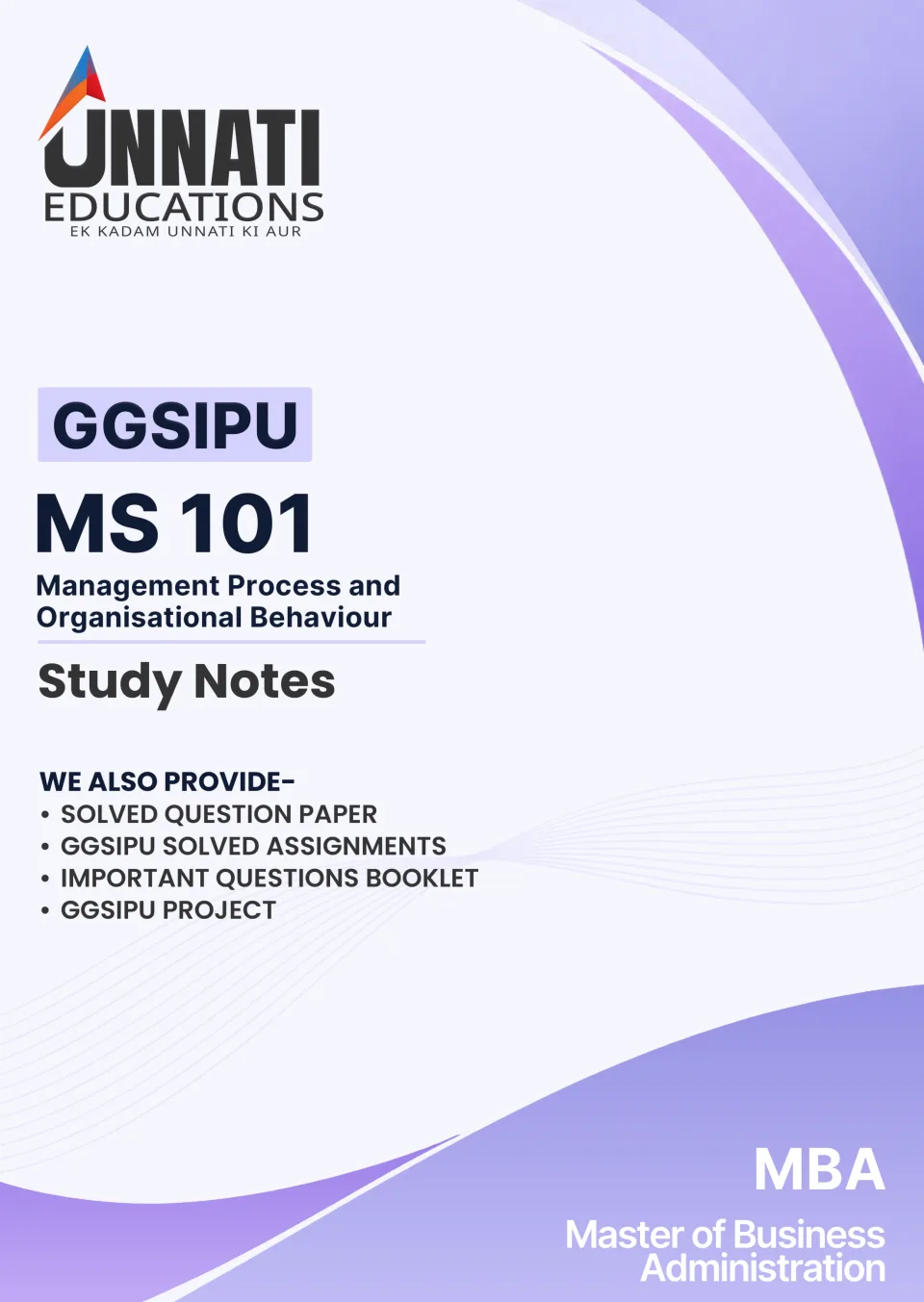
MS 101 Management Process and Organizational Behaviour Notes by Unnati Educations cover all 4 units of the GGSIPU MBA Semester 1 paper in an 81-page printed book: 30 numbered figures, 5 case studies with 17 solved case questions, 50 exam questions with answer pointers and a revision table for every unit. They follow the MBA scheme applicable from 2021-22 onwards.
Written by Prateek Talwar, Founder, Unnati Educations · Checked against the GGSIPU MBA Scheme and Syllabus 2021-22 onwards (Approved by AC Sub Committee) · Updated 13 October 2026 · Editorial policy
Scheme: MBA Scheme and Syllabus 2021-22 onwards | Applies to: batches admitted 2021-22 onwards | Verified against: GGSIPU MBA Scheme and Syllabus 2021-22 onwards (date not printed)
MS 101 Management Process and Organizational Behaviour at a glance: GGSIPU MBA Sem 1 credits, units and exam pattern
Code and title | MS 101 · Management Process & Organizational Behaviour (written "Organisational Behaviour" in the scheme table) |
|---|---|
Course and semester | Master of Business Administration (MBA), First Semester |
Category and credits | Core / Open Elective · 3 credits · 3 lecture hours a week (L-3, no tutorial or practical) |
Marks | 100: 25 internal + 75 end-term (scheme rule for all MBA theory courses) |
Internal 25 split | Class test 15 + individual assignments, presentation, viva-voce, group discussion or class participation 10 |
Applies to | Batches on the MBA scheme from the 2021-22 academic session |
End-term pattern | Paper-setter instructions are not printed in the official PDF; 75 end-term marks |
Exam duration | 3 hours |
Units and teaching hours | 4 units: Unit I 8 h · Unit II 8 h · Unit III 16 h · Unit IV 10 h (42 hours) |
Paired lab | None. The only Sem 1 lab, MS 117, is paired with MS 109 Information Technology Management |
Unit III carries 16 of the 42 teaching hours, close to two-fifths of the paper, which is why its notes run to 25 pages. MS 101 sits with eight other GGSIPU MBA Semester 1 papers, and it is one of three listed as core or open elective, with MS 111 and MS-115.
MS 101 Management Process and Organizational Behaviour Notes unit-wise: 17 solved case questions and 30 figures across 4 units
These Management Process and OB notes in English follow the official unit order, and each unit closes with a case study, a list of likely exam questions with answer pointers and a one-look revision table. You can check the layout in the sample PDF from the button above. Notes for every other MBA paper sit in GGSIPU MBA notes.
MS 101 Unit 1: Introduction to Management
Pages 4 to 21 (18 pages). It opens with six definitions of management and the efficiency versus effectiveness test, then 12 characteristics, the science, art and profession debate, levels and POSDCORB/POLC. Section 1.6 traces eight schools of thought; sections 1.7 and 1.8 cover Drucker's five operations, Mintzberg's 10 roles, Katz's three skills and the full MBO process. 6 figures, 1 case study (4 solved questions), 11 exam questions.
Basis | Taylor | Fayol |
|---|---|---|
Perspective | Bottom-up, shop floor | Top-down, top management |
Unity of command | Not followed (functional foremanship) | Strictly followed |
Applicability | Mainly factories | All organisations |
Quick look: Taylor vs Fayol (from page 10)
Basis
Perspective
Taylor
Bottom-up, shop floor
Fayol
Top-down, top management
Basis
Unity of command
Taylor
Not followed (functional foremanship)
Fayol
Strictly followed
Basis
Applicability
Taylor
Mainly factories
Fayol
All organisations
MS 101 Unit 2: Process of Management
Pages 22 to 38 (17 pages). Planning gets the nine-step chain, eight types of plans and ten techniques including SWOT and PERT/CPM. Directing covers nine principles and four elements; controlling covers the five-step process, three types of control and traditional versus modern techniques. Decision making ends with Simon's satisficing. 6 figures, 1 case study (4 solved questions), 12 exam questions.
Basis | Rational (economic man) | Bounded rationality (administrative man) |
|---|---|---|
Information | Complete | Limited |
Goal | Optimising | Satisficing, "good enough" |
Nature | Normative | Descriptive (Herbert Simon) |
Quick look: rational model vs bounded rationality (from page 33)
Basis
Information
Rational (economic man)
Complete
Bounded rationality (administrative man)
Limited
Basis
Goal
Rational (economic man)
Optimising
Bounded rationality (administrative man)
Satisficing, "good enough"
Basis
Nature
Rational (economic man)
Normative
Bounded rationality (administrative man)
Descriptive (Herbert Simon)
MS 101 Unit 3: Fundamentals of Organizational Behaviour, Organizational Processes and Structure
Pages 39 to 63 (25 pages), the longest unit. It covers Keith Davis's five OB models, personality (Big Five, MBTI, Type A/B), perception errors, the ABC model of attitude, four learning theories and ten motivation theories from Maslow to Locke. The structure half covers line to matrix forms, Schein's culture levels and Hofstede's six dimensions. 11 figures, 2 case studies (5 solved questions), 14 exam questions.
Hygiene factors | Motivators |
|---|---|
Salary, supervision, company policy | Achievement, recognition |
Working conditions, job security | Work itself, responsibility, growth |
Absence causes dissatisfaction | Presence causes satisfaction |
Quick look: Herzberg's two factors (from pages 49 to 50)
Hygiene factors
Salary, supervision, company policy
Motivators
Achievement, recognition
Hygiene factors
Working conditions, job security
Motivators
Work itself, responsibility, growth
Hygiene factors
Absence causes dissatisfaction
Motivators
Presence causes satisfaction
MS 101 Unit 4: Groups and their Dynamics, Work Teams
Pages 64 to 81 (18 pages). The official PDF names this unit "Group and their Dynamics, Work Teams"; the notes title it "Groups, Teams, Leadership and Justice", which matches the topic list. It moves from group types and structure (norms, cohesiveness, groupthink, social loafing) to five team types, Tuckman's five stages with the leader's role at each, and Belbin's nine roles. It closes with leadership theories and Colquitt's four-factor model of justice. 7 figures, 1 case study (4 solved questions), 13 exam questions.
Follower readiness | Leadership style |
|---|---|
R1 unable and unwilling | S1 Telling |
R2 unable but willing | S2 Selling |
R3 able but unwilling | S3 Participating |
R4 able and willing | S4 Delegating |
Quick look: Hersey and Blanchard (from page 74)
Follower readiness
R1 unable and unwilling
Leadership style
S1 Telling
Follower readiness
R2 unable but willing
Leadership style
S2 Selling
Follower readiness
R3 able but unwilling
Leadership style
S3 Participating
Follower readiness
R4 able and willing
Leadership style
S4 Delegating
The Hawthorne experiments in management thought: excerpt from page 11 of the MS 101 notes
Excerpt from page 11
1.6.3 Neo-classical Approach (Human Relations Movement)
The classical approach ignored the human side of work. The neo-classical approach focused on people, their feelings and their social relationships. Workers are seen as social man, not just economic man.
Hawthorne Experiments: Elton Mayo (1924 to 1932)
The studies were conducted at the Hawthorne plant of Western Electric Company, Chicago, by Elton Mayo, F.J. Roethlisberger and others from Harvard. Elton Mayo is called the "Father of the Human Relations Movement".
Phase | What was done | Finding |
|---|---|---|
1. Illumination experiments (1924 to 1927) | Lighting was increased and decreased for a test group | Output rose in both groups regardless of light; social and psychological factors mattered more than physical ones |
2. Relay assembly test room (1927 to 1929) | Six women were given changes in rest, hours and pay | Output rose steadily because of group feeling, attention and friendly supervision |
3. Mass interviewing (1928 to 1930) | About 20,000 employees were interviewed | Workers valued being listened to; attitudes and feelings affect output |
4. Bank wiring observation room (1931 to 1932) | 14 male workers were observed in a group | Informal groups set their own output norms, which can override management's targets |
The four phases of the Hawthorne experiments (page 11)
Phase
1. Illumination experiments (1924 to 1927)
What was done
Lighting was increased and decreased for a test group
Finding
Output rose in both groups regardless of light; social and psychological factors mattered more than physical ones
Phase
2. Relay assembly test room (1927 to 1929)
What was done
Six women were given changes in rest, hours and pay
Finding
Output rose steadily because of group feeling, attention and friendly supervision
Phase
3. Mass interviewing (1928 to 1930)
What was done
About 20,000 employees were interviewed
Finding
Workers valued being listened to; attitudes and feelings affect output
Phase
4. Bank wiring observation room (1931 to 1932)
What was done
14 male workers were observed in a group
Finding
Informal groups set their own output norms, which can override management's targets
Conclusions
The worker is a social being; informal groups strongly influence behaviour; attention and recognition raise morale; participative, friendly supervision raises productivity; and money is not the only motivator. This effect of being observed is now called the Hawthorne Effect.
Mary Parker Follett stressed integration of interests, "power with" rather than "power over", and resolving conflict through constructive integration.
1.6.4 Behavioural Science Approach
This approach went deeper into human behaviour using psychology, sociology and anthropology. Its major contributors were Abraham Maslow (need hierarchy), Douglas McGregor (Theory X and Theory Y), Frederick Herzberg (two-factor theory), Rensis Likert (four systems of management, from exploitative-authoritative to participative) and Chris Argyris (immaturity to maturity theory). These theories are covered in detail in Unit III under motivation.
Do the MS 101 notes cover the full GGSIPU syllabus?
Yes. Every topic in the four official units of MS 101 has its own section in the notes, including the case studies the syllabus asks for in Units I, II and III.
Official unit | Official topics | Where in the notes | Status |
|---|---|---|---|
Unit I | Meaning and Nature of Management, Evolution of Management, Tasks and Responsibilities of a Professional Manager, Management by Objectives, Case Study | 1.1 to 1.9, pages 4 to 17 | Covered |
Unit II | Planning (concept, process, techniques), Directing (definition, principles, process), Controlling (definition, process, techniques), Decision Making (concept, importance, models), Case Study | 2.1 to 2.5, pages 22 to 35 | Covered |
Unit III | OB nature and scope, OB models (merits and demerits), Personality, Perception and Attitude, Learning, Motivation, Managing stress at work, Organization Structure (concept and types), Case Studies; Organizational Design and Structure, Organizational Culture and Climate, Cross Cultural Organizational Behavior | 3.1 to 3.12, pages 39 to 59 | Covered |
Unit IV | Group and their dynamics (concept and types), Work Teams (definition and importance), Stages of team building and its behavioral dynamics, Leadership (concept, importance, styles), Organizational Justice (concept, importance, types) | 4.1 to 4.5, pages 64 to 77 | Covered |
MS 101 official topics mapped to the notes
Official unit
Unit I
Official topics
Meaning and Nature of Management, Evolution of Management, Tasks and Responsibilities of a Professional Manager, Management by Objectives, Case Study
Where in the notes
1.1 to 1.9, pages 4 to 17
Status
Covered
Official unit
Unit II
Official topics
Planning (concept, process, techniques), Directing (definition, principles, process), Controlling (definition, process, techniques), Decision Making (concept, importance, models), Case Study
Where in the notes
2.1 to 2.5, pages 22 to 35
Status
Covered
Official unit
Unit III
Official topics
OB nature and scope, OB models (merits and demerits), Personality, Perception and Attitude, Learning, Motivation, Managing stress at work, Organization Structure (concept and types), Case Studies; Organizational Design and Structure, Organizational Culture and Climate, Cross Cultural Organizational Behavior
Where in the notes
3.1 to 3.12, pages 39 to 59
Status
Covered
Official unit
Unit IV
Official topics
Group and their dynamics (concept and types), Work Teams (definition and importance), Stages of team building and its behavioral dynamics, Leadership (concept, importance, styles), Organizational Justice (concept, importance, types)
Where in the notes
4.1 to 4.5, pages 64 to 77
Status
Covered
Official source: GGSIPU MBA Scheme and Syllabus, 2021-22 onwards.
Beyond the list, the notes add Fiedler, path-goal and LMX theory to leadership. Every course in GGSIPU notes is mapped to its official PDF the same way.
How to write MS 101 answers: definitions, diagrams, comparison tables and case-linked solutions
MS 101 has no numericals, so marks come from structure. The notes' exam tips repeat one pattern for long answers: two or three definitions with the author's name, then features or steps with a one-line explanation each, then a diagram or comparison table, then a short conclusion.
The book numbers 30 diagrams, such as Figure 1.2 for the functions of management, Figure 2.5 for the control process and Figure 3.7 for Maslow's hierarchy, and the tips advise drawing one wherever a question allows it. For motivation, the notes suggest mapping Maslow's lower three needs to Herzberg's hygiene factors and the top two to motivators in one table.
Case questions follow a fixed order in the notes: name the issue, link it to the theory by name, quote facts from the case, then give numbered suggestions.
Worked example (GreenBrew case, page 34): the firm saw its sales shortfall only in quarterly accounts. Name it feedback control only, say concurrent and feed-forward control were missing, and suggest weekly sales reports with management by exception alerts.
The commonest slip the notes warn about is writing theory without the case facts. Practise this format on GGSIPU MBA important questions.
MS 101 exam corner: 17 solved case questions and 50 exam questions by unit
Unit | Case studies | Solved case questions | Exam questions with answer pointers | Figures |
|---|---|---|---|---|
Unit 1 | 1 | 4 | 11 | 6 |
Unit 2 | 1 | 4 | 12 | 6 |
Unit 3 | 2 | 5 | 14 | 11 |
Unit 4 | 1 | 4 | 13 | 7 |
Total | 5 | 17 | 50 | 30 |
Exam practice in the MS 101 notes, unit by unit
Unit
Unit 1
Case studies
1
Solved case questions
4
Exam questions with answer pointers
11
Figures
6
Unit
Unit 2
Case studies
1
Solved case questions
4
Exam questions with answer pointers
12
Figures
6
Unit
Unit 3
Case studies
2
Solved case questions
5
Exam questions with answer pointers
14
Figures
11
Unit
Unit 4
Case studies
1
Solved case questions
4
Exam questions with answer pointers
13
Figures
7
Unit
Total
Case studies
5
Solved case questions
17
Exam questions with answer pointers
50
Figures
30
The MS 101 notes solve 17 case questions across 5 case studies and list 50 exam-style questions with answer pointers over 4 units, backed by 30 numbered figures.
Unit 1: Is management a science, an art or a profession? Discuss. Pointer: features of each, a table testing six features of a profession, conclusion: science plus art, an emerging profession.
Unit 2: "Planning and controlling are Siamese twins." Explain. Pointer: planning sets the standards, control checks them and feeds the next plan; add a comparison table.
Unit 3: Explain Vroom's expectancy theory. How is it different from content theories? Pointer: M = E × I × V, meaning of each element, process versus content theories.
Unit 4: What is organisational justice? Explain its types and importance. Pointer: Greenberg 1987, distributive, procedural and interactional justice, Leventhal's six rules.
The other 46 questions and all 17 case answers are in the full book. More practice sits in the MS 101 important questions.
Who writes and checks the MS 101 management and OB notes?
Prateek Talwar, author and editor of these notes · Founder, Unnati Educations · Associate Company Secretary (ACS), ICSI · B.Com, University of Delhi · profile
These MS 101 Management Process and OB IPU notes are written and checked by the author above. The 2026-27 edition is mapped to the GGSIPU MBA Scheme and Syllabus 2021-22 onwards; Unit III keeps the official split into OB fundamentals and processes and structure. Last updated 13 October 2026. Read how we check every book in our editorial policy.
The same team prepares GGSIPU important questions for every course it covers.
MS 101 and the GGSIPU MBA Sem 1 papers it connects to
MS 101 has no paired lab; the Sem 1 lab MS 117 belongs to MS 109, so this book is the only material GGSIPU MBA Sem 1 Management Process and OB notes students need for the paper. The full paper list for the semester is in the GGSIPU MBA syllabus.
MS 113 Communication in Organizations: Unit 2's directing section (communication as one of four elements, and its barriers on page 27) is the base for MS 113's process and barriers of communication.
MS 103 Quantitative Techniques: the quantitative school on pages 11 to 12 (linear programming, game theory, decision trees) previews MS 103's Units III and IV.
MS 107 Accounting for Management: the control techniques table on pages 29 to 30 (budgetary control, standard costing, responsibility accounting, ROI) is taught in full in MS 107's Unit III.
MS 105 Managerial Economics, MS 109 Information Technology Management , MS 111 Marketing Management and MS-115 Legal Aspects of Business complete the semester.
MS 101 management and OB notes FAQs
How do I get the full MS 101 notes?
Tap "Get Full Notes" at the top or the button at the end of this page. It opens WhatsApp with a ready message for the MS 101 book. The MS 101 notes come as a printed book of 81 pages covering all 4 units; they are not sold as a PDF.
What is the passing mark for MS 101 in GGSIPU MBA?
MS 101 is marked out of 100: 25 internal (a 15-mark class test plus 10 marks for assignments, presentation, viva or participation) and 75 in the end-term exam. The MBA Scheme and Syllabus 2021-22 onwards does not print a pass percentage for each paper. For minimum marks and re-appear rules, check GGSIPU Ordinance 11 on ipu.ac.in or ask your institute.
Which MS 101 unit should I study first?
Start with Unit 3. It carries 16 of the 42 official teaching hours and fills 25 of the 81 pages, with ten motivation theories, five OB models and the structure topics. Revise Units 1 and 2 together, as they are shorter and closely linked.
Do the MS 101 notes follow the 2021-22 GGSIPU MBA scheme?
Yes. The book follows the MBA Scheme and Syllabus applicable from 2021-22, where MS 101 is a 3-credit Core or Open Elective paper with four units. Check that your batch is on this scheme. If your institute uses a newer revision, compare its unit list with our syllabus map above.
Are case studies solved in the MS 101 notes?
Yes. MS 101's syllabus lists case studies in Units I, II and III, and the notes solve 17 questions across 5 cases: SmartKart on MBO, GreenBrew on planning and control, CodeCraft on motivation, a merger culture clash, and Sunrise Appliances on teams and justice.
Are the MS 101 notes in English or Hindi?
The MS 101 notes are in English. The language is kept simple: short definitions with the author's name, one idea per bullet, and comparison tables for paired theories such as Taylor and Fayol or transactional and transformational leadership.
Get the full MS 101 Management Process and Organizational Behaviour Notes on WhatsApp
What is in the full MS 101 book
Part
Cover and index
Pages
1 to 3
Inside
Index with page numbers for every section
Part
Pages
4 to 21 (18)
Inside
MBO, 1 case
Part
Pages
22 to 38 (17)
Inside
Process of management, 1 case
Part
Pages
39 to 63 (25)
Inside
OB and structure, 2 cases
Part
Pages
64 to 81 (18)
Inside
Teams and leadership, 1 case
The MS 101 notes are available only as a printed book, not as a PDF. Order on WhatsApp and our team confirms dispatch and delivery to your address. Each unit ends with a one-look revision table.
Unnati Educations is an independent education provider based in Vikaspuri, Delhi. We are not affiliated with, authorised by, or endorsed by Guru Gobind Singh Indraprastha University (GGSIPU). "GGSIPU" and "IPU" are used only to describe the syllabus our notes follow. For official information, visit ipu.ac.in.
Ready for the full notes?
Discuss coverage and delivery with our team.