
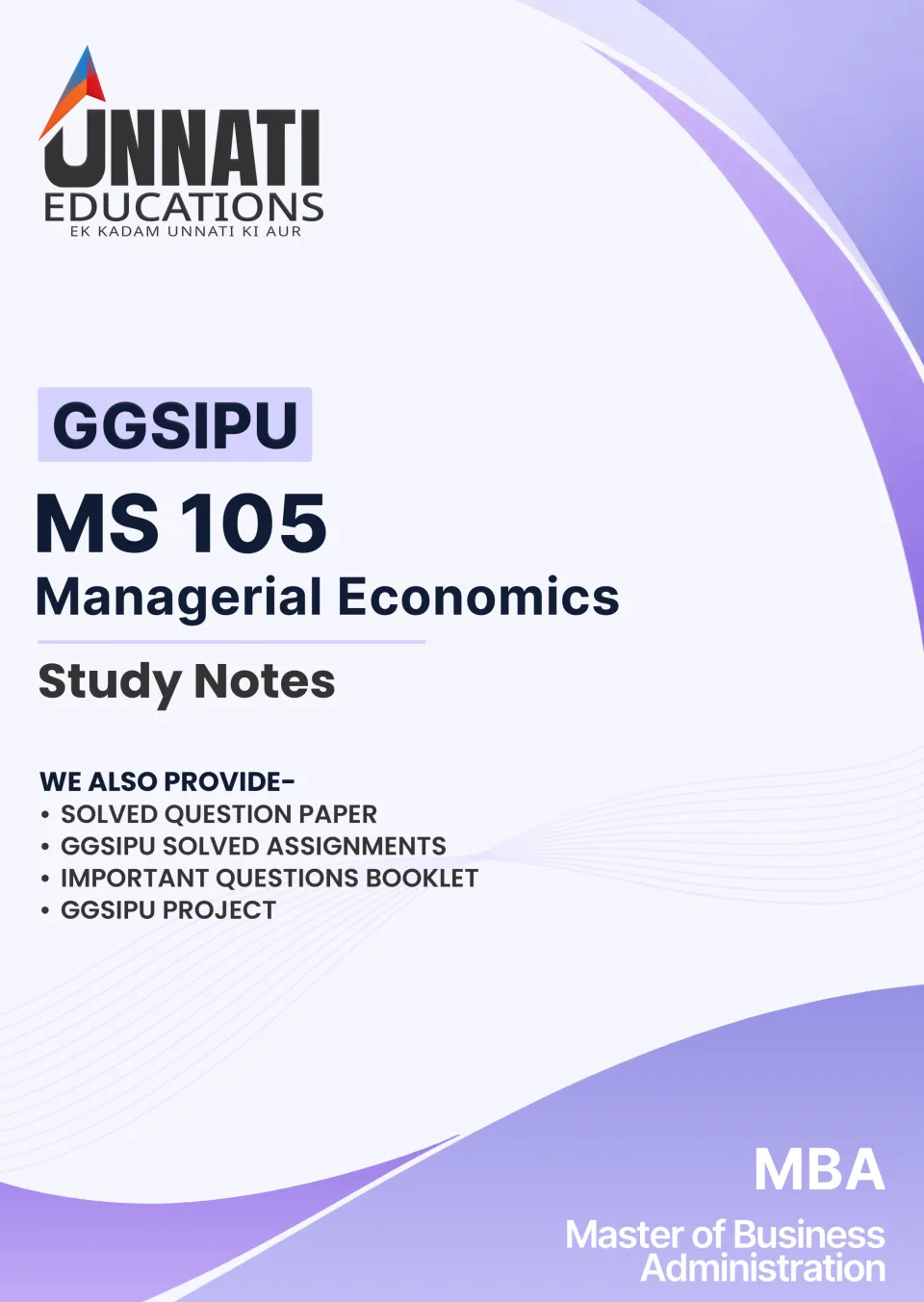
MS 105 Managerial Economics Notes cover all four units of the GGSIPU MBA Semester 1 paper in a 76-page printed book: 39 topic sections, 10 solved numericals, 26 labelled diagrams and 55 exam-style practice questions. They follow the MBA scheme and syllabus for batches admitted from 2021-22 onwards.
Written by Prateek Talwar, Founder, Unnati Educations · Checked against MBA Scheme and Syllabus 2021-22 onwards (Approved by AC Sub Committee), GGSIPU · Updated 13 October 2026 · Editorial policy
Scheme: MBA Scheme and Syllabus 2021-22 onwards | Applies to: batch admitted 2021-22 onwards | Verified against: MBA Scheme and Syllabus 2021-22 onwards (Approved by AC Sub Committee), checked 13 Oct 2026
MS 105 Managerial Economics at a glance: GGSIPU MBA Sem 1 credits, units and exam pattern
MS 105 is one of three pure Core papers in the first MBA semester, with MS 103 and MS 107. It sits with eight other GGSIPU MBA Semester 1 papers.
Item | MS 105 detail |
|---|---|
Code and title | MS 105 Managerial Economics (MS-105 on the syllabus page) |
Type and credits | Core · 3 credits · L-3, no tutorial or practical |
Marks | 100: 25 internal + 75 end-term |
Internal 25 | Class test 15 + assignment, presentation, viva-voce, group discussion or class participation 10 |
Applies to | Batch admitted 2021-22 onwards |
End-term pattern | 75 marks; paper-setter instructions not printed in the official PDF |
Exam duration | 3 hours |
Units and hours | 4 units: 12 + 10 + 10 + 10 = 42 hours |
Paired lab | None; MS 117 is the lab for MS 109 |
MS 105 Managerial Economics: official scheme facts (MBA, 2021-22 onwards)
Item
Code and title
MS 105 detail
MS 105 Managerial Economics (MS-105 on the syllabus page)
Item
Type and credits
MS 105 detail
Core · 3 credits · L-3, no tutorial or practical
Item
Marks
MS 105 detail
100: 25 internal + 75 end-term
Item
Internal 25
MS 105 detail
Class test 15 + assignment, presentation, viva-voce, group discussion or class participation 10
Item
Applies to
MS 105 detail
Batch admitted 2021-22 onwards
Item
End-term pattern
MS 105 detail
75 marks; paper-setter instructions not printed in the official PDF
Item
Exam duration
MS 105 detail
3 hours
Item
Units and hours
MS 105 detail
4 units: 12 + 10 + 10 + 10 = 42 hours
Item
Paired lab
MS 105 detail
None; MS 117 is the lab for MS 109
Pass and re-appear rules are in Ordinance 11.
MS 105 Managerial Economics Notes unit-wise: 10 solved numericals and 26 diagrams across 4 units
These MS 105 Managerial Economics IPU notes keep the official unit order. Notes for other MBA papers sit under GGSIPU MBA notes. The sample PDF above has one page per unit.
MS 105 Unit 1: Introduction
Also covered as "Introduction to Managerial Economics & Consumer Behaviour", pages 4 to 20. Five author definitions, operational versus environmental scope and six decision steps lead to opportunity cost and incremental reasoning. Then Marshall's cardinal approach meets Hicks and Allen's indifference curves. Count: 11 sections, 3 solved numericals, 5 diagrams, 13 practice questions.
Unit bought | MU of X | MU of Y |
|---|---|---|
1st | 20 | 24 |
2nd | 18 | 20 |
3rd | 16 | 16 |
Result | 3 X + 3 Y; MUx/Px = MUy/Py = 16; total 114 utils | |
MS 105 Unit 2: Demand Analysis and Theory of Production
Pages 21 to 41. A nine-factor demand function, four kinds of elasticity, and forecasting by survey (Delphi, test marketing) and statistical methods (trend, barometric, regression). Production runs from Cobb-Douglas and the three stages of variable proportions to isoquants and the expansion path. Count: 10 sections, 5 solved numericals (the most), 7 diagrams, 14 practice questions.
Quick look: least-squares trend forecast (from page 30)
Sales 2021 to 2025: 40, 44, 50, 54, 62 (Rs. lakh); origin 2023, so ΣX = 0.
a = 250 ÷ 5 = 50; b = ΣXY ÷ ΣX² = 54 ÷ 10 = 5.4.
Trend: Y = 50 + 5.4X.
Forecast: Rs. 66.2 lakh in 2026, Rs. 71.6 lakh in 2027.
MS 105 Unit 3: Theory of Cost and Market Structures
Pages 42 to 57. Ten cost concepts, a short-run cost schedule and the LAC as Viner's envelope curve, with the modern L-shaped view. The MR = MC rule then drives all four markets: shut-down point, price discrimination, excess capacity and the kinked demand curve. Count: 9 sections, 2 solved numericals, 9 diagrams, 14 practice questions.
Quick look: profit maximum for P = 100 − 2Q, TC = 200 + 20Q + 2Q² (from pages 46 to 47)
MR = 100 − 4Q; MC = 20 + 4Q.
MR = MC gives Q = 10 units.
P = Rs. 80; profit = 800 − 600 = Rs. 200.
MC cuts MR from below: second-order condition met.
MS 105 Unit 4: Introduction to Macro Economics
Pages 58 to 75. Adam Smith's invisible hand against seven causes of market failure, Musgrave's roles of government, and growth versus development (HDI, SDGs). Policy runs from M0 to M4 and MV = PT through inflation and the Phillips curve to RBI's inflation targeting and the FRBM Act. Count: 9 sections, 5 diagrams, no solved numericals, 14 practice questions.
Quick look: how a repo rate rise reaches prices (from page 72)
RBI raises the repo rate.
Banks' cost of funds rises; loan rates and EMIs go up.
Consumption and investment fall, so aggregate demand falls.
Inflation eases, though growth may slow for a while.
Degrees and measurement of price elasticity in managerial economics: excerpt from page 24 of the MS 105 notes
Excerpt from page 24
Degrees (types) of price elasticity
Price elasticity of demand is grouped into five degrees, each with its own curve shape (Fig 2.2 in the notes).
Degree | Value | Meaning | Example |
|---|---|---|---|
Perfectly elastic | Ep = ∞ | A tiny price change causes an infinite change in demand; horizontal curve | Product of a firm in perfect competition |
Perfectly inelastic | Ep = 0 | Demand does not change at all; vertical curve | Life-saving drugs, salt (approx.) |
Unitary elastic | Ep = 1 | % change in Q equals % change in P; rectangular hyperbola | Theoretical case |
Relatively elastic | Ep > 1 | % change in Q is more than % change in P; flatter curve | Luxuries, cars, branded clothes |
Relatively inelastic | Ep < 1 | % change in Q is less than % change in P; steeper curve | Necessities: rice, wheat, petrol |
Five degrees of price elasticity (MS 105 notes, page 24)
Degree
Perfectly elastic
Value
Ep = ∞
Meaning
A tiny price change causes an infinite change in demand; horizontal curve
Example
Product of a firm in perfect competition
Degree
Perfectly inelastic
Value
Ep = 0
Meaning
Demand does not change at all; vertical curve
Example
Life-saving drugs, salt (approx.)
Degree
Unitary elastic
Value
Ep = 1
Meaning
% change in Q equals % change in P; rectangular hyperbola
Example
Theoretical case
Degree
Relatively elastic
Value
Ep > 1
Meaning
% change in Q is more than % change in P; flatter curve
Example
Luxuries, cars, branded clothes
Degree
Relatively inelastic
Value
Ep < 1
Meaning
% change in Q is less than % change in P; steeper curve
Example
Necessities: rice, wheat, petrol
Methods of measuring price elasticity
(1) Percentage (proportionate) method. It uses the original price and quantity: Ep = (ΔQ/Q) ÷ (ΔP/P).
(2) Total outlay (total expenditure) method, from Marshall. Compare total expenditure (P × Q) before and after the price change. If a price fall increases total expenditure (and a price rise decreases it), demand is elastic, Ep > 1. If total expenditure stays the same either way, Ep = 1. If a price fall decreases total expenditure (and a price rise increases it), demand is inelastic, Ep < 1.
(3) Point (geometric) method. It is used for a very small change at one point on the demand curve. On a straight-line demand curve, Ep at a point = lower segment ÷ upper segment. At the midpoint Ep = 1; above the midpoint Ep > 1; below it Ep < 1. Where the curve meets the price axis Ep = ∞, and where it meets the quantity axis Ep = 0.
The notes continue on the next page with the arc method for large price changes and a solved example that applies the percentage, arc and total outlay methods to the same price fall.
How to write MS 105 answers: labelled diagrams, step-wise numericals and Indian policy examples
MS 105 answers score on three things: a correct labelled graph, numerical working shown step by step, and a business example. The notes advise drawing every graph at least twice and labelling both axes and every curve, since examiners give marks for neat diagrams. With 26 figures in the notes, diagram practice is most of the revision.
For the four numerical types the notes call scoring (elasticity, trend projection, profit maximisation, least-cost combination), write the formula, one step per line, then a one-line meaning, for example "|Ep| = 0.67, so demand is inelastic" (page 26).
Unit 4 answers gain from the notes' Indian references: the six-member MPC, the 4% ± 2% CPI target and the FRBM Act, 2003. Check the latest RBI policy statement before quoting current rates.
Worked example: the special order (page 10)
A firm with idle capacity gets a one-time order for 1,000 units at Rs. 80; average total cost is Rs. 90 (Rs. 60 variable + Rs. 30 fixed). Incremental revenue Rs. 80,000 minus incremental cost Rs. 60,000 adds Rs. 20,000 to profit, so the order is accepted even below average cost. The usual mistake is adding the Rs. 30 fixed cost, which is sunk and does not change with the decision.
Practise this answer format on GGSIPU MBA important questions.
MS 105 exam corner: 31 short-answer and 24 long-answer practice questions by unit
Each unit closes with an "Important Questions for Exam" list, given without model answers; the numericals carry full working.
Unit | Short-answer | Long-answer | Solved numericals | Diagrams |
|---|---|---|---|---|
Unit 1 | 7 | 6 | 3 | 5 |
Unit 2 | 8 | 6 | 5 | 7 |
Unit 3 | 8 | 6 | 2 | 9 |
Unit 4 | 8 | 6 | 0 | 5 |
MS 105 practice questions, solved numericals and diagrams per unit
Unit
Unit 1
Short-answer
7
Long-answer
6
Solved numericals
3
Diagrams
5
Unit
Unit 2
Short-answer
8
Long-answer
6
Solved numericals
5
Diagrams
7
Unit
Unit 3
Short-answer
8
Long-answer
6
Solved numericals
2
Diagrams
9
Unit
Unit 4
Short-answer
8
Long-answer
6
Solved numericals
0
Diagrams
5
Distinguish between marginal and incremental concept. (Unit 1) One extra unit against a whole decision; accept if IR > IC and ignore sunk cost (pages 9 to 10).
Distinguish between returns to a factor and returns to scale. (Unit 2) Short run, one factor varies, three stages; long run, all factors vary in the same proportion (page 35).
Why is LAC called an envelope curve? (Unit 3) It touches every SAC and shows the lowest cost of each output; name Viner, draw Fig 3.2 (pages 44 to 45).
Distinguish between demand-pull and cost-push inflation. (Unit 4) Excess aggregate demand against rising wage, oil and input costs; draw Fig 4.3 (page 68).
The MS 105 notes list 31 short-answer and 24 long-answer practice questions across 4 units, plus 10 solved numericals with step-by-step working.
More unit-wise practice sits in the MS 105 important questions.
MS 105 and the GGSIPU MBA Sem 1 papers it connects to
MS 105 has no paired lab; every semester's papers are listed on the GGSIPU MBA syllabus page.
MS 103 Quantitative Techniques: its regression and OLS feed MS 105 Unit 2 trend and regression forecasting (pages 29 to 30).
MS 107 Accounting for Management: its cost classification meets the accounting versus economic cost table in Unit 3 (page 42).
MS 111 Marketing Management: its pricing methods use elasticity and price discrimination (pages 27, 50 to 51).
MS 115 Legal Aspects of Business: its competitive-markets outcome links to the Competition Act cartel note in Unit 3 (page 54).
MS 101 Management Process and Organisational Behaviour, MS 109 Information Technology Management, MS 113 Communication in Organizations and MS 117 Information Technology Management Lab share little topic overlap.
Who writes and checks the MS 105 economics notes?
Prateek Talwar, author: writes and structures the MS 105 notes. Founder, Unnati Educations. Associate Company Secretary (ACS), ICSI, membership no. 58704, since 15 May 2019; B.Com, University of Delhi (School of Open Learning), 2012. Author bio
Sheetal Kirola, language and pedagogy review only: Academic Head, M.Ed., 7 years.
The 2026-27 edition of our GGSIPU MBA Sem 1 Managerial Economics notes is mapped to the 2021-22 onwards scheme, checked on 13 October 2026, and adds a four-markets equilibrium table (Unit 3) and a "how macro changes hit a business" table (Unit 4). Our editorial policy explains how notes are checked.
The same team prepares GGSIPU important questions for every course it covers.
Do the MS 105 notes cover the full GGSIPU syllabus?
Yes. Every topic in the four official MS 105 units has a matching section in the notes; our unit check found no gap.
Official unit | Official topics | Where in the notes | Status |
|---|---|---|---|
I: Introduction | Nature, scope, significance; other disciplines; decision making; opportunity cost; incremental concept; cardinal and ordinal approaches: equi-marginal principle, diminishing marginal utility, indifference curves | 1.1 to 1.11, pages 4 to 18 | Covered |
II: Demand Analysis and Theory of Production | Demand function, elasticity, forecasting, applications; production function, short and long run, isoquants, optimal input combination | 2.1 to 2.10, pages 21 to 38 | Covered |
III: Theory of Cost and Market Structures | Cost in short and long runs; price-output decisions under perfect competition, monopoly, monopolistic competition, oligopoly | 3.1 to 3.9, pages 42 to 55 | Covered |
IV: Introduction to Macro Economics | Nature, importance; market, command, mixed economies; invisible hand; government role; growth, development; money supply, inflation, interest rates | 4.1 to 4.9, pages 58 to 73 | Covered |
MS 105 official syllabus mapped to the notes
Official unit
I: Introduction
Official topics
Nature, scope, significance; other disciplines; decision making; opportunity cost; incremental concept; cardinal and ordinal approaches: equi-marginal principle, diminishing marginal utility, indifference curves
Where in the notes
1.1 to 1.11, pages 4 to 18
Status
Covered
Official unit
II: Demand Analysis and Theory of Production
Official topics
Demand function, elasticity, forecasting, applications; production function, short and long run, isoquants, optimal input combination
Where in the notes
2.1 to 2.10, pages 21 to 38
Status
Covered
Official unit
III: Theory of Cost and Market Structures
Official topics
Cost in short and long runs; price-output decisions under perfect competition, monopoly, monopolistic competition, oligopoly
Where in the notes
3.1 to 3.9, pages 42 to 55
Status
Covered
Official unit
IV: Introduction to Macro Economics
Official topics
Nature, importance; market, command, mixed economies; invisible hand; government role; growth, development; money supply, inflation, interest rates
Where in the notes
4.1 to 4.9, pages 58 to 73
Status
Covered
Official source: MBA Scheme and Syllabus 2021-22 onwards (Approved by AC Sub Committee), which also holds the 25 + 75 marks scheme.
Every course in GGSIPU notes is mapped to its official PDF the same way.
MS 105 economics notes FAQs
How do I get the full MS 105 notes?
The full MS 105 notes come only as a printed book; they are not sold as a PDF. Tap "Get Full Notes" at the top or the button at the end to open WhatsApp with your request typed; our team confirms the order and delivery there. The sample PDF shows one real page from each unit.
Do the MS 105 notes follow the MBA 2021-22 onwards scheme?
Yes. The MS 105 notes follow the MBA Scheme and Syllabus 2021-22 onwards, which applies to batches admitted from 2021-22, and keep its four-unit order: Introduction, Demand Analysis and Theory of Production, Theory of Cost and Market Structures, and Introduction to Macro Economics. The syllabus map on this page gives each official topic its section and page.
What is the passing mark for MS 105 Managerial Economics?
MS 105 is marked out of 100: 25 internal marks and 75 end-term marks, the split the MBA scheme sets for every theory paper. The scheme PDF we checked prints no pass percentage, so we do not state one here. End-term minimums, the pass rule and re-appear rules come from GGSIPU Ordinance 11 on ipu.ac.in.
Which MS 105 unit has the most solved numericals?
Unit 2 has 5 of the 10 solved numericals in the MS 105 notes: elasticity by three methods, point elasticity from Q = 500 − 20P, income and cross elasticity, a least-squares trend forecast and a least-cost input check. Unit 1 has 3, Unit 3 has 2, and Unit 4 relies on diagrams and policy tables.
Are the MS 105 practice questions in the notes solved?
Not as model answers. The MS 105 notes list 55 practice questions, 31 short-answer and 24 long-answer, and each answer is built from that unit's sections, diagrams and tables. The 10 numericals are fully solved, each with steps, a final answer and a one-line meaning, which mirrors how working should be shown in the exam.
How should I prepare MS 105 Unit 4 on macro economics?
Treat MS 105 Unit 4 as a diagram-and-example unit. Learn its five figures, from the business cycle to liquidity preference, and its comparison tables on economic systems, growth versus development, and monetary versus fiscal policy. Use the notes' Indian examples, such as the MPC and CPI targeting, and confirm current RBI rates before quoting them.
Get the full MS 105 Managerial Economics Notes on WhatsApp
The full notes are a 76-page printed book with all four units, a formula table and a quick revision table in each.
Format: printed book. These are Managerial Economics notes in English, not sold as a PDF; order and delivery are confirmed on WhatsApp.
Get the full MS 105 notes book on WhatsApp (4 units, 76 pages)
Unnati Educations is an independent education provider based in Vikaspuri, Delhi. We are not affiliated with, authorised by, or endorsed by Guru Gobind Singh Indraprastha University (GGSIPU). 'GGSIPU' and 'IPU' are used only to describe the syllabus our notes follow. For official information, visit ipu.ac.in.
Ready for the full notes?
Discuss coverage and delivery with our team.